

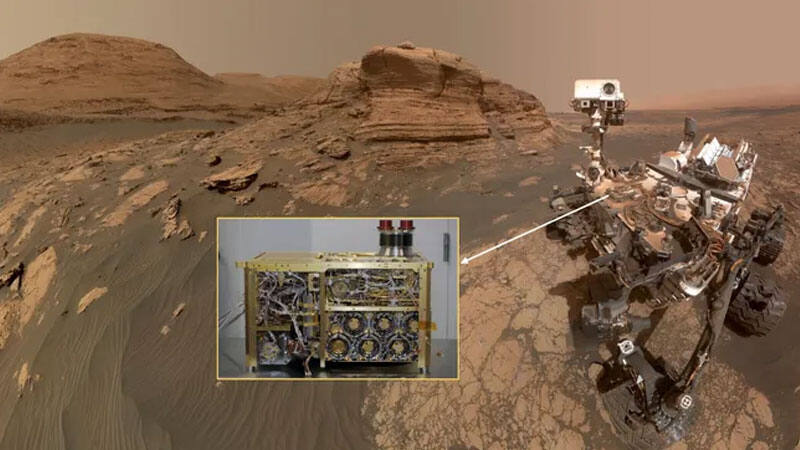
NASA’s Curiosity rover has just pulled off a small but important chemistry gamble on Mars: a scarce onboard reagent was used to analyze Martian soil in a way that exposed about 20 different organic molecules. The result does not prove life, of course, but it does show that organic compounds can survive for billions of years near the surface despite Mars’ harsh radiation bath. That is a much better setup for future life-hunting missions than the ”we found nothing” crowd likes to admit.
The Curiosity Mars organic molecules result came from SAM, the Sample Analysis at Mars instrument package aboard Curiosity, which has been roaming the planet since 2012. SAM combines pyrolysis, gas chromatography, and mass spectrometry, and in this case it also used TMAH, or tetramethylammonium hydroxide, a reagent stored on the rover in just two containers as a 25% solution in methanol.
Why TMAH mattered for this Mars test
Standard pyrolysis cannot reliably vaporize some organic compounds, which leaves parts of the sample effectively invisible to the instruments. TMAH changes that chemistry, but it is costly to use and had not previously been reserved for this kind of demanding search for organics on Mars. In other words: this was exactly the sort of experiment mission teams avoid unless they really think the payoff is worth it.
Researchers first modeled the reactions they needed and then applied the method to clay-rich material from a promising location within Curiosity’s reach. The payoff was immediate enough: the analysis turned up a broad mix of organic fragments in the near-surface soil. Similar chemistry is getting more attention across planetary science because the slow, careful approach often beats brute-force drilling and a prayer.
What the molecules do and don’t prove
That chemical inventory still leaves the big question open. The organics could come from volcanic processes, meteorite delivery, or biology, and the study does not claim to separate those possibilities. What it does establish is that Martian organics can persist in the upper layers of soil far longer than radiation alone might suggest.
That matters because it strengthens the case for shallow-subsurface targets on Mars, where future missions may have a better chance of catching preserved traces of ancient chemistry. It also adds momentum to the idea that Mars was not just once habitable in theory, but chemically busy enough to leave a detectable signature behind.
The next Mars and Titan chemistry missions
The success of TMAH does more than reward Curiosity’s caution. A related analyzer is slated for the European Rosalind Franklin rover, which is due for launch in 2028, and a version of the same approach will also ride on Dragonfly, the rotorcraft headed for Saturn’s moon Titan. Planetary science loves a good technical workaround, and this one suddenly looks like the sort of trick other missions will want in their toolbox.
The open question is how far this technique can go once it leaves Curiosity’s well-understood laboratory. If the next wave of missions can preserve the same sensitivity with the same finite chemistry budget, the hunt for organic material in the Solar System gets a lot less theoretical and a lot more interesting.