

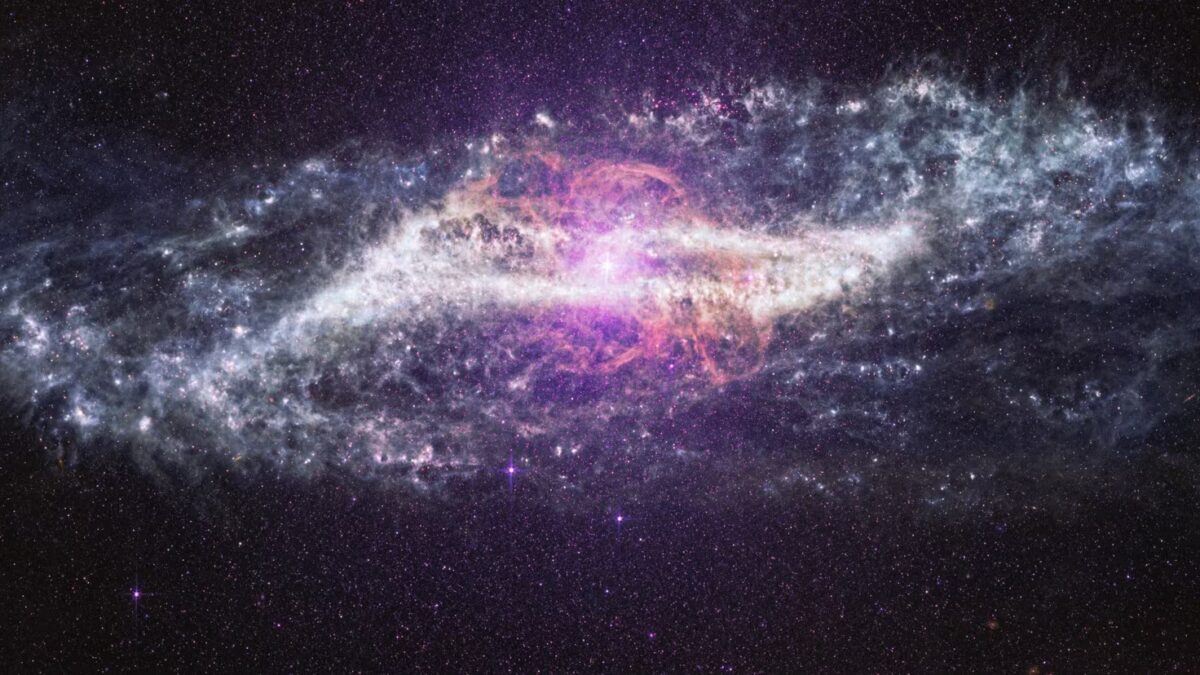
The James Webb Space Telescope has pierced the dense dust veiling Centaurus A, exposing millions of stars and the turbulent environment around its supermassive black hole like never before. This nearby active galaxy, roughly 11 million light-years away, offers astronomers a rare front-row seat to the aftermath of a colossal galactic merger that reshaped it 2 billion years ago.
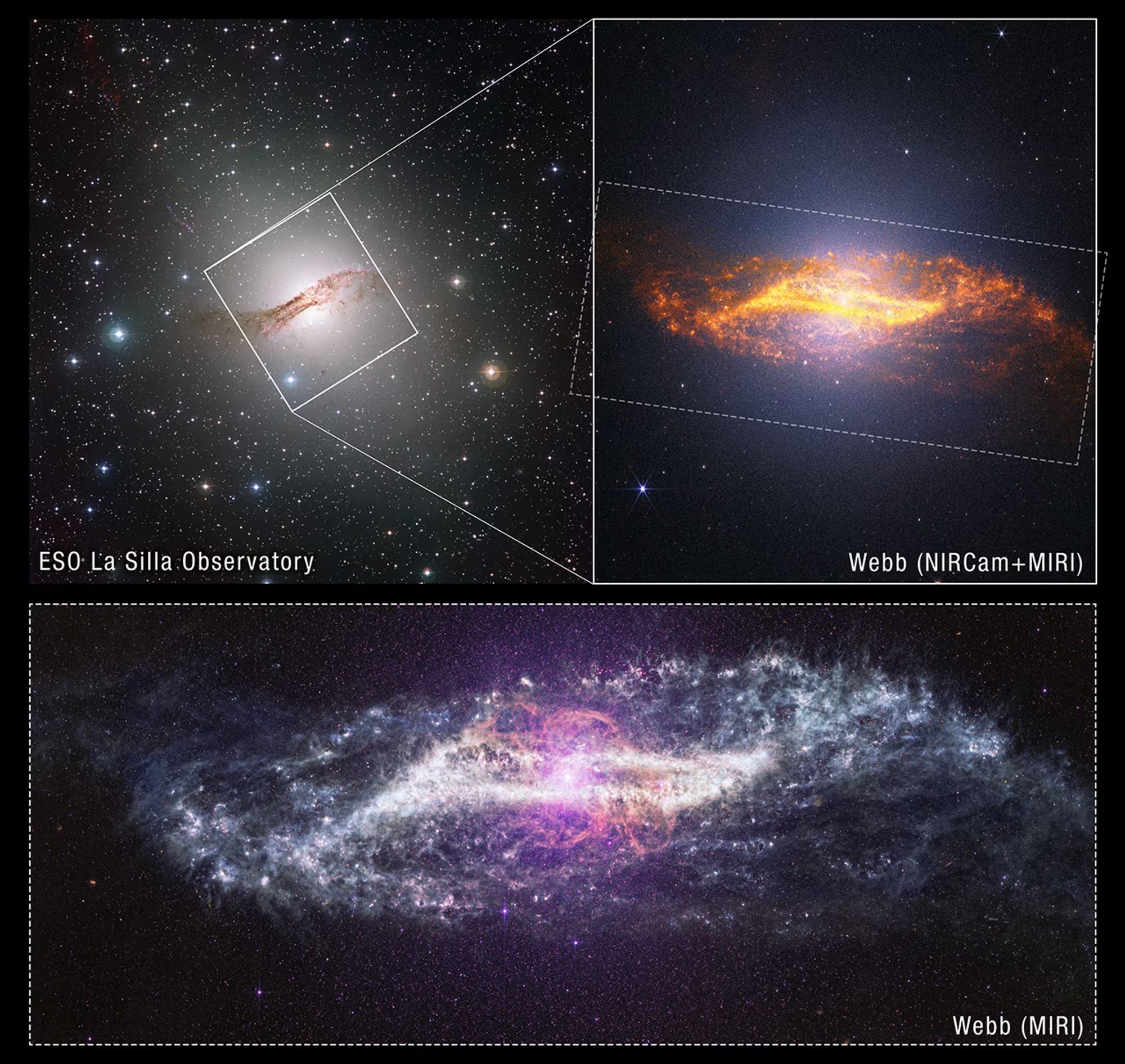
Centaurus A – also catalogued as NGC 5128 – stands out as one of the closest active galaxies and a potent radio source. At its heart lurks a black hole about 55 million times the mass of our Sun. What truly fascinates astronomers is how the galaxy still bears scars from a merger with another galaxy 2 billion years ago, a cosmic collision that continues to influence its structure and activity.
Previous telescopes struggled to peer through Centaurus A’s thick dust lane. Hubble’s optical images captured striking dark bands but revealed little about what lay behind. Spitzer, which ceased operations in 2020, mapped dust distribution better in infrared but lacked the resolution to resolve individual stars and detailed features in the core.
James Webb’s 6.5-meter mirror, combined with its NIRCam and MIRI instruments, pushed through the dust in unprecedented detail. Near-infrared cameras revealed millions of stars previously hidden in the glare, while MIRI’s mid-infrared data unveiled glowing dust structures, a twisted central strip of material, and a puzzling S-shaped feature. The origin of this feature remains a mystery-possibly linked to black hole activity, lingering effects of the ancient merger, or pockets of ongoing star formation.
What appeared as graininess in composite images actually emerges as dense fields of stars, including late-stage dusty stars and vibrant star-forming regions. Such resolved stellar populations enable scientists to chart how star generations shifted before and after the galactic collision.
James Webb’s detailed view of Centaurus A
Centaurus A has long been a prime target for major observatories, but only James Webb has combined both the big picture and the finer details. Hubble highlighted the galaxy’s distinctive dust lane, and Spitzer traced dust in infrared, but neither could dissect the inner workings down to individual stars and gas flows.
Beyond breathtaking images, these observations offer vital insights into the feedback mechanisms of active galactic nuclei (AGN). The central black hole doesn’t just swallow matter-it blasts jets and outflows that can either compress gas to spark new stars or expel gas, shutting star formation down. Webb’s data reveals this complex push-and-pull happening in real time.
Spectroscopic studies identified a fast-moving outflow of ionized gas likely driven by the black hole. Nearby, warm molecular hydrogen spirals within a warped disk. Together, these features paint a dynamic portrait of how the AGN simultaneously nourishes and disrupts its host galaxy.
Since beginning its science program in July 2022, James Webb has often grabbed headlines for probing the early universe’s most distant galaxies. Yet its work on nearby active galaxies like Centaurus A is equally important, serving as a laboratory for refining models of galactic evolution that can then be applied to more distant, fainter systems.
The next phase for astronomers is to integrate new stellar maps, gas dynamics, and dust distribution to reconstruct the sequence of events following the ancient merger and decode the origin of the S-shaped dust feature. If this research confirms a link between black hole outflows and bursts of star formation, Centaurus A will stand as a vivid example of how an active galactic nucleus can rewrite a galaxy’s history.