

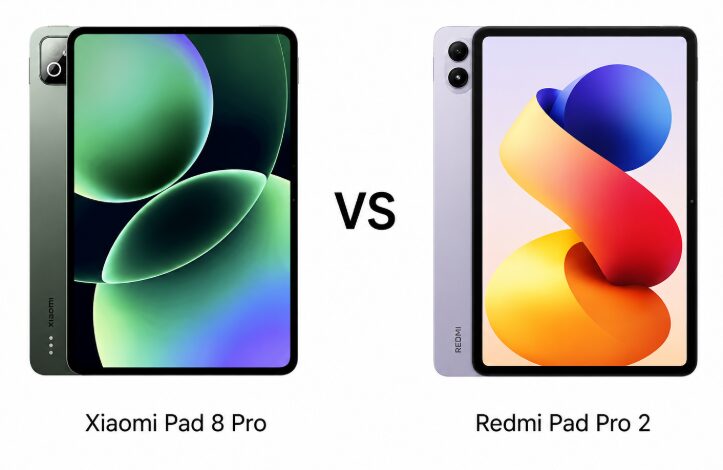
Xiaomi has split its tablet line in a way that makes the buyer’s job oddly simple: the Xiaomi Pad 8 Pro is the premium all-rounder, while the Redmi Pad Pro 2 is the cheaper slab built for people who want a big screen, long battery life, and don’t care about bragging rights. The catch is that the cheaper model is not trying to compete on raw speed or display quality, and the more expensive one is doing exactly what a flagship should do.
That gap is wider than the price tags suggest. Xiaomi’s flagship tablet starts around $500 (₹47,000), while the Redmi model starts around $240 (₹20,000), and the difference shows up everywhere from the chipset to the screen to charging speed. For buyers, this is less about the ”best tablet” and more about which compromises are tolerable.
Xiaomi Pad 8 Pro vs Redmi Pad Pro 2 display
The Xiaomi Pad 8 Pro uses an 11.2-inch 3.2K IPS panel with a 144Hz refresh rate, HDR10, Dolby Vision, and up to 800 nits brightness. At 345ppi, text and images should look noticeably sharper than on the Redmi Pad Pro 2, which moves to a bigger 12.1-inch screen but drops to 120Hz, lower resolution, and 249ppi.
That makes the Redmi the more comfortable choice for split-screen work and document viewing, while the Pad 8 Pro is the cleaner pick for media and reading. Xiaomi is clearly selling two different experiences here, and the flagship panel is the one that feels expensive in the good way.
Snapdragon 8 Elite versus Snapdragon 7s Gen 4
Performance is where the comparison stops being polite. The Pad 8 Pro is powered by the Snapdragon 8 Elite with up to 16GB RAM and UFS 4.1 storage, which puts it in the territory of serious gaming, heavy multitasking, and more demanding creative work. The Redmi Pad Pro 2’s Snapdragon 7s Gen 4 is fine for browsing, streaming, note-taking, and casual games, but it is not built for bragging about benchmarks.
Both tablets run HyperOS, but the Pad 8 Pro ships with Android 16-based HyperOS 3, which gives it a newer software foundation. That matters because tablets tend to age slowly until they suddenly don’t, and starting with the stronger chip and newer software stack usually buys you a longer useful life.
- Pad 8 Pro: Snapdragon 8 Elite, up to 16GB RAM, UFS 4.1, USB 3.2
- Redmi Pad Pro 2: Snapdragon 7s Gen 4, HyperOS, microSD support
- Winner for speed: Xiaomi Pad 8 Pro
Battery, accessories, and camera trade-offs
The Redmi Pad Pro 2 counters with a 12,000mAh battery, which is larger than the Pad 8 Pro’s 9,200mAh cell, plus microSD expansion and optional cellular connectivity. It also keeps a 3.5mm headphone jack, a small but welcome piece of stubborn practicality that many premium tablets would rather pretend nobody asked for.
The Pad 8 Pro claws back ground with 67W charging, compared with 33W on the Redmi, and with a much more capable camera setup: a 50MP rear camera and 32MP ultrawide front camera, plus 4K video at up to 60fps. The Redmi’s 8MP front camera and 8MP or 13MP rear camera are good enough for calls and scanning, but they are not remotely in the same league.
So which tablet gives better value? If the answer is ”the one that does the basics well for less money,” the Redmi Pad Pro 2 wins easily. If the answer is ”the one that feels like a proper premium Android tablet,” the Pad 8 Pro earns its price by doing almost everything better, and doing it with far less patience required from the user.
The most likely split is straightforward: students, readers, and casual streamers will keep drifting toward the Redmi, while power users, gamers, and anyone who cares about display quality will pay up for the Pad 8 Pro. Xiaomi has not made the choice hard; it has made the hierarchy obvious.