

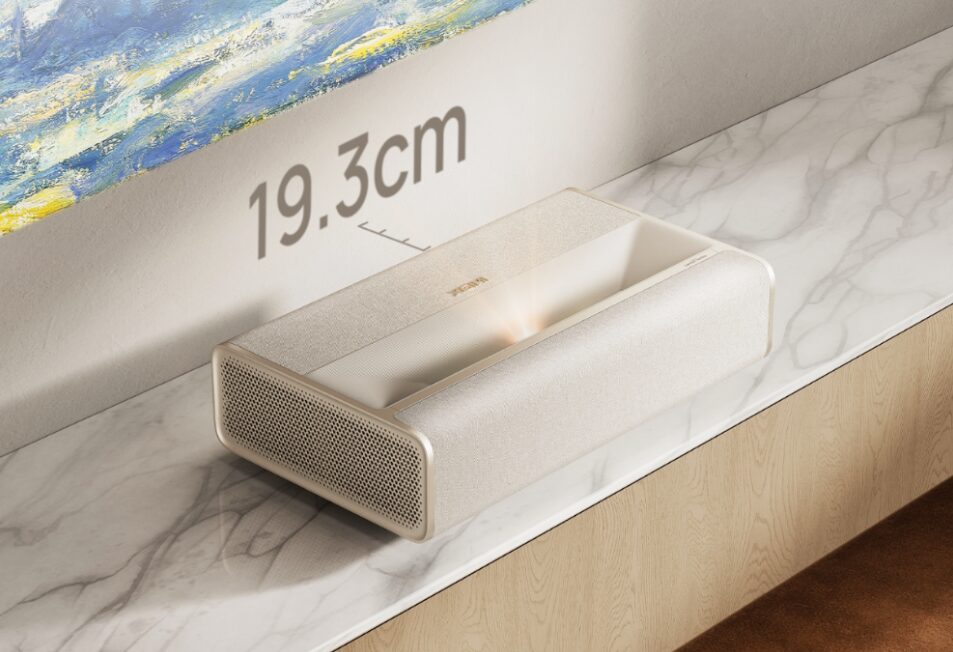
Xgimi has added two ultra-short-throw projectors to its MIRA lineup in China, and the answer is straightforward: the MIRA 4K Pro brings 3,000 ISO lumens, while the standard MIRA 4K starts at 6,499 yuan ($950). The Pro costs 7,999 yuan ($1,170), and its brighter output is aimed at premium living-room projector buyers who want a 100-inch image almost on top of the wall.
Both models use a 0.175:1 throw ratio, which means Xgimi says you can get a 100-inch picture from just 19.3 cm away. That’s the kind of spec that makes a TV stand look outdated, at least until you remember you still need a decent wall, decent light control, and a willingness to treat your living room like a mini cinema.
MIRA 4K Pro specs and image tuning
The higher-end model gets the fancier silicon and picture processing. Xgimi says the MIRA 4K Pro uses a 0.39-inch DMD chip, a high-transmittance coated lens, native 4K support, and compatibility with 2K and 4K input signals. It also includes AI-SR for super resolution, AI-PQ for picture adjustments, and AI-HDR for frame-by-frame dynamic clarity.
On paper, the display side is where Xgimi is trying to separate this projector from the usual ”big picture, good enough” crowd. The Pro covers 110% of the BT.2020 color gamut and posts a Delta E value of under 1, which is the sort of number calibration-minded buyers like to see. Competing models from the likes of Epson, Hisense, and Samsung have leaned hard into color and living-room flexibility, so Xgimi is clearly aiming above entry-level hardware here.
Audio, software, and smart setup features
Xgimi also packed in a fairly serious audio setup. The projector has 36W speakers tuned by Harman Kardon, a 2.1-channel layout, 360-degree sound, bass down to 55Hz, plus Dolby Audio and DTS:X support. That won’t replace a proper sound system, but it does make the usual tinny projector speaker problem a little less embarrassing.
Inside, the MIRA 4K Pro runs on the MediaTek MT9681 with 2GB of RAM and 64GB of storage, using GMUI 6.0 for the interface. Wireless casting comes through AirPlay and DLNA, while the smart toolkit includes automatic keystone correction, obstacle avoidance, wall color adaptation, and TÜV Rheinland-certified eye protection. Those are the kinds of features that matter most when the projector is meant to live in a shared room rather than a dedicated theater.
Ports, power, and the real trade-offs
Connectivity is broad enough to keep most people happy: three HDMI ports, including one with eARC, USB 2.0, USB 3.0, a 3.5mm audio jack, optical audio output, and LAN. Wireless options include dual-band Wi-Fi 6 and Bluetooth 5.2. Xgimi says the unit draws up to 200W, runs at 32dB, and weighs 5.3 kg.
- MIRA 4K: 6,499 yuan ($950), 2,000 ISO lumens
- MIRA 4K Pro: 7,999 yuan ($1,170), 3,000 ISO lumens
- Throw ratio: 0.175:1
- 100-inch image distance: 19.3 cm
- Audio: 36W, 2.1-channel, Harman Kardon tuning
The bigger question is whether the Pro’s extra brightness is enough to justify the jump in price. In the ultra-short-throw category, that answer usually depends less on specs than on room lighting and how much buyers care about setup convenience versus screen quality. Xgimi’s timing is sensible: premium projectors are leaning harder on smarter software and stronger brightness claims, because raw resolution alone stopped being enough a while ago.