

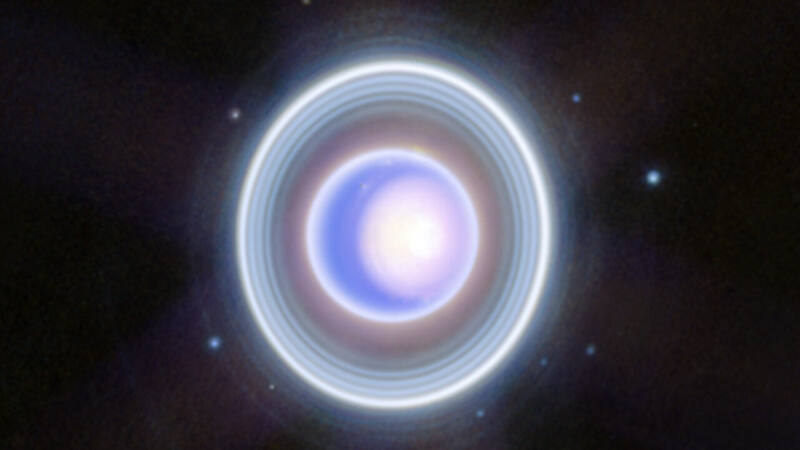
NASA’s James Webb Space Telescope has done something Uranus has been waiting on for decades: it has mapped the full reflected spectrum of the planet’s outer rings for the first time. The payoff is more than a prettier view. One ring, mu, looks icy and comes from the small moon Mab; the other, nu, is rich in carbon-bearing material and may be fed by yet unseen moons hiding among Uranus’s inner satellites.
That is the sort of result you only get when you stitch together old and new observatories. Researchers combined archival data from Hubble and Keck with Webb’s infrared observations, then used the spectrum to read the grain size and composition of the rings. Uranus is still the odd one out in ring astronomy: unlike Saturn’s bright, sprawling system, its rings were identified only in 1977 and remain faint enough to be easily missed.
What Webb found in the mu and nu rings
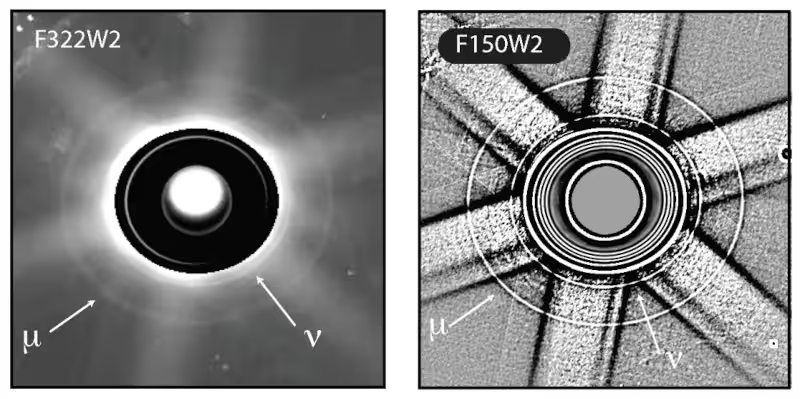
The key split is simple and strange. Mu is blue, which points to very small particles, and the new spectrum shows those particles are mostly water ice. That makes it resemble Saturn’s E ring, which is fed by icy spray from Enceladus. Nu is redder, and its mass appears to include 10 to 15 percent carbon-rich organic compounds, the kind of material more common in the cold outer reaches of the Solar System.
For Uranus, that matters because these rings sit inside a crowded inner system where debris does not stay put for long. The planet has 29 known moons, but the new data suggest there may be more small bodies still waiting to be identified, quietly shedding dust into the ring plane.
Why Mab stands out
Webb’s analysis traced the icy material in mu back to Mab, a moon only 12 kilometers wide. That is a neat reminder that tiny moons can have outsize influence: if their surfaces are being eroded or constantly refreshed, they can seed nearby rings without much fuss. The older inner moons around Uranus tend to be dirtier, with more rock and dust mixed in, which makes Mab something of an exception.
- Uranus has 13 known rings.
- Mu and nu are the two outermost rings.
- Mab is 12 kilometers wide and linked to the mu ring.
- Nu contains 10 to 15 percent carbon-rich organic material.
The search for more small moons
The stranger story is nu. Its chemistry points to dust being kicked off the surfaces of additional tiny moons that have not yet been spotted. That would fit Uranus’s awkward reputation: the system was first found by star occultations, Voyager 2 only snapped the rings up close in 1986, and even now the inner region is hard to read because everything is faint, small, and tightly packed.
If that sounds like unfinished business, it is. Webb has not ”solved” Uranus so much as shown where the next rounds of hunting should go, and the obvious target is the inner moon system. The next question is whether those hidden bodies are real moons or just especially stubborn clumps of ring material.