

An international team of planetary scientists using the James Webb Space Telescope has detected a mysterious absorption feature at 5.11 microns on both Titan and Pluto’s surfaces. Despite observations from two separate instruments confirming the signal, no known molecule fully explains this spectral line. The finding is striking: two vastly different worlds share the same chemical fingerprint, but researchers have yet to decipher it.

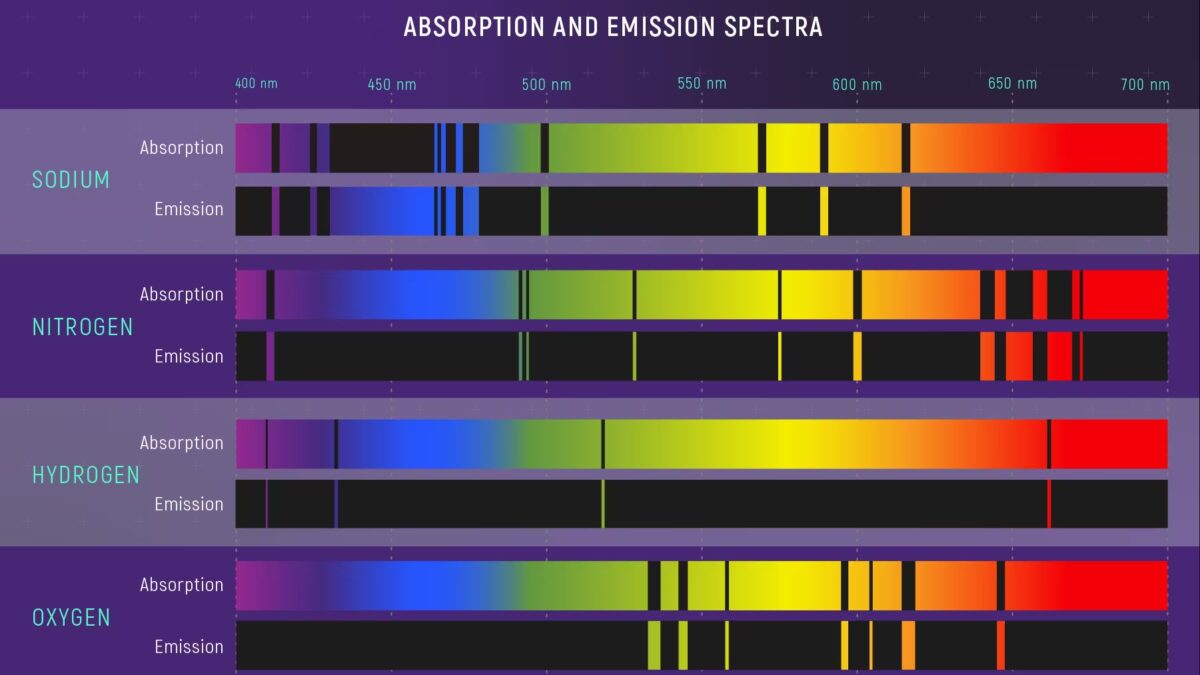
Spectral lines act like fingerprints for astronomers. Different molecules absorb light at specific wavelengths, creating dips in reflected or emitted spectra that reveal surface or atmospheric composition. Webb detected a distinct absorption feature centered around 5.113 microns (1956 cm-1) simultaneously with both its NIRSpec and MIRI instruments. Having consistent results from two independent tools solidifies the reality of this previously unseen signal.
The absorption depth is about 6-7% on Titan and roughly 4.5% on Pluto. Scientists tested whether the feature might come from Titan’s thick nitrogen-methane atmosphere laden with organic hazes. Modeling spectra including methane, carbon monoxide, ethane, acetylene, and aerosol particles failed to reproduce the signature. Additionally, the signal weakens from Titan’s disk center toward the edge, opposite of what would be expected if caused by atmospheric haze.
Pluto presents an even clearer case for surface origin. Its atmosphere is thousands of times thinner than Titan’s, so the absorption likely arises from surface ices or organics. The line is also broader on Pluto-about three times wider-which researchers attribute to differences in ice physical state, chemical environments, and surface processing by high-energy particles reshaping organic molecules.
Chemical clues link Titan and Pluto
Though Titan and Pluto look nothing alike, their chemistry shares a foundation. Both have nitrogen-dominated atmospheres with methane fueling complex organic chemistry. Solar radiation and energetic particle bombardment create aerosols and heavier compounds that settle onto their surfaces. The matching absorption band may indicate a common synthesis mechanism producing similar organic materials in nitrogen-methane dominated environments.
Previous spacecraft missions struggled to penetrate Titan’s thick haze in this wavelength range. The Cassini probe collected vast data, but its VIMS spectrometer lacked sensitivity around 5 microns. James Webb has opened a valuable spectral window, detecting faint features that were previously lost in noise on both these distant bodies. Similar stories have played out studying exoplanet atmospheres and protoplanetary disks, where new instruments find unknown lines that take years of laboratory work to identify.
Current candidate molecules for the 5.11 micron feature include allenes-organics with C=C=C fragments-as well as mixtures involving benzene and ketene. The challenge is these surfaces rarely exhibit spectra from a pure substance; instead, they likely represent complex blends of ices, organics, and radiation-processed materials that laboratory simulations have yet to recreate. Hence, this unknown line might signal a new class of complex organic mixtures.
NASA’s upcoming Dragonfly mission to Titan, planned to launch in 2028 and arrive in the mid-2030s, will carry a mass spectrometer (DraMS) designed to analyze organic molecules directly on Titan’s surface. If the 5.11 micron signature truly reflects a widespread surface chemistry, Dragonfly could finally reveal its molecular identity in situ rather than relying solely on remote spectral data.
This discovery also offers a new benchmark for the outer solar system. Since the New Horizons flyby, Pluto has seen little new data, and Titan remains a prime candidate among ocean worlds and icy satellites for studying complex prebiotic chemistry. If similar spectral signatures appear on other nitrogen-methane bodies, researchers may soon define a distinct category of surface organics. JWST’s future observation campaigns and ensuing lab work will be important to unraveling these mysteries.
As Webb continues to chart the solar system’s most enigmatic surfaces, the 5.11 micron absorption stands out as a chemical riddle bridging worlds millions of kilometers apart. Unlocking its secrets could rewrite our understanding of organic synthesis in cold, nitrogen-rich environments-paving the way for fresh insights into the chemistry shaping icy bodies across the cosmos.