

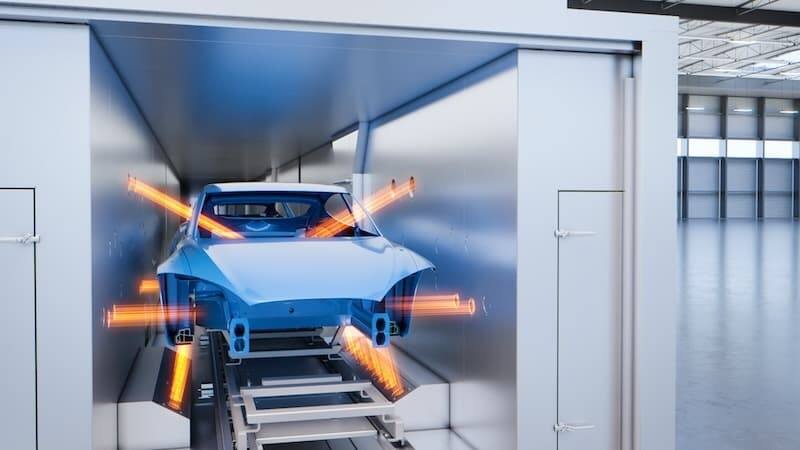
Volkswagen Autoeuropa is getting a new low-emission paint shop in Palmela, Portugal, and Dürr is building more than just another production line. The project ties a lower-emission coating system to a single digital control layer that will link three separate paint operations for the first time, a practical upgrade for a plant that built 236,100 vehicles in 2024.
The timing makes sense. Carmakers are under pressure to cut energy use and carbon output without slowing throughput, and paint shops are often where both the money and the emissions disappear fastest. Autoeuropa’s upgrade is designed to attack exactly that problem, while also preparing the site for new models.
EcoBell4 Pro Hu handles gloss and matte finishes
At the heart of the new setup is Dürr’s EcoBell4 Pro Hu robot system with 2×2K technology. The same spray head can apply glossy and matte coatings, which cuts the need for cleaning materials when the line switches between finishes. That is the kind of detail that sounds boring until you realize how much downtime and solvent use it saves.
- High transfer efficiency: up to 90% material transfer
- 30% less forming air consumption
- Reduced spray distance and lower paint consumption
- One robot for glossy and matte coatings
Dürr is also leaning on EcoSmartCure, an electrically heated drying system with intermittent operation. The idea is to heat bodies more precisely, which matters for electric vehicles and helps shorten drying time while cutting CO2 emissions. Traditional ovens are thirsty beasts; precision heating is the more civilized option.
Three paint operations move into one SCADA system
The digital side may be the more ambitious part of the project. DXQcontrol will bring the new paint shop, the main paint shop, and a separate two-tone roof line into one SCADA industrial control system. For Volkswagen, that means fewer disconnected islands of software and a better chance of seeing problems before they become expensive ones.
Dürr says the tricky part is not the new hardware but the migration of third-party software and the modernization of older control systems. That is the sort of integration work that rarely gets a glossy brochure, yet it is usually what decides whether a factory upgrade becomes a smooth transition or a long, ugly exercise in workarounds.
What Dürr is delivering in Palmela
The project also includes an automated measuring station, a paint kitchen, process platforms, and internal transport systems, with Dürr acting as general contractor across construction and equipment integration. The work is split into three phases and is scheduled to finish by mid-2027.
If it works as planned, Palmela will end up with one of Europe’s more advanced body-paint operations: more automated, more tightly controlled, and less wasteful. The bigger question is how quickly other older plants can follow, because this mix of electrified drying, high-transfer spraying, and unified software control is quickly becoming the new baseline rather than the fancy extra.