

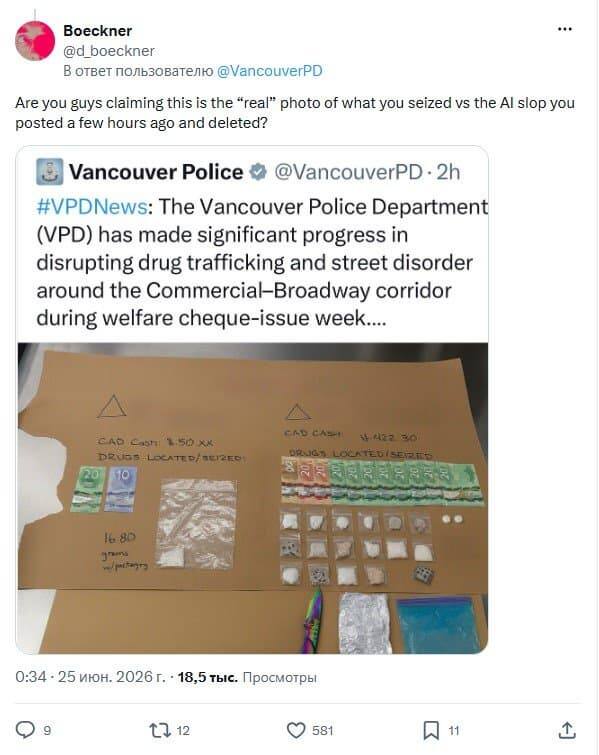
Vancouver police managed to turn a routine drug bust post into a trust problem. After publishing a photo of seized cash and narcotics on X, the force had to pull it once users spotted AI-generated errors in the image, including mangled banknote denominations that looked like classic machine hallucination rather than evidence handling.
The Vancouver police AI photo was later explained as a case where artificial intelligence had been used only to remove the names of accused people before publication. That explanation did little to calm things down, especially because the original image was apparently just a straightforward evidence shot on cardboard with marker labels – the sort of thing police have been posting for years without needing a generative detour.
What users spotted in the image
Online criticism focused on the details that gave the game away. Bills marked as $50 were labeled as $20, and one $100 note appeared to show only ”00” as its value. The post was replaced with an original, cropped photo after the backlash, but by then the damage was done: in a social feed, the repair often becomes part of the scandal.
That matters because police forces are under growing pressure to prove that digital evidence is handled cleanly. Across several countries, law enforcement agencies have already drawn heat for using generative AI in reports, surveillance analysis, and evidence processing – and each miss makes the next one easier to believe.
Why this hit a nerve
The Vancouver case landed amid arrests tied to alleged drug possession near the Commercial-Broadway transit hub during the social assistance payment period. In that context, even a small editing shortcut can look sloppy at best and deceptive at worst, which is exactly the kind of optics law enforcement can least afford.
Police and prosecutors elsewhere have learned that once AI touches official material, the burden shifts from ”Was this useful?” to ”Can anyone still trust it?” Vancouver’s embarrassment suggests that agencies are still answering that question in the wrong order.
The bigger problem for police PR
The smarter move would have been the dull one: crop the names out manually and publish the untouched evidence photo. Instead, the department handed critics an easy headline and invited a broader debate about whether AI belongs anywhere near police evidence, even for housekeeping tasks.
Expect other forces to become more cautious after this. The likely next step is not more AI, but stricter rules on where it can be used – because if a picture of cash and drugs can’t survive a closer look, the public will start wondering what else can’t.