

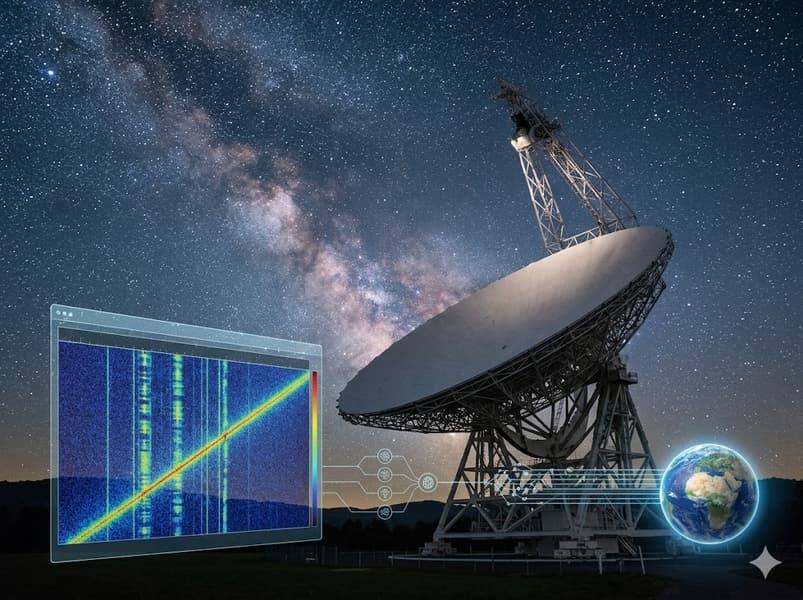
A decade of listening has not turned up an alien broadcast, but UCLA’s SETI project says it did something almost as useful: it built a search system that can separate likely technosignatures from Earth’s own radio mess with 94% efficiency. After scanning more than 70,000 star and planet systems with the Green Bank Telescope, the group argues that radio-capable civilizations appear to be very scarce in our patch of the Milky Way.
That is the real headline here. The silence is disappointing for anyone hoping for a cosmic hello, but the project also shows how much of SETI now depends on software, citizen science, and brute-force data cleaning rather than just bigger dishes and longer observing runs.
How UCLA cleaned up 100 million signals
The biggest obstacle was not distance. It was Earth. The team says it encountered more than 100 million suspicious signals, and 99.5% of them were traced to human-made interference from navigation satellites and ground stations. That is a neat reminder that before astronomers can look for alien transmitters, they first have to outwit themselves.
To do that, the researchers leaned on a mix of machine learning and volunteer labor. A ResNet-based neural network was trained on 76,000 examples labeled by 40,000 volunteers on Zooniverse, through a project called ”Are We Alone in the Universe?” The result was a system that could identify interference with 0.99 accuracy, freeing scientists to focus on the few candidates that actually deserved a second look.
The team also introduced a modified Drake-style metric that folds in signal drift, not just telescope sensitivity. That matters because orbital motion shifts frequency through the Doppler effect, which is exactly the sort of subtle wobble a blind search can miss if it averages spectra too aggressively. UCLA says direct processing without that averaging prevented weak drifting signals from slipping through the cracks in many other searches.
What the numbers say about alien transmitters
The statistical takeaway is blunt. With 95% confidence, the researchers estimate that within a radius of 20,000 light years from Earth, fewer than one in 16,000 stars hosts a radio transmitter comparable to the most powerful terrestrial radars. That does not prove nobody is out there; it says the loud, radio-shouting kind of civilization is at least uncommon.
There is also a funding story hiding inside the astronomy. The authors say technosignature work gets a tiny slice of NASA funding, even though it can survey a vastly larger space than traditional biomarker searches. That imbalance is not unique to SETI: big observatories often favor mainstream planetary science, while narrower hunts for artificial signals are expected to justify themselves twice over.
SETI is becoming a software problem
This is where the UCLA project feels like a template for the next phase of SETI. The field is moving away from romantic one-off listening sessions and toward high-throughput pipelines that can chew through enormous data sets, filter out radio pollution and rank the few anomalies worth chasing. The expensive part is no longer just the telescope; it is the computing and the human effort needed to keep the telescope from being fooled.
UCLA’s decade-long run did not find aliens. It did, however, tighten the screws on what counts as evidence and made the search more testable, more scalable and less hand-wavy. If another group wants to claim a better shot at finding technosignatures, it will now have to beat a system that combines AI, 40,000 volunteers and a very large radio telescope – which is a lot harder than hoping the universe decides to phone first.