

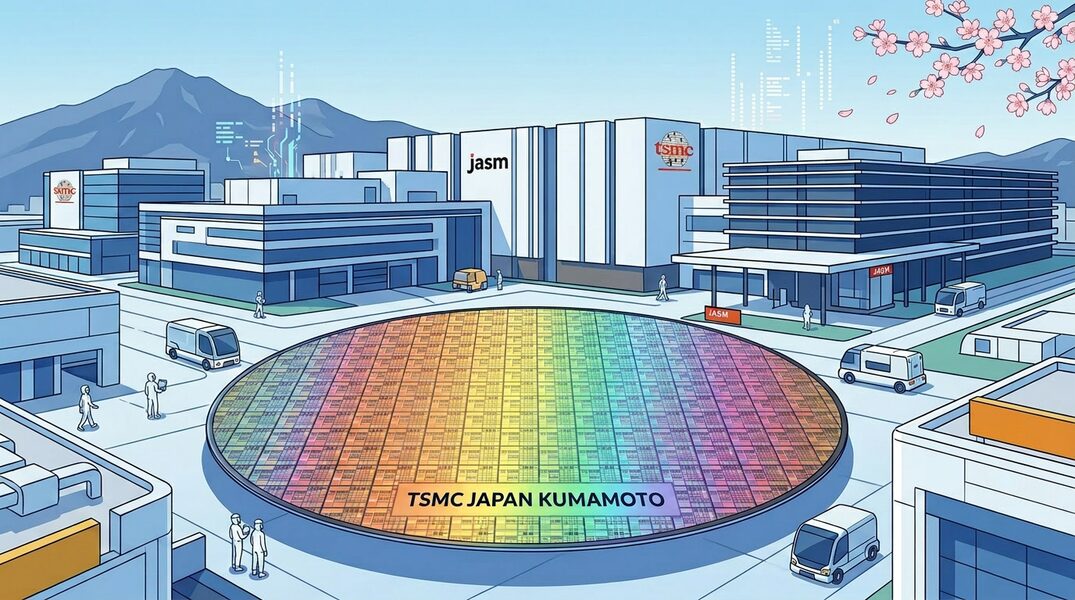
TSMC’s Japan plant has finally turned profitable. The Kumamoto factory, run by joint venture Japan Advanced Semiconductor Manufacturing Inc. (JASM), posted about $30 million in profit in the first quarter, a sharp turnaround from the previous quarter and a sign that the company is getting more out of a facility that still makes relatively mature chips.
The first Kumamoto fab currently produces chips on 12-, 16-, 22-, and 28-nm processes, aimed mainly at automotive electronics and industrial customers. That may not sound glamorous next to bleeding-edge AI silicon, but it is exactly the kind of steady demand that fills factories and pays bills. The result also underlines a simple truth of semiconductor manufacturing: even an older node can become profitable quickly if utilization rises high enough.
Kumamoto’s second fab is moving to 3nm
TSMC is not stopping at that first win. The company is building a second plant in Japan, and the plan has become more ambitious than it was at launch: instead of 6-nanometer production, it is now talking about 3-nanometer chips. The reason is obvious enough. Demand for AI accelerators and high-performance processors has surged, and the foundry business is following the money as fast as it can pour concrete.
Japan is not the only beneficiary of that rush. TSMC Arizona also posted almost $600 million in profit in the first quarter, far above a year earlier, with its first fab already producing 4-nm chips. The second Arizona fab is expected to move to 3-nanometer production in 2027, while construction has begun on a third plant and site prep is underway for a fourth fab and an in-house chip packaging facility. TSMC’s total U.S. investment is estimated at $165 billion, a number that tells you just how seriously it is treating geographic diversification.
TSMC’s European project is still paying the price for timing
Europe is the odd one out. The European Semiconductor Manufacturing Co. plant in Dresden is still under construction and still in the red, which is hardly surprising for a project that has not yet reached production. It does, however, show how uneven TSMC’s global buildout is: the company is collecting profits from some overseas sites while others are still expensive promises on a blueprint.
The bigger story is not just one profitable factory in Japan. It is TSMC trying to do three things at once: reduce dependence on Taiwan, capture demand from AI and data centers, and keep its grip on automotive and industrial chips. That is a lot to ask of any manufacturer, and the next test will be whether the second Kumamoto fab can move to 3 nm quickly enough to justify the upgrade.