

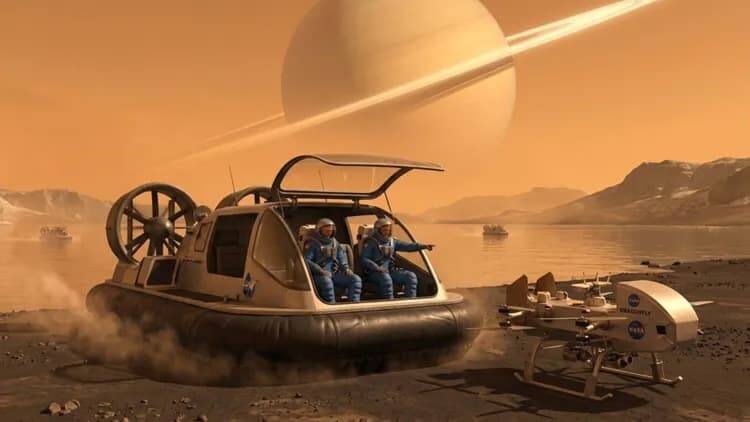
Scientists are starting to talk seriously about a Titan human mission, sending people to Saturn’s largest moon, and they have a decent sales pitch: a thick atmosphere, potential local fuel sources, and a surface that could be less hostile to humans than the Moon or Mars. That’s the headline from the first Humans to Titan Summit 2026 in Boulder, where planetary scientists and aerospace engineers sketched out what a future mission would need, even if the actual journey is still firmly in the ”not soon” category.
Titan is not getting this attention because it sounds friendly. It is cold, bathed in methane seas and hydrocarbon rain, and far away enough to make mission planners wince. But in a field where every promising destination comes with a catch, Titan’s dense nitrogen atmosphere gives it a rare advantage: natural shielding from cosmic radiation. In other words, it is one of the few places in the outer Solar System that can be described as dangerous in an oddly manageable way.
Why Titan is getting fresh attention
The argument for Titan is less romantic than strategic. Researchers say methane and nitrogen could eventually be used to produce fuel and support supply chains for future expeditions, which is the kind of practical detail that turns a sci-fi destination into an engineering discussion. Titan could also serve as a staging point for work around Saturn’s other moons, giving it a role beyond being just another frozen outpost.
- Large moon of Saturn with a dense nitrogen atmosphere
- Methane seas and hydrocarbon rain on the surface
- Potential use of local methane and nitrogen for fuel
- Possible base for studying other Saturnian moons
Dragonfly will arrive long before any astronauts
For now, the real test will come from NASA’s Dragonfly mission, which is currently scheduled to launch no earlier than 2028. The rotorcraft is expected to spend more than three years studying Titan’s surface, chemistry, and soil, and that data will matter more than any speculative architect’s sketch of a future colony. This is how these ambitions usually begin: robotic reconnaissance first, human dreams later, and a lot of waiting in between.
The summit’s organizers are careful not to oversell the moment. They are talking about a long-term roadmap, not a mission manifest, and that distinction matters because Titan is the sort of place that punishes optimism. The next conference is planned closer to Dragonfly’s launch, which suggests the people pushing this idea know the story is still in its opening chapter.
The real obstacle is the trip to Titan
Distance remains the ugly problem nobody can design around with a clever slide deck. Either travel times have to come down sharply, or crews will need systems that can keep them alive and functional through a journey measured in years. That is a much harder sell than the notion of building hardware for cold weather.
If Titan ever becomes a human destination, it will not happen because it is easy. It will happen because the Moon and Mars have already been pushed to their limits, and Saturn’s biggest moon turns out to be the next place where the numbers, the chemistry, and the ambition line up just enough to make people ask: why not here?