
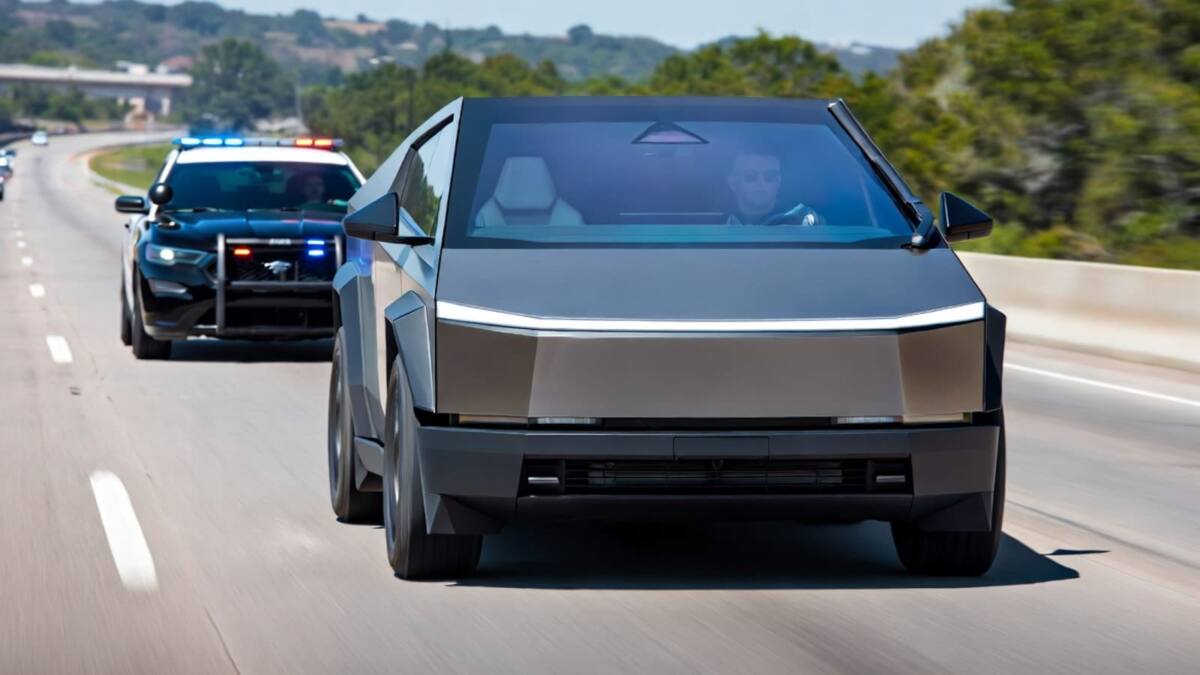
Tesla’s FSD system is starting to act less like a blunt piece of software and more like a cautious driver with a few seasons of highway experience. Owners say the system now spots police cars on the median, eases off the throttle, and changes lanes smoothly, while also handling roadside work vehicles, disabled cars, and other hazards with more human-like restraint.
That matters because this is exactly the kind of judgment no spec sheet can brag about. Plenty of driver-assistance systems can keep a car centered in a lane; far fewer can read the social cue of a patrol car and decide that a little extra space is probably the smart move.
How Tesla FSD reacts to police cars and roadside hazards
The reported behavior is straightforward: once the vehicle identifies a police car on a divided road, it slows down and drifts into the next lane without drama. Users say the maneuver looks natural, which is high praise for a machine that is usually either too timid or too eager to prove a point.
The same logic now appears to apply to broken-down cars, road crews, and other obstacles near the shoulder. Rather than treating every object as the same problem, FSD seems to be learning that a flashing light, a stalled vehicle, or a worker’s truck all demand a softer touch.
Tesla’s end-to-end training is teaching road manners
These tweaks are the result of Tesla’s end-to-end neural network training on large volumes of real driving data. In plain English: the system is absorbing the habits of human drivers and turning them into defaults, which is a more useful trick than memorizing a dozen rigid rules that fail the moment traffic gets weird.
- Slows down when a police car is detected
- Changes lanes smoothly around roadside hazards
- Preserves more distance from disabled vehicles and work zones
Tesla had already taught FSD to avoid emergency vehicles with flashing lights. Extending that behavior to everyday road scenes is the bigger step, because it suggests the system is starting to generalize rather than just recognize a few obvious sirens-and-strobes cases.
The next test is consistency, not just clever demos
The flattering part is obvious: Tesla can point to software that behaves with some common sense. The harder part is making sure that same judgment shows up every time, in every city, in ugly weather, and on roads where human drivers can barely agree on a zipper merge, let alone a safe one.
If FSD keeps getting better at reading roadside situations, the real question is whether it can stay calm and predictable at scale. That is where a useful assistant stops being a flashy demo and starts looking like something people might actually trust on a daily commute.