

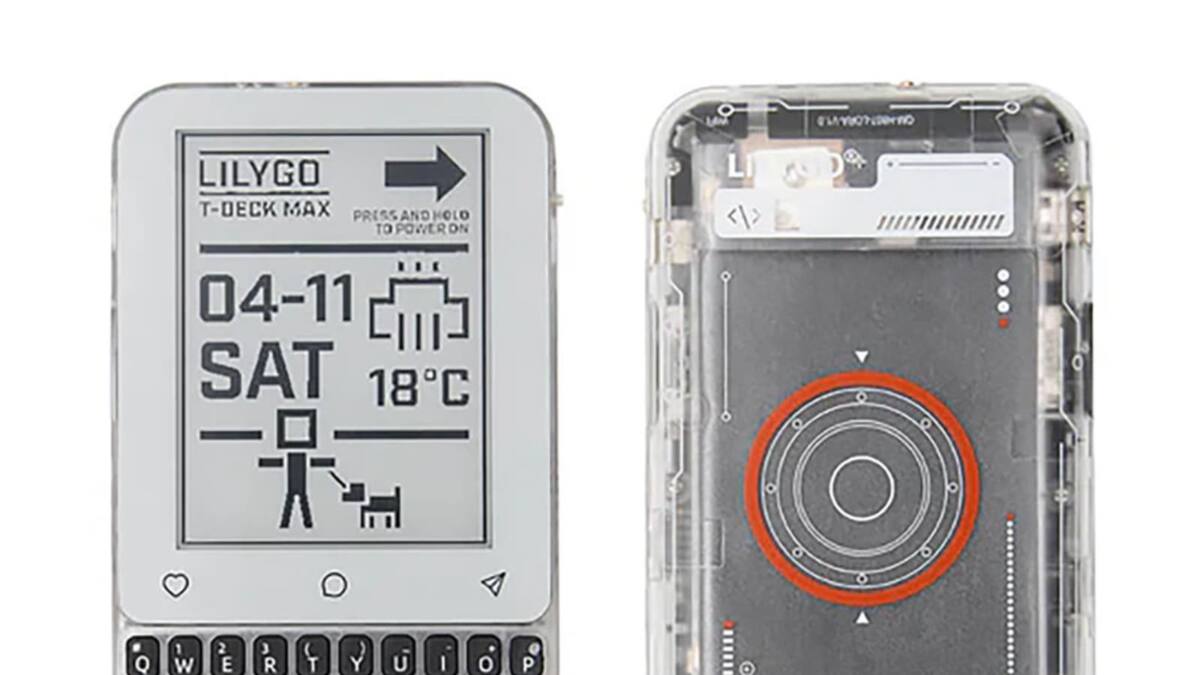
LilyGo has rolled out the T-Deck Max, a $110 experimental handheld that skips Android entirely and leans into something far less ordinary: offline-first communication over LoRa, with a QWERTY keyboard, GPS, and support for add-on radios and sensors. It is not a consumer smartphone, and that is the point. This is a gadget for builders, field use, and anyone who thinks a phone should be more hackable than glossy.
Under the hood, the device uses an ESP32-S3 microcontroller with a dual-core Xtensa LX7 CPU clocked up to 240 MHz. That is nowhere near phone-class silicon, but it gives the T-Deck Max a simpler, more open hardware base than the average locked-down handset. The trade-off is obvious: less raw power, more room for tinkering.
LoRa, GPS, and optional 4G in one handheld
The headline feature is LoRa, which can move small data packets over long distances without relying on a mobile network. That makes the device potentially useful on industrial sites, during outages, or in emergency scenarios where cellular coverage is patchy or missing altogether. LilyGo also adds a GPS module for location sharing, plus an option to connect a 4G modem if users want a more conventional data path.
That mix puts the T-Deck Max in a small but growing class of niche communicators aimed at resilience rather than convenience. Products in this category tend to attract the same crowd that buys Meshtastic-compatible hardware, field radios, and Raspberry Pi accessories: people who want a device that can be adapted to the job, not just carried in a pocket.
The T-Deck Max screen and keyboard are built for utility
LilyGo equips the T-Deck Max with a 3.1-inch E-ink display at 320×240 pixels, along with a microphone, a speaker, and a physical QWERTY keyboard for text input. There is also a microSD slot, which should help with logs, data transfer, and whatever creative storage scheme builders dream up next.
- Display: 3.1-inch E-ink, 320×240 pixels
- CPU: ESP32-S3 with dual-core Xtensa LX7 up to 240 MHz
- Connectivity: LoRa, GPS, optional 4G modem
- Input: physical QWERTY keyboard
- Storage: microSD slot
Arduino and PlatformIO keep the T-Deck Max developer-friendly
Support for Arduino and PlatformIO is the clearest signal that this is a platform, not a finished lifestyle product. LilyGo is effectively selling a base for custom apps, messaging tools, and sensor projects. The company is betting that a dedicated audience would rather build a useful communication device than wait for a polished one to arrive from a giant smartphone maker.
At $110, the T-Deck Max is priced low enough to be a serious experiment, not an indulgence. The more interesting question is whether this kind of hybrid handheld stays a hobbyist curiosity or becomes the sort of backup communications tool that people actually keep charged in a drawer.