

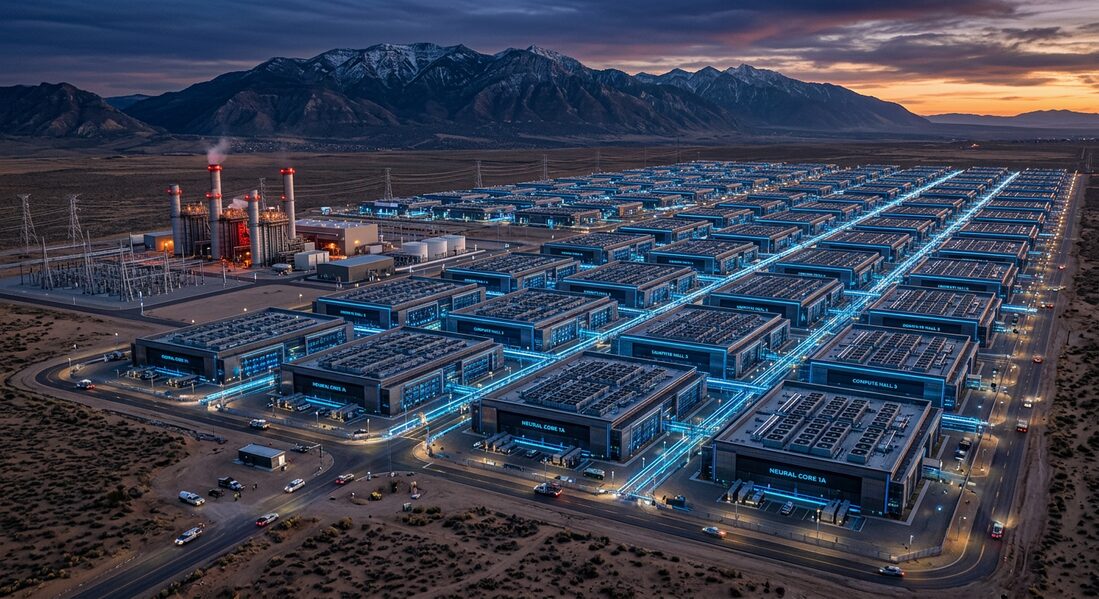
Utah has approved Stratos, a giant AI data center campus that could eventually draw as much as 9 GW of power – roughly the same scale as the state’s total electricity use. The project, backed by Kevin O’Leary’s O’Leary Digital, is designed to start at about 3 GW and grow into one of the most power-hungry computing sites ever planned in the US.
The pitch is simple enough: build the servers, generate the electricity on site, and keep the whole thing running from a location in Box Elder County that spans private and public land. The catch is equally obvious. A facility this large is not just a data center; it is effectively an industrial power project with racks attached.
What Stratos is built to consume
At launch, the Stratos AI data center campus in Utah is expected to need around 3 GW, with the full buildout reaching 9 GW. That scale helps explain why the plan calls for local power generation tied to a major gas pipeline running through northern Utah. Data centers keep getting bigger, but this one is already operating in a different category – more grid politics than server farm.
- Initial demand: about 3 GW
- Final demand: up to 9 GW
- Location: Box Elder County
- Energy source: on-site generation connected to a large gas pipeline
Utah is paying for the promise with tax breaks
Stratos has also won unusually generous tax treatment. The energy tax rate is being cut from the standard 6% to 0.5%, and 80% of the property tax is set to be returned to the developer. That is a very friendly deal for a project of this scale, though officials are betting the math still works for the county.
They say it should. The early phase is projected to bring in about $30 million a year, rising to more than $100 million once the campus is fully built out. It is also expected to create around 2,000 permanent jobs, which is the usual political glue for projects that would otherwise look absurd on a power bill.
The race for AI infrastructure is getting more expensive
O’Leary has framed the project as part of a global contest for AI infrastructure, pointing to massive Chinese investment in energy and data centers. That argument is doing a lot of work here, because the real competition is no longer just about chips or models; it is about who can secure enough electricity, land, and permits to keep the machines fed. The US already has a growing pipeline of hyperscale builds, but a 9 GW campus pushes the conversation into utility territory.
The open question is whether Stratos becomes a template or a warning label. If the economics hold, other states may try the same playbook: cheap land, aggressive incentives, and power generation built into the project itself. If they do not, Utah may have just approved one very expensive symbol of how far AI ambition can outgrow the grid.