

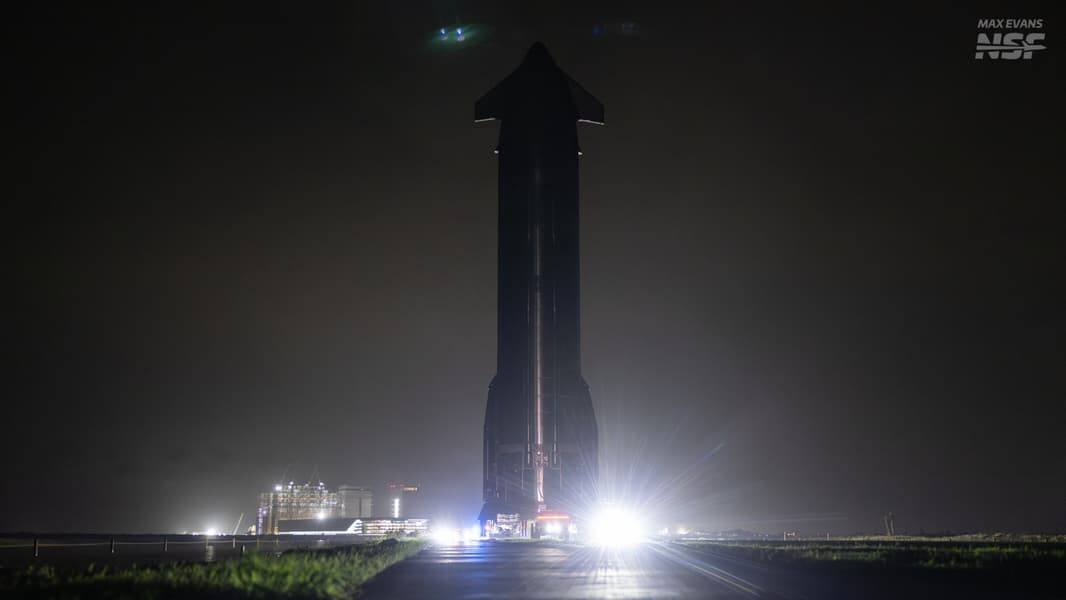
SpaceX has moved Ship 39, the first Starship V3 spacecraft, to Pad 2 for mating with Super Heavy Booster 19, setting up the pair for Flight 12. The launch is currently penciled in for 15 May in recently published NOTAM notices, which is the kind of paperwork that tends to appear before rockets get interesting.
For SpaceX, the move matters because Ship 39 is the first ship to show up at the launch site since Ship 38 was readied for Flight 11 in October. That gap underscores how much of the next phase depends on the new hardware actually reaching the pad, not just looking good in renders and spec sheets.
Starship V3 specifications
Starship’s third generation, also known as V3 or Block 3, is a bigger and more ambitious machine than the previous version. It is said to be about 124.4 m tall, lighter, and capable of carrying more than 100 t, up from 35 t for V2.
- Raptor 3 engines without external piping
- Super Heavy with 3 large fins instead of 4
- More propellant: 4050 t
- Improved heat shield, refueling ports, and structural robustness
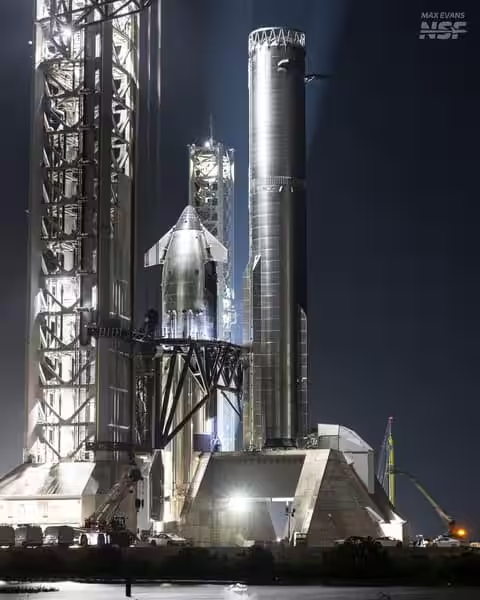
Booster 19 reached the spotlight after a successful static fire of all 33 Raptor 3 engines at Starbase. That test was not exactly elegant: the water-deluge system stopped unexpectedly, making the run look for a moment like a cancellation rather than a rehearsal. SpaceX still got the data it wanted, which is usually how these things are measured when the vehicle is this large and this expensive to feed.
Flight 12 depends on the pad checkout
The next step is the obvious one: stack Ship 39 on Booster 19 and see whether the upgraded system behaves better than its predecessors. If the 15 May target holds, SpaceX will be trying to turn a long development cycle into a visible leap forward for a vehicle that has spent as much time proving the basics as chasing the moon-shot ambitions attached to it.