

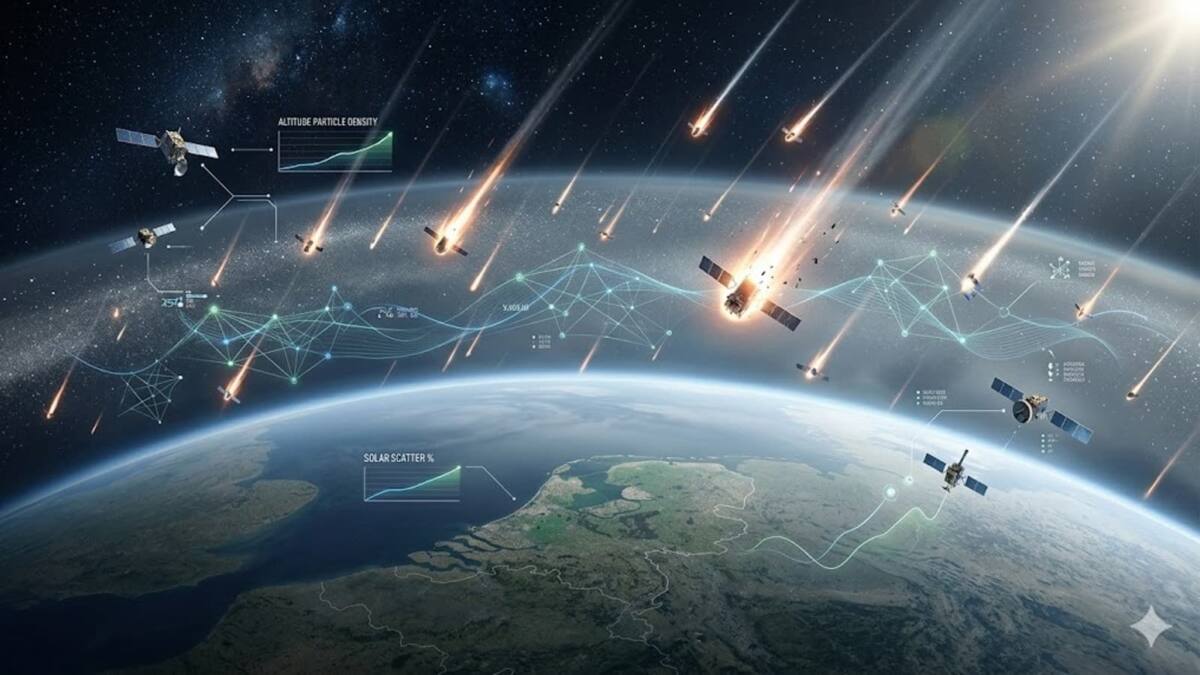
Spent satellites are already dimming Earth, according to a new study, and the effect could become more pronounced before the decade is out if launch rates keep climbing. The research says the growing wave of satellites burning up in the atmosphere is reducing the sunlight reaching Earth’s surface, in a way that starts to resemble deliberate solar geoengineering.
The study, published in Earth’s Future, focuses on what happens when defunct satellites re-enter the atmosphere and vaporize. The headline takeaway is awkward for a sector that likes to market itself as clean and futuristic: the byproducts of those fiery deaths are not disappearing harmlessly but accumulating in the upper atmosphere, where they can alter climate behavior.
Spent satellites are now part of the climate equation
Scientists led by Eloise Marais at University College London modeled the pollutants released by deorbited satellites between 2020 and 2022. They concluded that in 2020, burning satellites accounted for 25% of the space industry’s total climate impact, rising to 42% by 2029 if launches continue at the current pace.
That shift matters because the industry is expanding fast. Launch activity has tripled over the past five years, driven largely by commercial megaconstellations such as Starlink, which has about 12,000 satellites, and Amazon’s Project Kuiper, which plans more than 5,000. More hardware in orbit means more hardware coming back down, and that means more material being dumped into a thin atmospheric layer with nowhere to go.
- 2020 share of space industry’s climate impact from burning satellites: 25%
- Projected share by 2029: 42%
- Projected annual soot from launches by 2029: about 870 metric tons
Why reentry debris is more than just debris
This is not just about losing a satellite. Previous studies have already raised alarms about metals such as lead and aluminum released during reentry, warning that they could contribute to ozone damage. The new work goes a step further by arguing that the combined effect of these emissions is starting to look like a small, unregulated version of solar geoengineering.
There is a grim irony here. The same industry building internet access from orbit is also injecting soot and metal particles into the very atmosphere scientists are trying to protect. And unlike a controlled climate experiment, this one has no consent form, no oversight, and no obvious off-switch.
Soot from rockets is the easier problem to measure
The study also looked at rocket launches themselves, which pump soot directly into the upper atmosphere, where it can linger for years because there is no rain to wash it out. By 2029, the researchers estimate launches will add about 870 metric tons of soot annually, roughly matching the total soot emissions from all passenger cars in the United Kingdom.
That comparison should make regulators uncomfortable. Space traffic has become a genuine pollution source, and the problem is growing fast enough that waiting for the market to self-correct feels optimistic in the way only aerospace lobbyists can manage.
The real test is regulation, not rocket science
Marais says the scale is still small enough that action can limit the damage, which is the polite scientific way of saying the window is open but narrowing. The obvious fix is tougher international rules on atmospheric pollution from satellites and launches, though the history of space governance suggests the industry will move faster than the rulebook.
The unsettling question is whether the next wave of orbital expansion will be treated like an emissions problem or a side effect to be hand-waved away. If current trends hold, Earth may end up dimmer not because anyone tried to cool it, but because we launched too much stuff and let physics do the rest.