

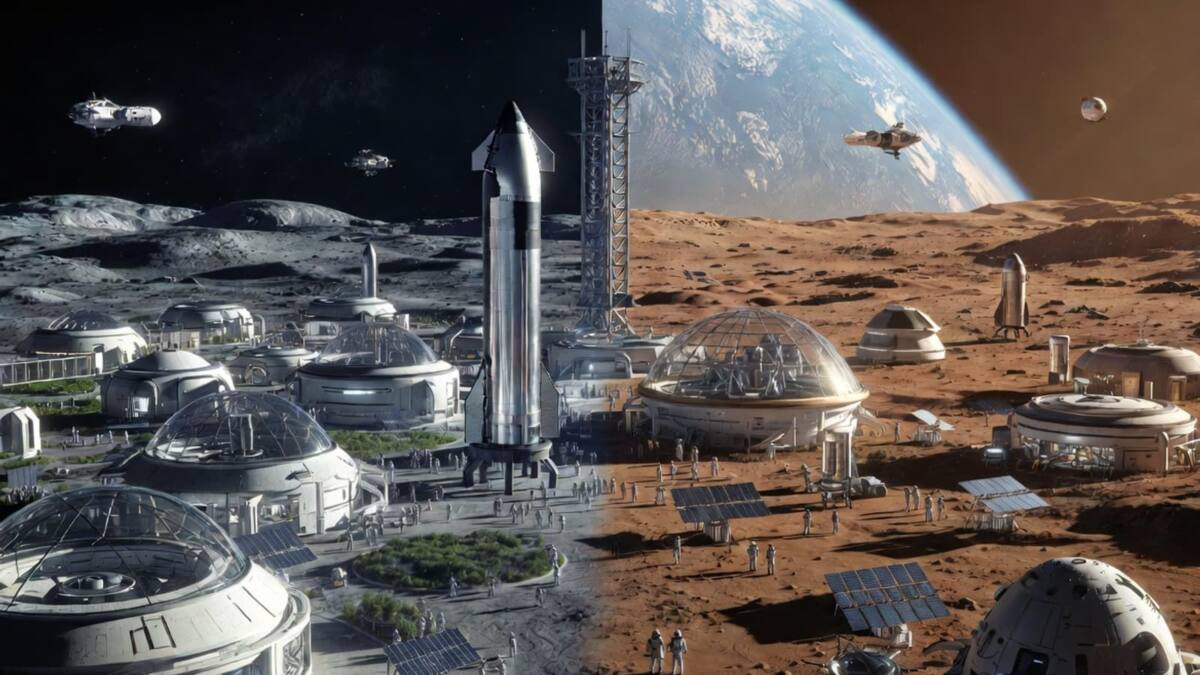
Elon Musk has sharpened SpaceX’s mission again: the company is not just trying to reach the Moon and Mars, but to help build self-sustaining civilizations on both. The Moon would get there faster thanks to proximity, while Mars is the tougher but safer bet if you are trying to hedge against Earth-sized disasters. SpaceX’s Starship is at the center of that plan.
The comment came after former SpaceX astronaut Garrett Reisman said Musk evaluates major decisions by one question: does this move the company closer to a self-sufficient Mars colony? Musk said that was broadly right, then widened the frame. His argument is simple enough to fit on a launch pad: if humanity puts all its future on one planet, it stays one bad day away from extinction.
Why the Moon comes first
The Moon is the easier test case. It is close enough to Earth to simplify logistics, resupply, and emergency support, which is exactly why it can serve as a proving ground for life beyond Earth. But that convenience is also the weakness: a lunar settlement is still exposed to the same planetary risks that could hit Earth, from geopolitical collapse to global nuclear war.
Mars, by contrast, is a much better insurance policy precisely because it is farther away. That distance makes everything harder – travel, cargo, timing, recovery – but it also means a disaster on Earth is less likely to wipe out a Martian settlement. SpaceX is basically betting that survival gets easier once the species stops keeping all of its eggs in one gravity well.
How Starship fits the plan
None of this works without Starship, the giant rocket SpaceX has built its deep-space strategy around. The company is already preparing uncrewed missions and pushing technologies meant to support long-term human presence off Earth, which is the boring part of a very un-boring ambition. The hard part is not getting there once; it is building a system that can keep running without Earth constantly babysitting it.
- Moon: faster path to self-sufficiency because it is closer to Earth.
- Mars: slower to reach self-sufficiency, but better protection from Earth-based catastrophes.
- Starship: the vehicle SpaceX is using to try to make either plan scale.
The familiar SpaceX pattern is showing up again here: talk about rockets, but really build an escape hatch for civilization. The more interesting question is whether the company can turn that philosophy into an actual settlement plan before the rhetoric outruns the hardware. For now, Musk is making the same point in slightly different words: one planet is a gamble, two planets are a strategy.