


South Korean researchers at the Korea Advanced Institute of Science and Technology (KAIST) say they have built a silicon-based computing system that can tackle hard combinatorial problems far faster than conventional semiconductor computers, and they are pitching it as the start of a ”third era” for transistors: not switches, not amplifiers, but oscillators.
The claim comes from KAIST, where the team says ordinary CMOS hardware can be turned into an oscillator-based Ising machine without exotic materials or a new fabrication stack. That matters because a lot of futuristic computing still dies at the foundry gate; this one is designed to survive contact with the real semiconductor industry.
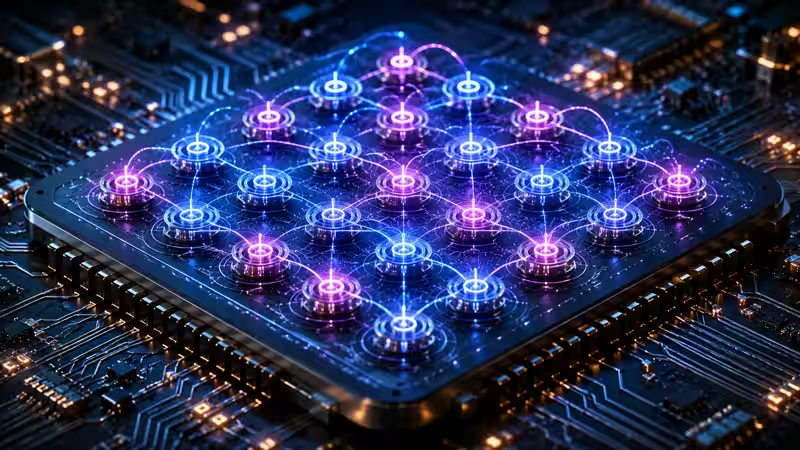
How the silicon oscillator machine works
At the core is the Ising model, a mathematical framework originally built to describe magnetism. In this setup, many oscillators exchange signals, lock their frequencies, and settle into the most stable state, which corresponds to the best solution for the problem being computed.
That is a neat trick because the system is not grinding through possibilities one by one in the way a standard computer often has to. For certain tasks, the researchers say the machine can find an answer in hours where a classical system would need thousands of years of nonstop work. The usual caveat applies: that is for specific problem classes, not a magic button for every spreadsheet in the world.
Max-cut is the headline benchmark
The team tested the system on the maximum cut problem, a classic graph-optimization challenge with uses in logistics, financial analysis, and semiconductor design. The research also points to broader applications in statistical physics, finance, chemistry, and materials science, which is the sort of list that usually appears when a platform wants to sound smaller than a universe and bigger than a chip.
- Platform: oscillator-based Ising machine
- Hardware: standard silicon transistors
- Target problems: combinatorial optimization and statistical computing
- Stated benefit: compatibility with existing CMOS manufacturing
Why this is different from quantum hype
Quantum computing still gets the headlines, and D-Wave’s quantum annealing systems have kept the optimization conversation alive, but practical quantum machines remain limited in real-world reach. KAIST’s pitch is more grounded: use mature silicon, keep the factories, and add new behavior at the device level instead of waiting for a miracle material.
That makes the timing interesting. As transistor scaling approaches physical limits, any path that extracts more useful computation from standard CMOS is going to get attention, especially from industries that care less about elegance than about shipping something that works on existing lines.
The commercial test will be manufacturing, not philosophy
KAIST is framing the work as a new era of transistors, and the rhetoric is not entirely fluff. If the synchronization gains hold outside the lab, the result could be a class of processors aimed at hard optimization rather than general-purpose arithmetic, with a much easier path to production than most ”future computing” schemes.
The open question is scale. A clever oscillator array that solves a benchmark is one thing; a reliable chip that can be dropped into industrial workflows is another. If this approach keeps its performance while growing up, the third era of transistors may arrive as a niche workhorse before it becomes anyone’s grand new computer.