

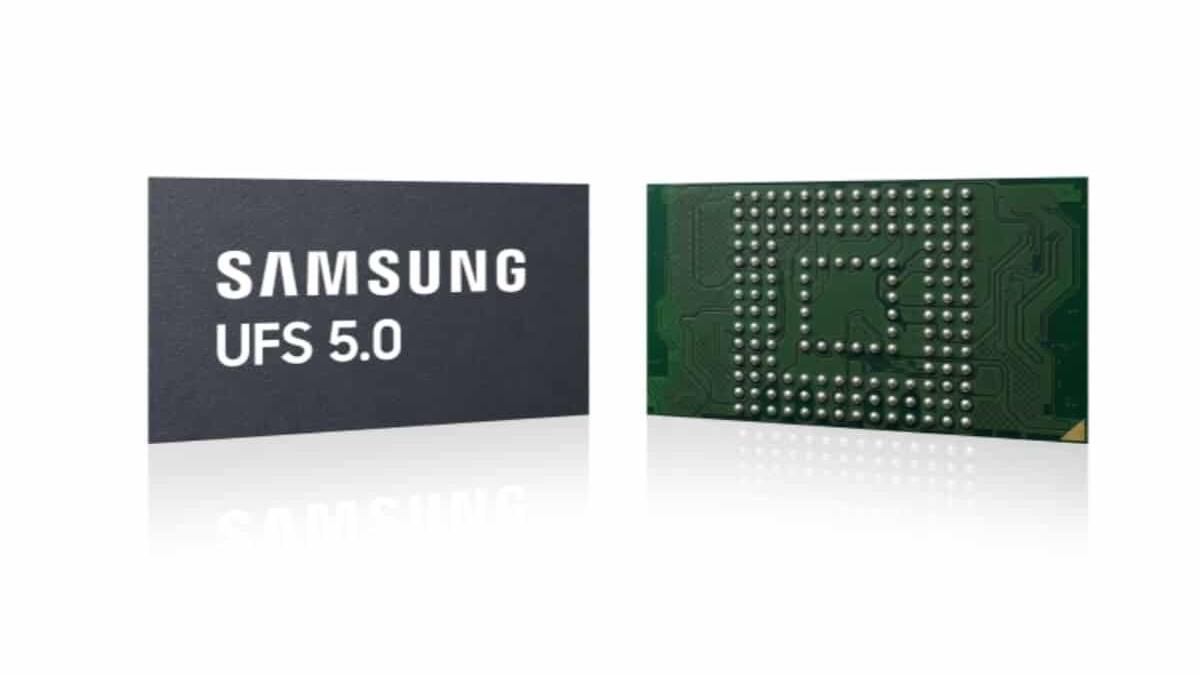
Samsung has unveiled UFS 5.0, its next-generation embedded storage standard, and the headline number is hard to miss: up to twice the performance of UFS 4.1. The company says the new flash storage is built to cut latency, improve response times for on-device large language models, and give future Galaxy phones a much snappier feel, assuming handset makers actually ship it instead of leaving it on a slide deck.
Samsung says UFS 5.0 reaches sequential read speeds of up to 10.8GB/s and sequential write speeds of up to 9.8GB/s. It is also more than 40% more power efficient than UFS 4.1, 16.7% smaller overall, and can scale up to 1TB of capacity, which should be enough for heavy local AI features and oversized app installs phone makers keep pretending people want.
UFS 5.0 speed and efficiency numbers
On paper, this is the sort of storage upgrade that matters more than a lot of marketing-friendly camera tweaks. Faster storage can make app launches, multitasking, and AI processing feel less sluggish, especially as phones lean harder on local inference instead of pushing everything to the cloud. Samsung says the new standard is based on JEDEC’s latest embedded storage interface specification, which is the unglamorous part that usually decides whether a spec becomes real hardware or just a press release.
- Sequential read speed: up to 10.8GB/s
- Sequential write speed: up to 9.8GB/s
- Power efficiency: more than 40% better than UFS 4.1
- Size: 16.7% smaller overall
- Maximum capacity: 1TB
When Samsung plans to ship UFS 5.0
Mass production is scheduled to begin in the fourth quarter of this year, which means the first phones using UFS 5.0 probably won’t be far behind if Samsung and its partners move quickly. That timing also puts the company in position to pressure rivals like Apple and other Android makers, all of whom are trying to make their devices feel faster without simply burning more battery to do it.
For buyers, the takeaway is simple: UFS 5.0 is less about a spec-sheet arms race and more about the next wave of phones trying to keep up with AI-heavy software. The real test will be whether manufacturers use the extra speed and efficiency to deliver better battery life and fewer stutters, or just tack the name onto a premium model and call it innovation.