

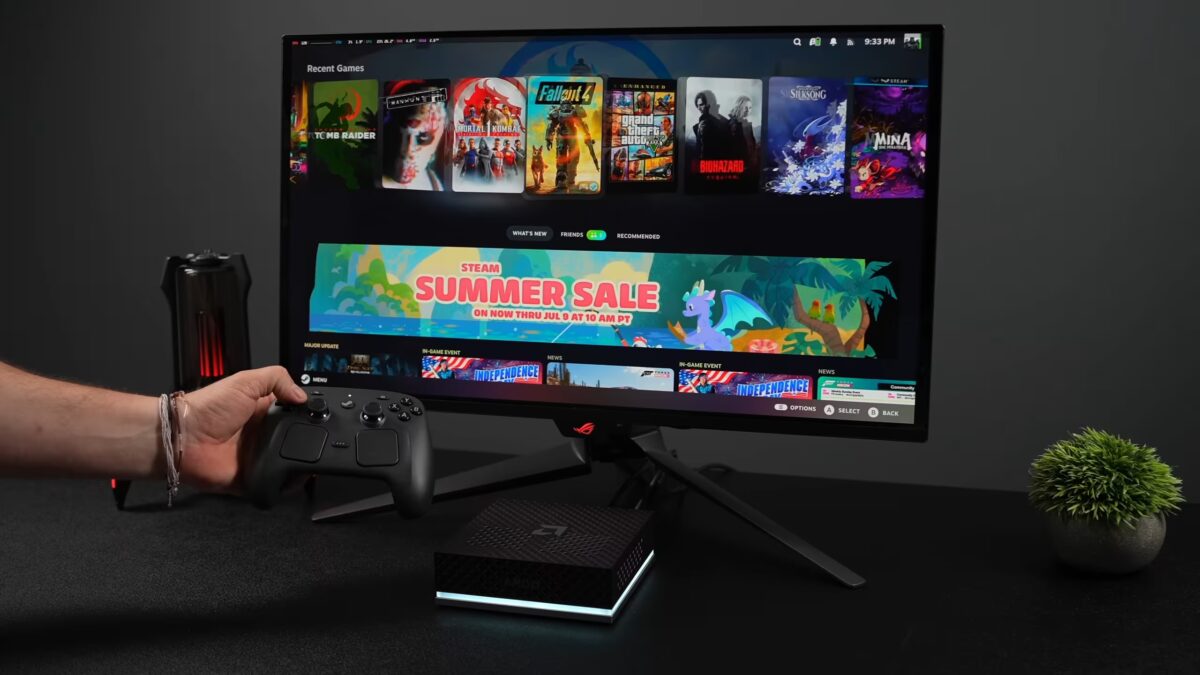
Valve’s decision to open up SteamOS for regular PCs sparked immediate curiosity among enthusiasts eager to see how the operating system would run on high-end hardware. The ETA PRIME channel tested SteamOS on a Ryzen AI Max+ 395-powered mini PC, pitting it against Valve’s own Steam Machine. The result was clear: AMD’s Ryzen AI Halo leads in performance, but its price is more than triple that of Valve’s Steam Machine.
Across three games, the Ryzen AI Halo mini PC delivered faster frame rates. At 1080p, it outpaced the Steam Machine by 17-24%, while at 4K resolution, the lead widened to 23-50%. This boost is hardly surprising: the Ryzen AI Max+ 395 features 16 Zen 5 cores and integrated Radeon 8060S graphics with 2,560 stream processors based on RDNA 3.5 architecture. Valve’s Steam Machine uses an APU with just six Zen 4 cores and a Radeon GPU offering 1,792 stream processors on RDNA 3.
Power consumption also played a big role in the performance differences. Valve’s platform is tightly constrained on power use, limiting performance headroom. Meanwhile, the more power-hungry-and pricier-Ryzen AI mini PC benefits from looser restrictions under SteamOS. Still, the performance gap isn’t a blowout; Valve’s device holds its own, especially at lower resolutions, highlighting both the efficiency of SteamOS and the Steam Machine’s hardware design.
The biggest drawback? Price. The Ryzen AI Max+ systems come in at more than three times the cost of Valve’s Steam Machine, according to ETA PRIME. That shifts the Ryzen AI-powered mini PC away from being just an alternative gaming console toward a compact premium gaming PC. ASUS’s ROG NUC and similar small form-factor PCs with mobile Ryzen 9 HX processors have already shown that impressive gaming rigs can fit into tiny cases-it’s just rare they’re budget-friendly.
Valve’s move to expand SteamOS support beyond its own hardware benefits AMD most, thanks to solid Radeon GPU compatibility. If drivers for other configurations improve rapidly, the mini PC space could gain a new category: compact gaming boxes running SteamOS with a console-like interface, rather than just small Windows PCs dressed up for gaming. IDC reports that the global PC market is growing again in 2025, prompting manufacturers to chase profitable niches like premium mini PCs over conventional laptops.
With high-performance Ryzen mini PCs demonstrating serious power under SteamOS, the real question becomes how Valve and AMD will balance price, power, and performance to attract gamers seeking a console experience without compromise. Will we see more affordable Ryzen AI systems optimized for SteamOS, or will Valve’s Steam Machine remain the pragmatic choice for those who want Steam’s ecosystem on affordable hardware? The competition between open PC gaming and closed-console simplicity is heating up in a way that could reshape how we think about gaming’s smallest rigs.