

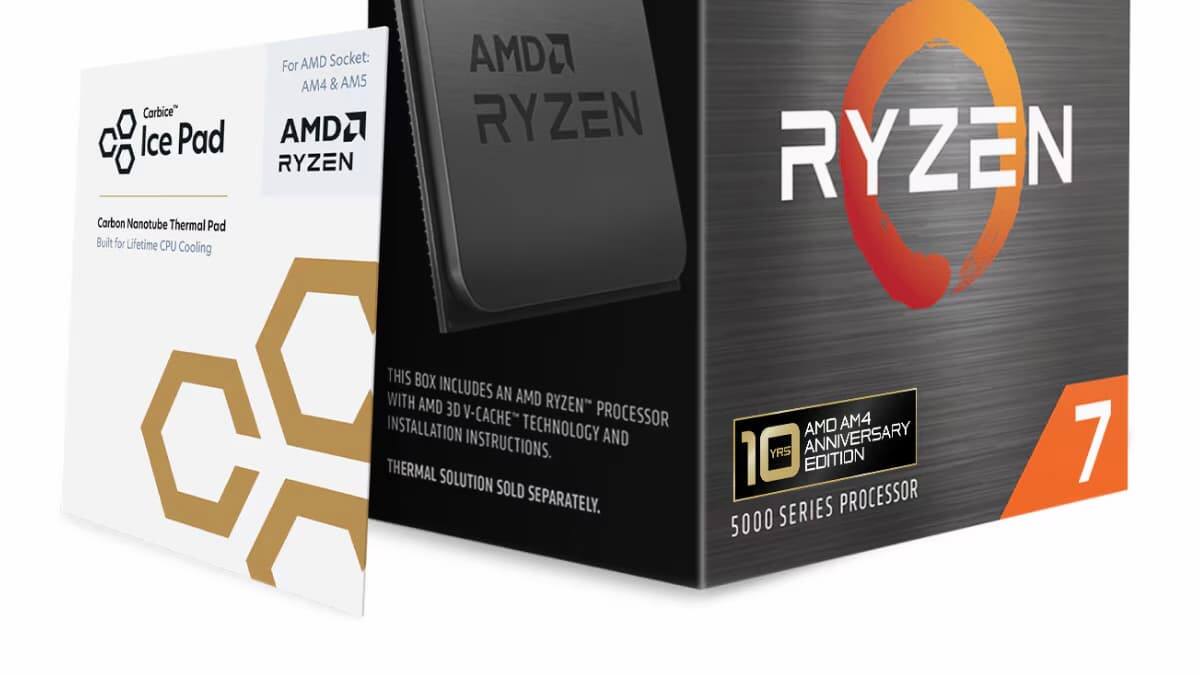
AMD’s Ryzen 7 5800X3D 10th Anniversary Edition barely hit shelves in the US before disappearing, and the secondary market did what it always does: slapped a fat markup on a limited-edition CPU that isn’t actually faster than the original. With retail stock evaporating within minutes, some buyers are now paying up to $750 for a chip that carries a recommended price of $350.
That kind of rush says less about performance than about supply. Anniversary editions and ”limited” hardware tend to trigger the same reflexive scramble, especially when the underlying product already has a reputation among gamers. AMD may have dressed this one up with a revised chiplet connection approach, but the spec sheet is unchanged where it counts.
MicroCenter has the official stock
According to Tom’s Hardware, the processor appeared at retailers only briefly before vanishing again. In the US, the official route is MicroCenter, and even there the chip is sold only in physical stores, not online. That keeps the launch feeling exclusive, but it also makes the product easier to hoard and resell.
MicroCenter is also bundling the CPU with motherboards and RAM, which is a familiar retail move: it helps clear more inventory while giving resellers a convenient way to buy multiple components at once. If some of those bundles are ending up on eBay, that’s not exactly a shocking plot twist.
eBay prices jumped to $750
On eBay, the Anniversary Edition is being listed for $600 to $750. Real sales have already been recorded at $540 and $585, so this is not just wishful asking-price theater. It’s a reminder that scarcity can move hardware prices almost as much as performance does.
- 8 cores
- 16 threads
- Up to 4.5 GHz
- 96 MB L3 cache
- 105 W TDP
Same chip, new packaging, familiar frenzy
Strip away the anniversary badge and this is still the Ryzen 7 5800X3D people already know. That’s the odd part: the frenzy is being driven by collectability and constrained access, not a big leap in specs. The bigger question is whether AMD wanted a celebratory release or a controlled scarcity event. It got a bit of both.
If stock stays this thin, the reseller premium will probably linger until the first wave of eager buyers is satisfied. If more units appear through retail bundles, the flipping game gets riskier fast. Either way, the CPU has already proved one thing: in the right circumstances, nostalgia plus shortage can be worth more than 8 cores on paper.