

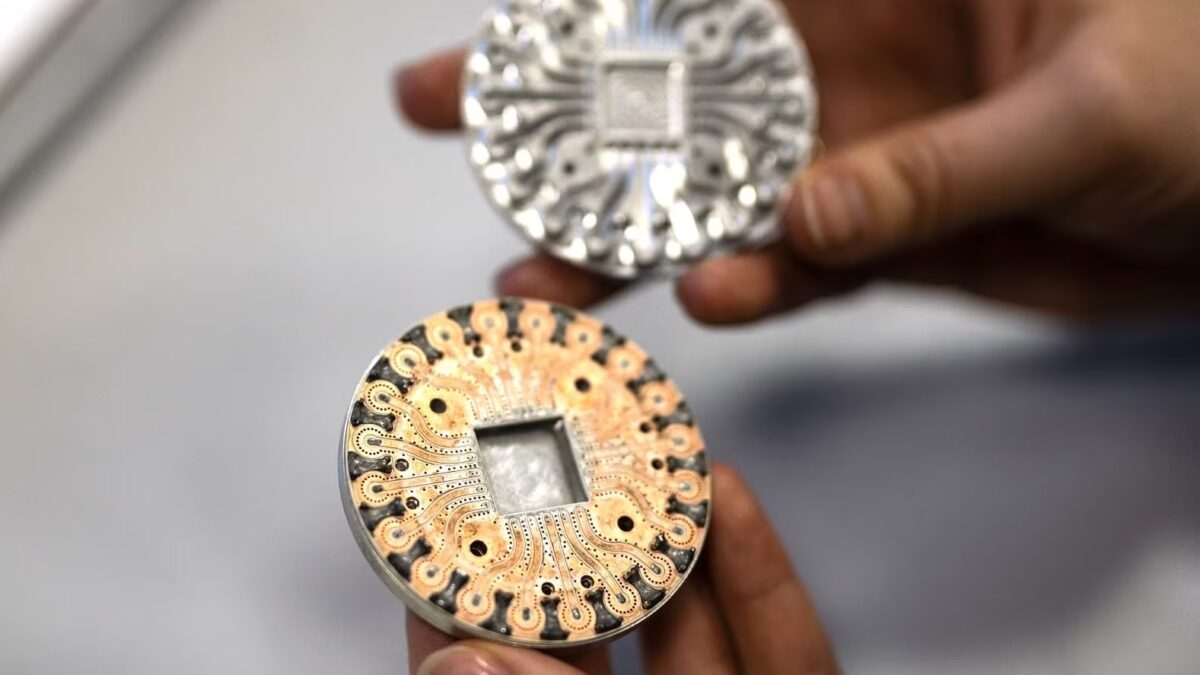
Russian scientists have unveiled a new quantum processor architecture that uses mobile neutral atoms as quantum state carriers to link distant qubits. This design aims to reduce errors that typically accumulate when connecting qubits through chains of stationary atoms-a serious obstacle to scaling neutral-atom quantum systems. The collaborative research involved teams from NITU MISIS, MIPT, Skoltech, the Russian Quantum Center, Moscow State University, and the Steklov Mathematical Institute.
Neutral-atom platforms are among the top contenders for scalable quantum computing, alongside superconducting circuits and trapped ions. They offer the advantage of assembling large, orderly qubit arrays using optical traps. However, connecting qubits separated across the array remains challenging because interactions usually rely on nearest-neighbor coupling, which increases errors and complicates scaling as the system grows. Leading players worldwide in this field include startups like QuEra and Pasqal, as well as Amazon’s AWS Center for Quantum Computing, which actively develops neutral-atom approaches.
In the newly proposed quantum processor architecture, computational qubits stay fixed in a grid of optical traps, while specialized ”courier” atoms physically move between them, directly transporting quantum states. This eliminates the need for multistep, error-prone intermediary transfers. The researchers describe five variants of this concept, differing in how the mobile atoms are maneuvered-ranging from movement within optical traps to free atomic flight combined with quantum teleportation protocols.

Mobile qubit quantum processor design and variants
Among the proposed models, the team considers a bidirectional conveyor-belt scheme most feasible for near-term experimental implementation, citing existing technological groundwork. The study detailing these architectures appeared in the journal Physical Review A.
Challenges in connecting distant qubits with neutral atoms
Quantum computing is expected to become a multibillion-dollar industry by 2035, driven by real-world applications in chemistry, logistics, and materials simulation-fields where quantum advantage could finally show tangible impact. For Russia’s quantum research community, the forthcoming challenge is to test these mobile-qubit architectures in real multi-qubit systems, measuring how well they maintain operational fidelity and coherence times. These performance metrics often mark the transition from elegant theoretical proposals to practical engineering solutions.