

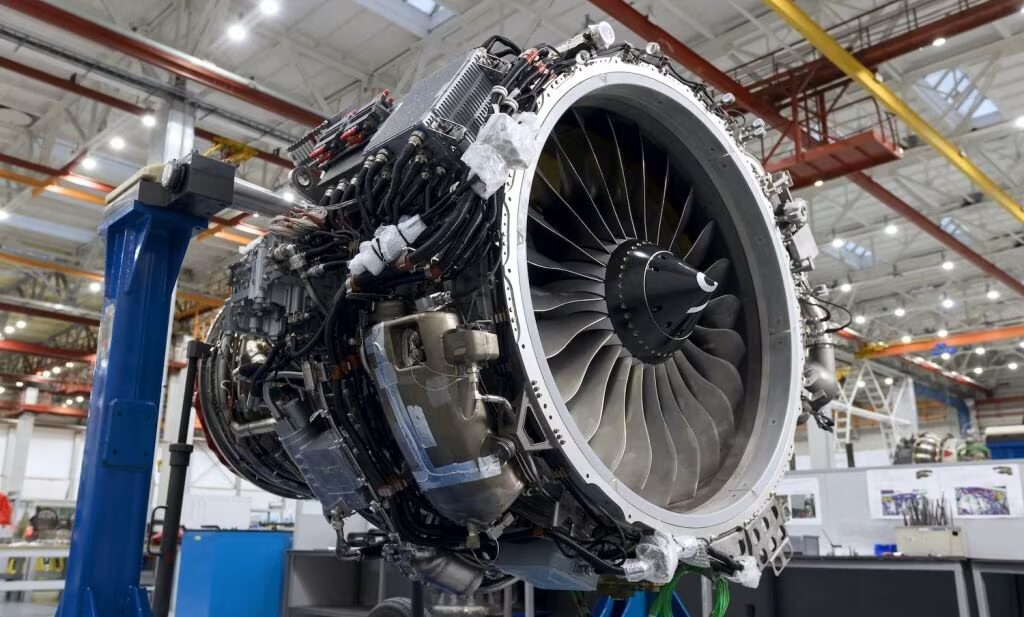
The Russian-made PD-8 aircraft engine, designed to power the domestically sourced SSJ-100 airliner, is set to increase its operational lifespan by more than 20 times by the end of 2026. Anton Alikhanov, head of the Ministry of Industry and Trade, announced the upgrade, adding that the engine will reach its target service life by late 2027.
Currently, the PD-8 is certified with a modest lifespan, but officials plan to extend this figure massively before the year ends. By 2027, the engine’s lifespan should exceed 3,000 flight hours, a key benchmark for the SSJ-100 program. Previously, the Sukhoi Superjet relied on the French-Russian SaM146 engine. However, Western sanctions have pushed Russia to fully localize its engines, making the PD-8 a vital step in import substitution for the aircraft.
The PD-8 received its type certificate in early June 2026, and shortly after, Rostec announced the start of serial production. Developed using technologies from the larger PD-14 engine, the PD-8’s design approach aims to speed up development and certification processes. In commercial aviation, engine lifespan is more than just a specification – longer service intervals mean fewer repairs and lower operating costs for airlines.
PD-8 aircraft engine lifespan and certification milestones
- Type certification obtained: June 2026
- Planned lifespan increase: more than 20-fold by end of 2026
- Target service life: over 3,000 flight hours by 2027
- Start of serial production: shortly after certification
Significance of PD-8 for SSJ-100 and Russian aviation
The PD-8 engine is critical to replacing the previously used SaM146 engine on the Sukhoi Superjet 100, driven by the need to localize production amid Western sanctions. The upgrade enhances the SSJ-100’s competitiveness by improving engine reliability and reducing operating costs. This move also aligns with Russia’s broader strategy of import substitution in the aerospace sector.
PD-8 compared to global aircraft engine leaders
Compared to industry leaders like Pratt & Whitney and General Electric, whose engines typically achieve thousands of flight hours per overhaul, the PD-8 aims to close the gap with its ambitious lifespan targets. Using technology from the PD-14, the PD-8 leverages proven advancements to boost performance and durability.
Future outlook for PD-8 and SSJ-100 fleet operations
The PD-8’s success could play a key role in sustaining and reviving the SSJ-100 fleet. The engine’s performance under extended commercial use will be closely watched to see if it meets the reliability standards required by global aviation markets. Additionally, the development of the PD-8 highlights Russia’s efforts to innovate independently in aerospace technology over the coming decade.