

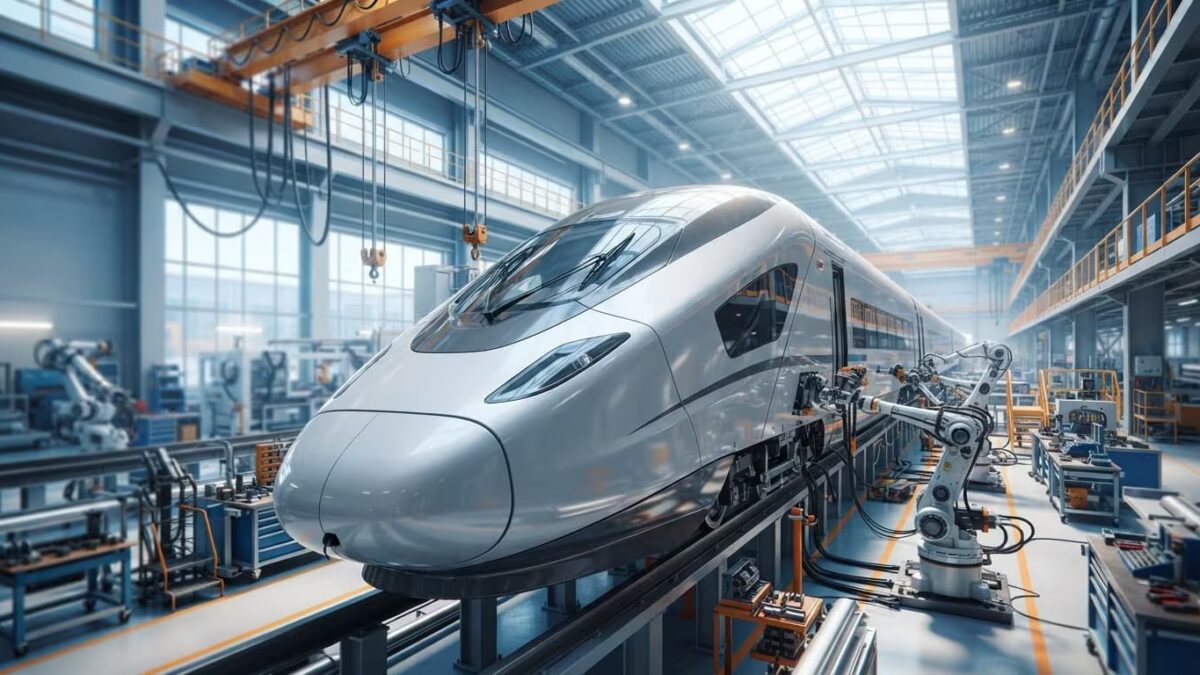
Russia plans to begin assembly of its first 400 km/h high-speed train for the Moscow-St. Petersburg high-speed rail corridor by the end of 2026. Prime Minister Mikhail Mishustin announced the project during the Innoprom-2026 expo, highlighting it as a major step for the country’s railway ambitions.
The train will be built at the Ural Locomotives factory in the Sverdlovsk region, where a new production complex is nearing completion. Five buildings covering 67,000 square meters are about 75% finished. These facilities will handle everything from car body manufacturing and traction system testing to commissioning, alongside design and administrative offices.
Danil Znachkov, Deputy CEO of Sinara-Development, said the site already has installed local wastewater treatment and ventilation systems. They are currently pouring final floor slabs and installing engineering infrastructure. Several prototype components for the train have already been fabricated.
What sets this project apart is the attempt to consolidate the full cycle-from design to rigorous testing-under one roof. For Ural Locomotives, traditionally a manufacturer of modern rolling stock like the Finist electric trains, this marks a significant expansion. The plant is now the lead integrator for Russia’s most ambitious high-speed rail effort.
Meanwhile, construction of the high-speed rail line itself is underway. Regional officials say there is an internal order backlog exceeding 1 million tons of materials-including rails, rebar, bridge steel, and steel cables-already secured for the project. The pilot route will directly link Moscow and St. Petersburg, marking a flagship infrastructure investment.
To put these plans in global perspective: Russia’s current high-speed trains, the Sapsan, max out at around 250 km/h in service. Most European high-speed lines support speeds of 300-320 km/h, while China routinely operates commercial services at 350 km/h. If Russia hits its target of 400 km/h, it will join the rarefied group of countries running ultra-high-speed trains-although actual operating speeds may fall short of the top design speed.
The upcoming assembly and testing phases will reveal how quickly Russia can transition from prototypes to serial production. The project is a bold investment in regional industrial capabilities, focused on the Ural’s existing strength in engineering, metallurgy, and testing infrastructure. Observers will be watching closely to see if this effort pushes Russia closer to the high-speed rail standards already set by global leaders.