• 3 min read
Honor’s Lightning sets a robot half-marathon record in Beijing
Humanoid robots just had their most persuasive public workout yet. In Beijing, Honor’s autonomous runner Lightning won a half marathon in 50 minutes and 26 seconds, beating the fastest recorded human time listed in the s
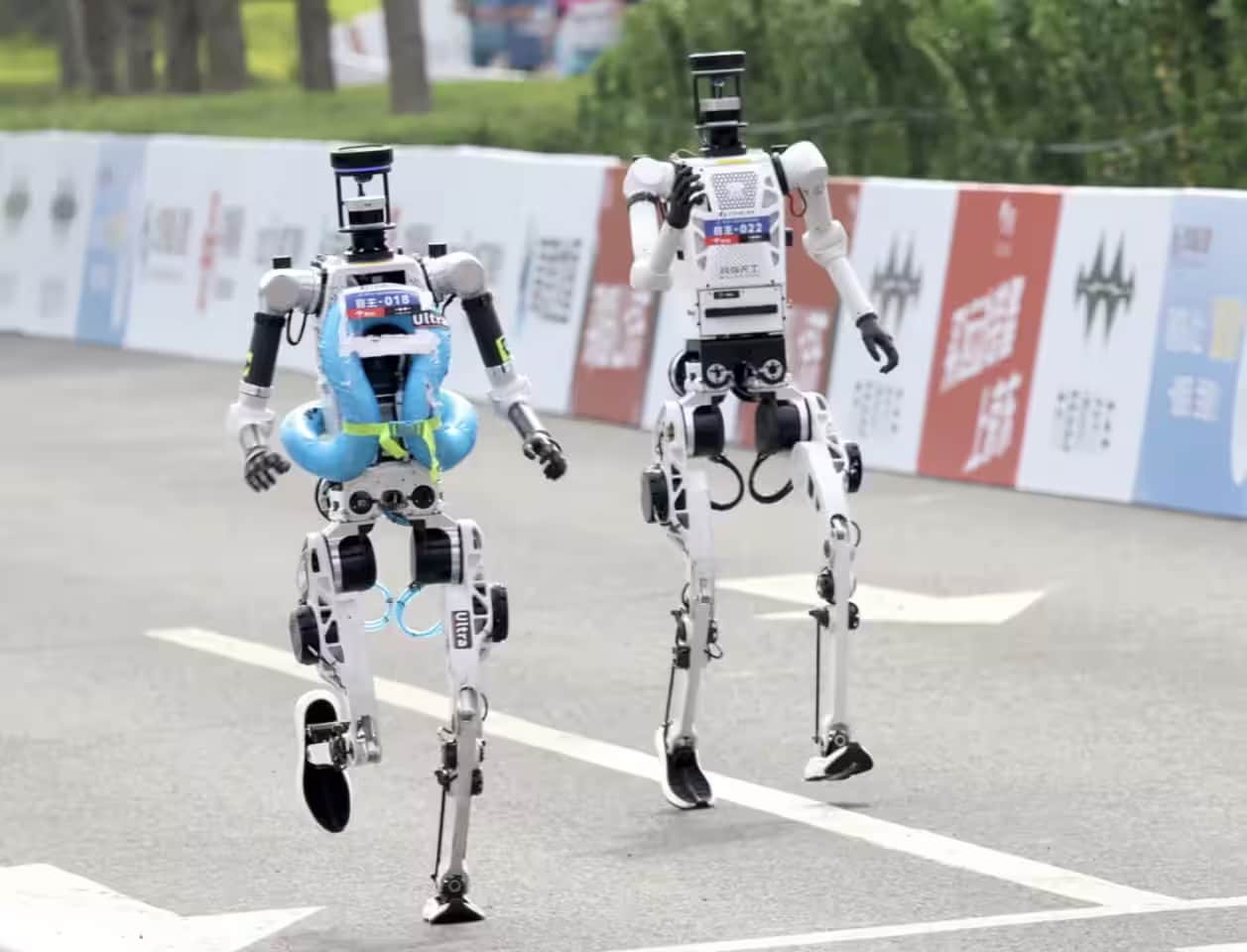
Image: newatlas.com
Humanoid robots just had their most persuasive public workout yet. In Beijing, Honor’s autonomous runner Lightning won a half marathon in 50 minutes and 26 seconds, beating the fastest recorded human time listed in the source and leaving a rival machine in pieces after a spectacularly bad start.
The robot half-marathon record was set in Beijing’s E-Town economic and technological development zone on Sunday, April 19, and it doubled as a tech demo with a stopwatch. More than 100 groups entered their machines, and the top three spots went to robots developed by Honor, a company better known for phones and laptops than for producing endurance athletes with metal knees. That’s the point: China’s humanoid push is no longer about novelty walks and awkward hand waves. It is about speed, balance, and staying upright for 21.1 km.
Lightning’s 50:26 finish and the human benchmark
Lightning stands 169 cm tall and, according to China Daily, uses a peak torque of 400 Nm plus a liquid-cooling system designed to move heat away through channels deep inside the motor. In plain English: this bot is built to keep going, not merely to look impressive on a stage. China Global Television Network’s footage showed it sprinting through the finish-line ribbon like it had somewhere else to be.

Recommended reading
Zinc flow battery runs for 5,128 hours
The comparison that matters is simple. The fastest recorded human time cited in the source is 57 minutes and 20 seconds, which means a robot has now posted a better headline time in a half marathon. Before anyone starts drafting retirement papers for flesh-and-blood runners, there’s an obvious caveat: this was a highly managed event, with navigation assistance from the BeiDou Navigation Satellite System and 5G real-time information. Even so, the speed jump in a single year is hard to ignore.
The race was part engineering test, part slapstick
Not every machine enjoyed a triumphant Sunday. One robot tripped at the starting line and broke apart so thoroughly that its support team had to rush over with a stretcher to collect the scattered parts. Another collided with a barricade near the end but was helped back up and still finished. Robotics has always had this split personality: one minute it’s a polished showcase of national capability, the next it’s a heap of expensive limbs on the road.
That mix of polish and chaos is also what makes these events useful. The winning systems are improving in joint mobility and operational efficiency, the two things humanoids need most if they ever move from stage demos to warehouses, factories, or anywhere else that punishes bad balance. If you were waiting for the moment robots stopped being a joke in sports, this is probably it.
What the Beijing result suggests for humanoid robots
The smarter read is not that robots have “beaten” humans at running. It is that Chinese developers are compressing the timeline from showpiece prototypes to serious endurance machines faster than many observers expected. Honor’s clean sweep at the front of the field, plus the support infrastructure around the race, suggests this is becoming a systems competition as much as a robotics one.
Expect more of this. Once one company shows a robot can hold a steady pace over 13.1 miles, rivals rarely stay interested in waddling around stage demos for long. The next question is whether these machines can keep that speed, survive rougher terrain, and do it without a crew jogging behind them with remote controls and a rescue plan.

Frontier Editor
Dan is our resident futurist, covering electric mobility, space exploration, and the smart home. He's interested in atoms just as much as bits. Whether it's a new battery chemistry, a reusable rocket, or a protocol that finally makes IoT devices talk to each other, Dan breaks down the engineering that pushes humanity forward.
via newatlas.com