

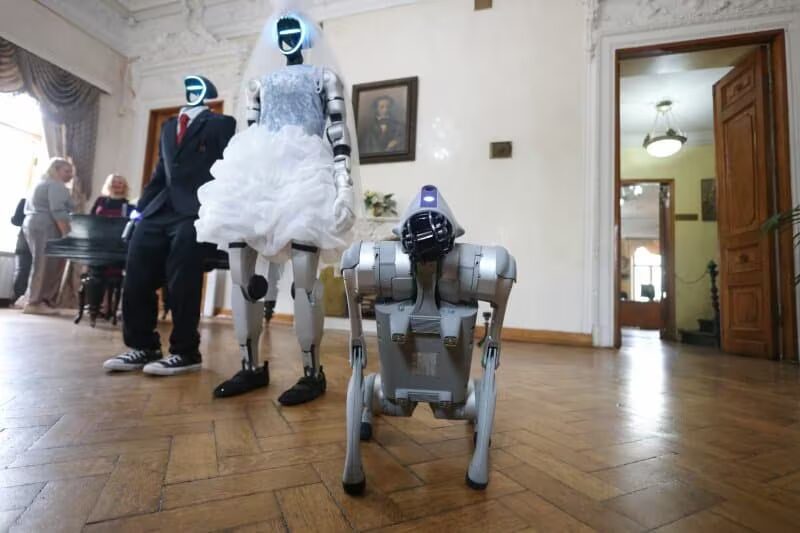
Moscow hosted what may be Russia’s first wedding ceremony between two domestically designed humanoid robots, turning a tech demo into an event held in a library. On July 8, the Day of Family, Love, and Fidelity, the Pushkin Library’s reading hall became the venue where humanoids Robert and Matilda were ”married” under the watchful eye of a registrar.
The ceremony unfolded in the library’s grand halls, with the robots reciting vows via speech synthesis. Instead of traditional wedding rings, they exchanged glowing wristbands carried in by a robotic dog named Dogmatik-a techno twist on a ring bearer. Both robots operate on Russian-developed software and are controlled in real time by operators wearing VR headsets who mimic gestures that the robots replicate.
Robert even demonstrated kung-fu moves while Matilda performed ballet steps during the event. This robot duo previously made appearances as ”cyber stars” at the St. Petersburg International Economic Forum, highlighting their role as showcases of advancing Russian robotics.
Key features of the Russian humanoid robots
- Speech synthesis enabling vocal vow recital
- Teleoperated control via VR headsets
- Humanlike motor skills, including kung-fu and ballet movements
- Russian-developed software and hardware
- Symbolic interaction through a robotic dog ring bearer
The event ended with a symbolic gift from the robotic couple to the library: a collection of books on contemporary technology and artificial intelligence. The venue choice intentionally linked classic culture with new digital ventures, while the date emphasized the ceremony’s connection to Russia’s celebration of family and fidelity-a holiday that has increasingly become a platform for official and urban tech projects alike.
The significance of Russia’s humanoid robot wedding
Though the wedding was largely a staged spectacle, it spotlighted real technological milestones: speech synthesis, teleoperated control, and humanlike motor skills in Russian-built robots. According to Goldman Sachs, the global humanoid robot market could reach $38 billion by 2035. Against this backdrop, such public demonstrations serve as a rare chance for Russian developers to showcase their hardware beyond government and conference audiences.