

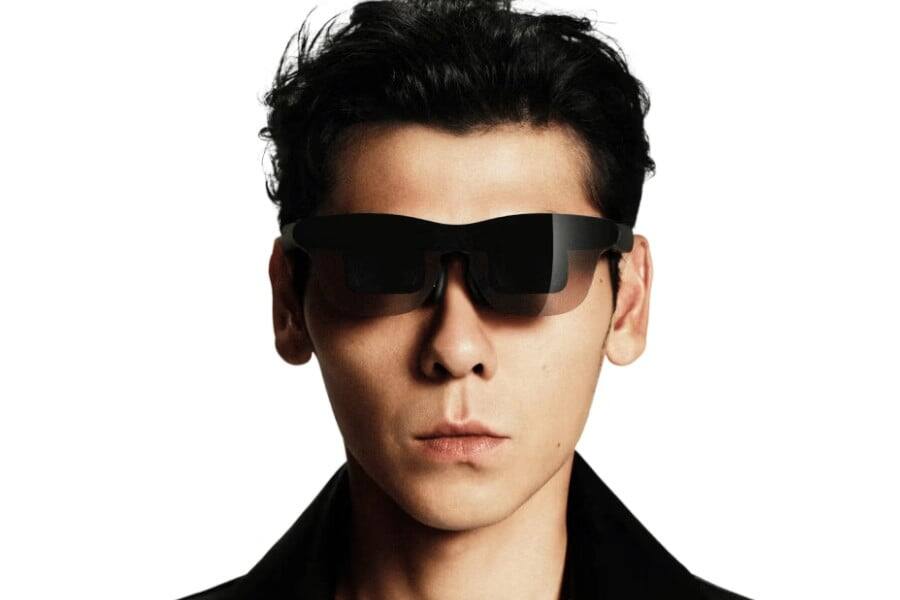
RayNeo has unveiled a pair of flagship AR glasses that try to do three things at once: widen the field of view, improve image quality, and make the whole category feel less like a demo and more like a product. The new RayNeo GT Max leads the charge with a 59-degree field of view, Dolby Vision support, and audio tuned by Bang & Olufsen.
The RayNeo GT Max is also billed as the world’s first AR glasses with Dolby Vision. To use it, buyers will need RayNeo’s Magic Box 2 Dolby Vision Edition, but the company has already lined up support from Youku, Tencent Video, iQIYI, and Bilibili.
That 59-degree figure matters more than the marketing gloss around it. RayNeo says most consumer AR glasses stop at 45 degrees, so the GT Max is aiming for a much larger virtual screen without forcing users to wear something that looks like a prototype from a failed sci-fi prop department.
GT Max optical engine and display upgrades
To get there, RayNeo built a new optical system called the Peacock Optical Engine 3.0 Max, which uses a prism light module and multi-layer reflection technology. The company says the module is 29% thinner than before, even though manufacturing time for each optical module is up 60% and costs have more than doubled. That is the sort of trade-off hardware companies make when they want a spec sheet headline more than a comfortable factory spreadsheet.
The display is a 5.5-generation Micro OLED panel with a dual-layer design for better brightness, color, and contrast. RayNeo says it worked with TCL’s picture quality lab to tune the panel and added a Pure Cinema Mode that aims to preserve creator intent instead of blasting everything with oversaturated colors.
Dolby Vision support and chip features
Inside the glasses are two dedicated chips, the Vision 4000 for image processing and the Zone 360 for spatial calculation. Together, they enable follow mode, spatial fixation mode, and image stabilization, which should make the glasses useful both for couch viewing and for keeping a screen locked in place on a train.
Audio, fit, and the cheaper RayNeo GT
RayNeo also pushed audio harder than many rivals bother to. The GT Max uses custom racetrack-shaped speakers that are 38% larger than standard units, plus a six-magnetic-circuit setup. Bang & Olufsen handled the tuning, and head-tracking spatial audio means the sound shifts as the image moves in space.
The top model weighs 78 grams, down from an 89-gram prototype after six months of trimming. It uses nylon, magnesium-aluminum alloy, and powder metallurgy hinges, supports prescription lenses up to 1,000 degrees of myopia and 800 degrees of hyperopia, and comes in S, M, and L sizes. RayNeo also launched the standard GT, which weighs 68 grams, has a 46-degree field of view, and keeps the dual-chip spatial modes.
- RayNeo GT Max: 2,599 yuan (around $385)
- RayNeo GT: 1,899 yuan (around $280)
- Magic Box 2 Dolby Vision Edition: 999 yuan (around $150)
- Pre-orders are open now
- First deliveries are scheduled for May 30th
The RayNeo GT Max has the specs to make a convincing case for premium AR glasses, but it still has to prove that Dolby Vision, a wider field of view, and better audio are enough to push the category beyond niche gadget status. For now, it looks like one of the most ambitious attempts yet to turn a wearable giant screen into a mainstream product.