

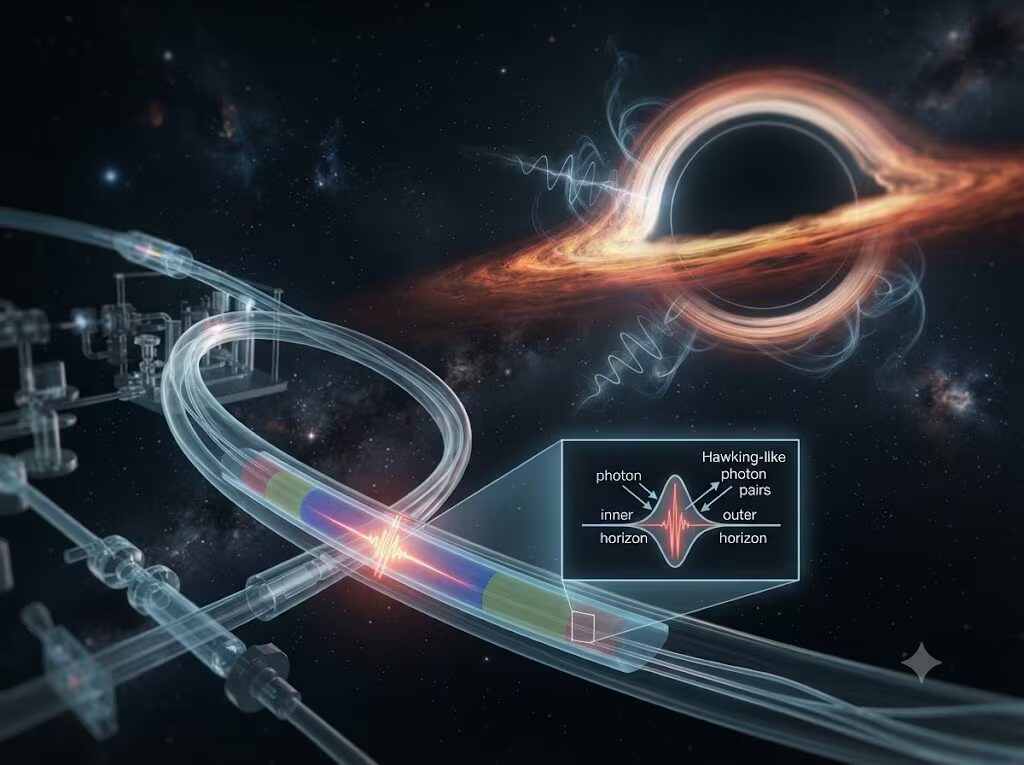
An international team of physicists from Germany, Mexico, and Israel has unveiled a new laboratory model that demystifies Hawking radiation-the faint thermal glow predicted to escape black holes. By simulating event horizon conditions in a nonlinear optical fiber setup, the researchers propose a simpler mechanism behind the elusive radiation than previously thought. If confirmed, this fresh perspective could make studying black hole evaporation far more accessible for both theorists and experimentalists.
Hawking radiation was first predicted in 1974, suggesting that black holes aren’t completely black. Quantum effects at the event horizon cause them to emit a tiny amount of heat, slowly losing mass and energy over time. While elegant, this concept faces a major stumbling block: in space, the signal is so weak it’s effectively drowned out by cosmic noise, making direct observation all but impossible.
To sidestep this, physicists have long turned to lab analogues, recreating the math behind event horizon physics in controlled environments. The new study uses light traveling through a nonlinear optical fiber to mimic quantum fields near an event horizon. Though no actual black hole is involved, this setup allows scientists to test predictions repeatedly and affordably, an impossible feat with distant celestial objects.
The crux of the discovery: the team identified a more straightforward scenario for Hawking-like radiation. Older theories depended on chains of complex quantum interactions and mode couplings. Instead, their data points to a feedback loop between the emitted radiation and its source as the main driver. Lead researcher Lorenzo M. Procopio says this simpler approach could clarify what’s really happening around gravitational objects in space and refine existing theories.
Lab experiments exploring Hawking radiation analogues
Scientists have chased Hawking radiation analogues across various platforms for years-from fluid flows and superfluids to Bose-Einstein condensates. One landmark moment came in 2016, when Jeff Steinhauer’s team reported observing a similar effect in an ultracold atomic gas. While the finding generated excitement, it also sparked debate over data interpretation-highlighting the thin line between ”looks like” and ”proven” in this challenging field.
Optical systems, however, offer distinct advantages for simulating Hawking radiation. They provide precise control over the environment and allow detailed tracking of how the system responds to excitations. Photonic platforms have become a favorite testbed for elusive quantum effects that remain hard or impossible to detect directly in astrophysics. This approach echoes broader efforts to simulate early-universe conditions and cosmological horizons-phenomena too distant, faint, or slow to measure with telescopes.
A key insight from the new work is the recognition of back-reaction-the effect of radiation on its own source. In real black holes, this is where theory gets messy. Emitting quanta affects a black hole’s mass and raises profound questions about how to reconcile general relativity with quantum mechanics. Hawking radiation sits at the heart of this puzzle, linking two fundamental but notoriously incompatible theories.
This study doesn’t claim direct proof of black hole evaporation. Instead, it narrows the field of plausible explanations by spotlighting a simpler feedback mechanism that replicates Hawking radiation’s essential traits. Future experiments can now focus on this specific model, streamlining tests that previously relied on intricate and unwieldy quantum scenarios.
For laboratory physics, this development means greater efficiency in testing Hawking radiation models. For theorists, it offers a chance to trim extraneous complexity that might stem from modeling methods rather than underlying physics.
Interest in experimental Hawking radiation isn’t fading anytime soon. Detecting it from actual astronomical black holes remains practically impossible-especially with supermassive ones, whose Hawking temperature is vanishingly low. For now, the best hopes for understanding black hole evaporation-and for probing the interplay of gravity and quantum mechanics-lie in laboratory analogues. The next challenge will be confirming whether this simplified optical feedback model holds up across other quantum and photonic systems.