

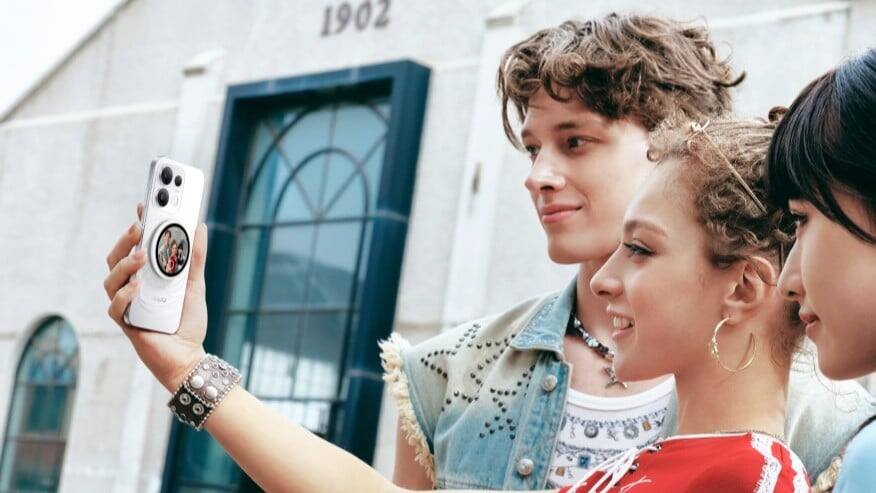
Oppo has turned one of its strangest accessories into something iPhone users can actually buy: the Bubble selfie screen now supports iPhone X and newer models running iOS 15.0 or higher. It keeps the original pitch intact – a tiny rear-mounted AMOLED display that helps you frame selfies with the main camera – but adds MagSafe-style convenience, custom wallpapers, and a bit of fashion-wallet energy for people who want their phone setup to look less boring than everyone else’s.
Pre-orders are open now, with sales set to start on July 6. The Oppo Bubble costs 499 yuan, or roughly $70 to $75. That puts it in the same zone as niche creator accessories, not a mass-market must-have, which is probably fine because this is not a device built for people who say, ”I’ll just use the front camera.” Those people will continue living their lives in low-resolution peace.
What the Oppo Bubble actually does
The Bubble is a small circular AMOLED screen, about 1.73 inches across, that magnetically attaches to the back of the phone. Once connected, it shows a live preview from the rear camera, so you can check framing, lighting, and facial expressions without twisting yourself into an awkward mirror pose.
- Display size: about 1.73 inches
- Battery: 550mAh
- Battery life: roughly 9.66 hours
- Weight: 27.5g
- Thickness: 7mm
- Wireless shutter range: up to 10 meters
That spec sheet matters because accessories like this live or die on convenience. Oppo’s own phones already had the Bubble first, but cross-platform support is the bigger move here: it turns a brand-specific gimmick into something with a wider audience, even if the audience is still very much the ”I want my phone to wear jewelry” crowd.
Why iPhone support changes the pitch
For iPhone owners, the appeal is less about solving a problem and more about making a statement. The Bubble can also store static or animated wallpapers, and Oppo’s ”Mag E-Badge” mode pushes it further into accessory territory, letting users treat it like a mini display, bag charm, or decorative add-on. That puts it closer to fashion-tech than a plain camera tool.
There are already a few similar products around, including Insta360’s Snap, but Oppo is leaning on three things at once: the thin design, the wireless shutter range, and the customization angle. In a market crowded with phone cases, clips, and selfie rigs, those details are what make a product feel less like a prototype and more like something people might actually keep using.
A niche gadget with a broader ambition
Oppo is selling the Bubble in China now and says it is also available in select global markets. The iPhone compatibility makes sense as a next step: Apple users are often willing to pay for accessories that are a little impractical, a little polished, and easy to show off. Whether that turns the Bubble into a real cross-ecosystem hit or just another clever side project will depend on whether people want a rear screen for selfies badly enough to carry one around.