

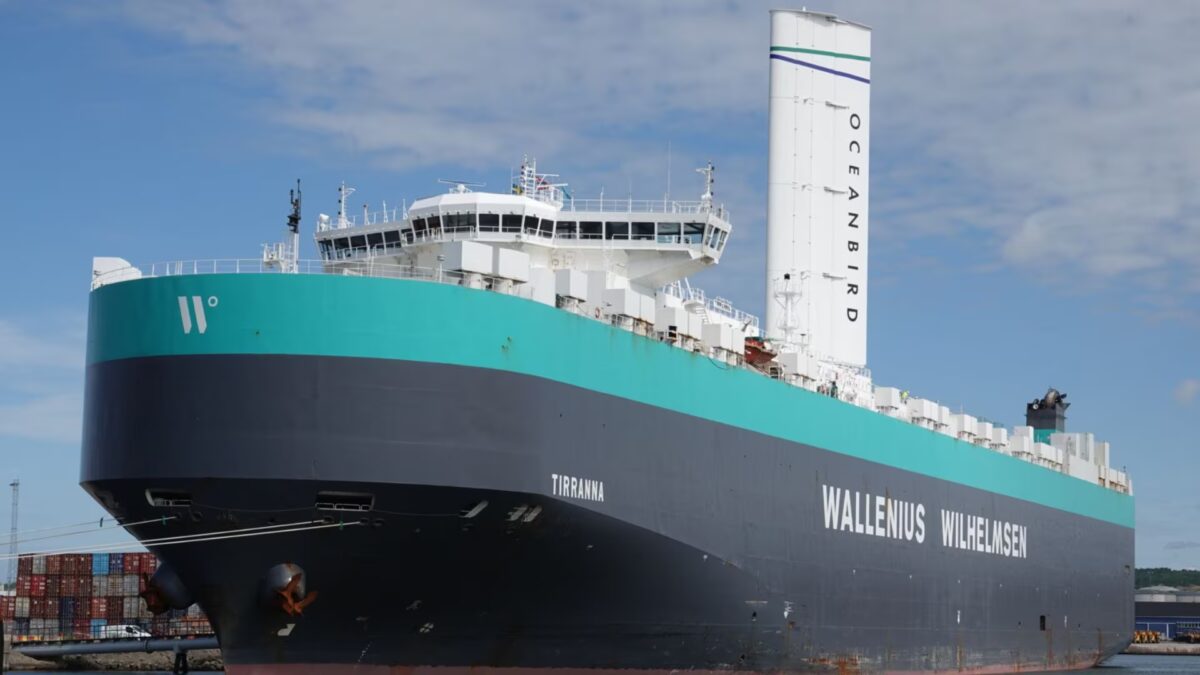
Oceanbird has completed sea trials of its 46-meter-tall rigid Wing560 sail on the 230-meter car carrier Tirranna, which has returned to commercial service. Unlike many experimental setups, this isn’t just a test rig but a large working cargo ship collecting real-world data on wind-assisted propulsion during regular voyages-a rare move in maritime innovation.
The Wing560 functions more like an airplane wing than a traditional sail. Measuring 46 meters high and 14 meters wide, it harnesses wind power to provide additional thrust, reducing the load on the ship’s main engine. This translates directly into fuel savings and lower CO₂ emissions, a simple but effective strategy for greener shipping.
Before installation, the Wing560 was certified by DNV, a leading international maritime classification society. The sail was mounted at Damen’s Rotterdam shipyard, after which Tirranna underwent a series of sea trials to validate performance. Now, with Oceanbird engineers aboard, the ship is back on commercial routes, monitoring how the automated system copes with real weather conditions and integrates with ship controls.
Oceanbird estimates that a single Wing560 can cut fuel consumption by around 10%. With multiple sails installed on a vessel, wind thrust could supply over half of the ship’s power needs-without increasing transit times. For operators, even a few percentage points of savings translate into significant cost reductions over long-haul routes.
The shipping industry accounts for about 3% of global greenhouse gas emissions, according to the International Maritime Organization. Given the slow fleet turnover and the high cost of new builds, wind-assisted propulsion technologies offer a practical path to reducing emissions without requiring a full fleet overhaul. Competitors like Norsepower have already deployed Flettner rotor sails on tankers and bulk carriers, and Michelin is developing inflatable Wing Sail systems. Oceanbird’s approach differs by focusing on large rigid wings integrated into next-generation vessels like the Orcelle Horizon project.
Oceanbird is now moving beyond experimental trials and into commercial validation. If Tirranna consistently delivers the promised fuel savings on scheduled routes, wind-assisted propulsion could move from pilot projects to regular production in the car carrier and heavy cargo sectors-where 5-10% fuel reductions make a serious financial impact.
How the Wing560 rigid sail improves fuel efficiency
The Wing560’s rigid sail is designed to optimize wind propulsion efficiently and reliably. Key features include:
- Height: 46 meters
- Width: 14 meters
- Shape inspired by airplane wings to maximize lift
- Automated control system integrated with the ship’s navigation
- Certified by DNV for safety and performance
These design elements allow the sail to reduce the reliance on the main engine and lower fuel consumption consistently during voyages.
Oceanbird’s testing and commercial deployment plan
The Tirranna vessel, equipped with the Wing560, has completed successful sea trials and resumed commercial service. Oceanbird engineers are collecting data on:
- Fuel consumption reductions
- System reliability in varying weather conditions
- Integration with ship controls for automatic adjustments
- Impact on transit times
Following validation, Oceanbird aims to expand wind-assisted propulsion technology into the broader car carrier and heavy cargo sectors, potentially reducing fuel costs significantly.