

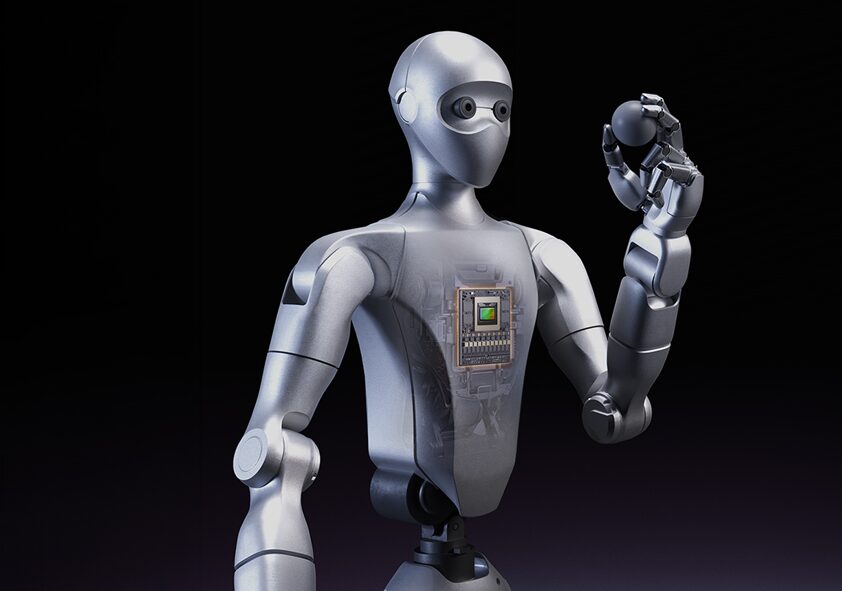
Nvidia has moved from selling the brains for robots to sketching the body itself. The company used Jensen Huang’s Computex 2026 keynote in Taipei to unveil H2+, a humanoid robot reference platform built with Unitree Robotics and Singapore-based Sharpa, and it is aimed at companies that want to build humanoid robots faster rather than buy a finished one off the shelf.
That distinction matters. H2+ is not a retail robot, but a blueprint that bundles hardware, AI models, training tools, and deployment software into one package. In a field where everyone talks about humanoids and very few ship them at scale, Nvidia is betting that standardizing the stack will matter more than flashy demo videos.
What the H2+ humanoid robot platform includes
The platform combines Unitree’s H2 Plus humanoid body, Sharpa’s Wave robotic hands, and Nvidia’s Isaac GR00T AI models. The compute heart is the Jetson AGX Thor T5000, built on Nvidia’s Blackwell GPU architecture, which gives the robot enough headroom to handle more complex tasks on the fly.
- Height: nearly six feet
- Degrees of freedom: 75
- Hand joints: 22 active joints
- AI performance: up to 2,070 FP4 TOPS
- Memory: 128GB
Those specs are aimed at a simple problem with a nasty amount of engineering behind it: humanoids need to perceive, decide, and move in the same loop. Nvidia is trying to own the whole loop, which is a smart move if you’re the company already selling the chips everyone else wants.
Cosmos 3 is Nvidia’s training-data answer
Alongside H2+, Nvidia introduced Cosmos 3, a physical AI world model designed to help robots learn from their surroundings. Huang framed the training-data shortage as one of robotics’ biggest bottlenecks, and Cosmos 3 is Nvidia’s answer: it can interpret both first-person and third-person views to generate robot-centric data for training.
That approach echoes what the company has been doing in autonomous driving and simulation: if the real world is too expensive, slow, or dangerous to learn in, make a better synthetic one. It is also a reminder that humanoid robotics is starting to look less like mechanical design and more like an AI data business with limbs attached.
Nvidia wants humanoid robot partners outside China
Nvidia also said it plans to expand humanoid robot partnerships beyond China, with potential work in the United States, Europe, and South Korea. No partner names were announced, but the direction is obvious: Nvidia wants a global reference ecosystem, not a one-country story.
Security is part of that pitch. The company says future standardized platforms will include features such as Secure Boot and Confidential Computing so only verified software can run on the machines. That is the sort of detail investors and enterprise buyers like to hear, because nobody wants a robot that can be turned into a very expensive prank.
China’s humanoid robot sales could exceed 28,000 units in 2026
The timing is not subtle. Morgan Stanley analysts expect China’s humanoid robot sales to exceed 28,000 units in 2026, which would make it the largest market for the category. That gives Nvidia a ready-made testbed, but it also explains why the company is moving quickly to widen its partner base before rivals lock in their own platforms.
The most likely next step is not a wave of consumer humanoids marching into homes. It is a slower, messier rollout through research labs, industrial pilots, and specialized deployments, where standardized hardware and AI tooling can actually prove they save time. If Nvidia can make H2+ the default starting point, it could end up shaping the robot market the same way its chips shaped AI training: by being everywhere before the final product fully arrives.