

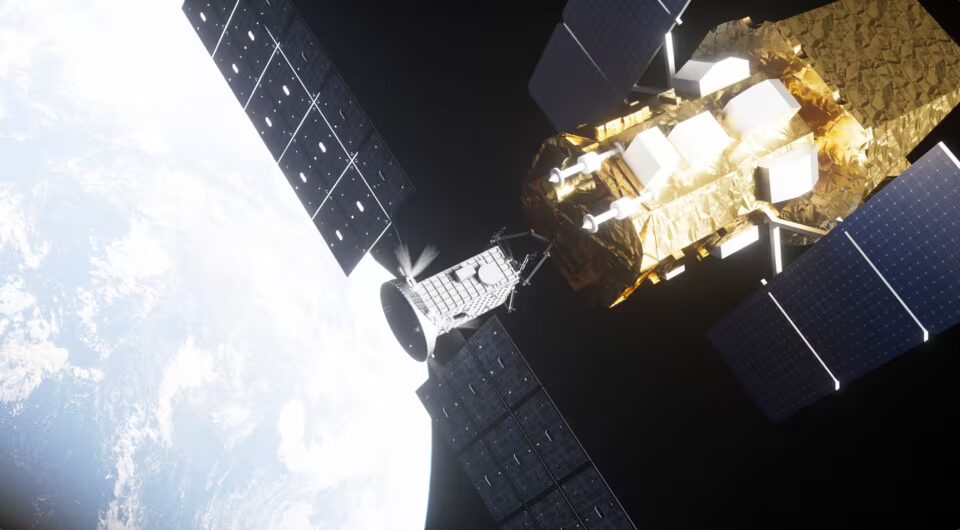
On July 3, Northrop Grumman launched the LINK satellite aboard a Pegasus XL rocket dropped from a Stargazer L-1011 airplane. LINK’s mission is to rendezvous with NASA’s aging Swift space telescope and use robotic arms to raise its orbit by at least 300 kilometers, extending the observatory’s lifespan beyond its current precarious altitude.
Swift, which has been circling Earth since 2004, has deteriorated to an orbit so low that atmospheric drag now threatens to pull it down within months. To conserve fuel and buy time for the upcoming docking, Swift temporarily suspended scientific observations. LINK’s goal is to catch up with Swift by fall 2026, secure it with three manipulators, and lift it to a higher orbit where atmospheric resistance is less of a concern.
Swift is one of the longest-serving astrophysics observatories in low Earth orbit, primarily designed to detect gamma-ray bursts and observe their afterglows. Over its two decades in space, it has also studied supernovae, kilonovae, and black hole binaries. Losing Swift due to a drop of just a few dozen kilometers in altitude would be a costly blow for NASA, both scientifically and financially.
LINK’s mission represents a rare example of in-orbit satellite servicing outside the commercial sector. While Northrop Grumman successfully docked servicing vehicles MEV-1 and MEV-2 with Intelsat satellites in geostationary orbit in 2020 and 2021, similar operations for scientific observatories are nearly unheard of. Since the Space Shuttle program ended in 2011, the US has lacked a routine method for ”field repairs” or orbital upgrades of major observatories like Hubble or Swift.
The choice of Pegasus XL as the launch vehicle also stands out. Unlike most rockets, Pegasus XL is an air-launched rocket, released midair from a carrier aircraft. This method provides launch flexibility in terms of location but limits payload capacity, keeping Pegasus in a niche category with infrequent missions.
For context, air-launched rockets like Pegasus offer nimble deployment options compared to traditional ground launches but carry smaller payloads. In contrast, larger rockets like SpaceX’s Falcon 9 or ULA’s Atlas V handle heavier satellites but operate from fixed launch sites. LINK’s deployment via Pegasus fits its specialized mission profile, emphasizing precision and adaptability over raw power.
The success of LINK’s docking and orbit boost could buy NASA months or even years of additional operation for Swift, depending on the final orbit achieved and how efficiently fuel is used. The critical moment will arrive this fall, when it becomes clear whether this one-off satellite servicing mission can save a telescope that has been continuously observing the cosmos for more than 20 years.
If successful, LINK could set a precedent for extending the life of other aging scientific satellites in low Earth orbit, showing that satellite servicing doesn’t have to be limited to commercial or geostationary platforms. With the growing constellation of scientific instruments in orbit, the ability to refuel, reposition, or repair them could become an increasingly vital tool in space operations.