

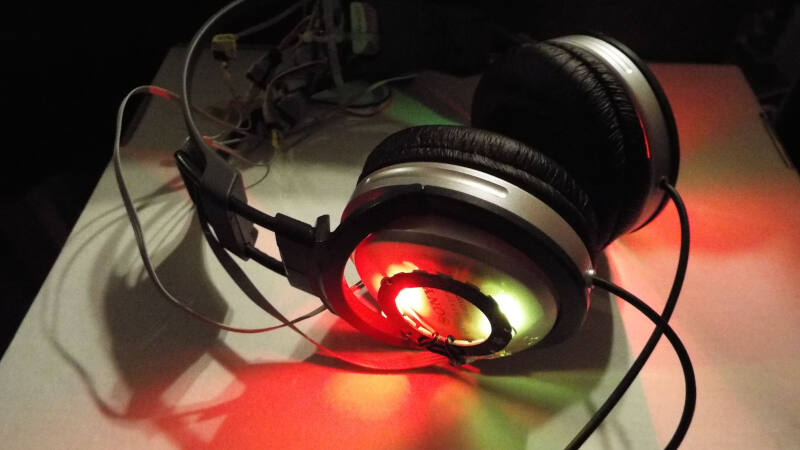
Most noise-cancelling headphones treat the city like an enemy and your battery like a hostage. Alessandro Sgarzi’s answer is delightfully perverse: harvest the city’s ambient noise to power the cancellation circuit itself, turning racket into runtime for a project entered in the 2026 Green Powered Challenge.
The setup uses a sheet of piezoelectric film feeding an LTC3588-1 power-harvesting IC and a pair of supercapacitors. An STM32L011K4T6 microcontroller handles input from a MEMS microphone, then drives a low-power class D amplifier. The whole circuit reportedly sips just 1.7 nW, which is absurdly little power for something living in a loud urban environment.
Piezo film, supercapacitors and a very patient microcontroller
The hardware stack is the sort of thing that makes battery designers twitch: piezo film for scavenging, supercapacitors for buffering, and a low-power STM32 doing the orchestration. That combination is a familiar pattern in energy-harvesting projects, but the twist here is the load itself. Noise cancellation is usually a constant drain, so making it self-powered from ambient sound is a neat bit of engineering theater that also happens to make sense.
- Energy source: piezoelectric film harvesting ambient city noise
- Power management: LTC3588-1 harvesting IC
- Storage: a pair of supercapacitors
- Controller: STM32L011K4T6 microcontroller
- Audio path: MEMS microphone and low-power class D amplifier
The wired headphone comeback nobody expected
Audio still arrives through a traditional 3.5 mm connector, which is either charmingly retro or the only sensible way to keep the power budget under control. Wireless earbuds may dominate store shelves, but they also burn through batteries and rely on radios that are not exactly stingy. Here, the cable is doing the honest work while the city pays the electricity bill.
The broader trend is easy to spot: energy-harvesting gadgets keep getting more practical as ultra-low-power chips become less fussy. Projects like this rarely replace mainstream products overnight, but they do show where the clever engineering is headed. If you want a shot at the 2026 Green Powered Challenge yourself, you probably should not wait until the deadline notices start sounding louder than the headphones.