

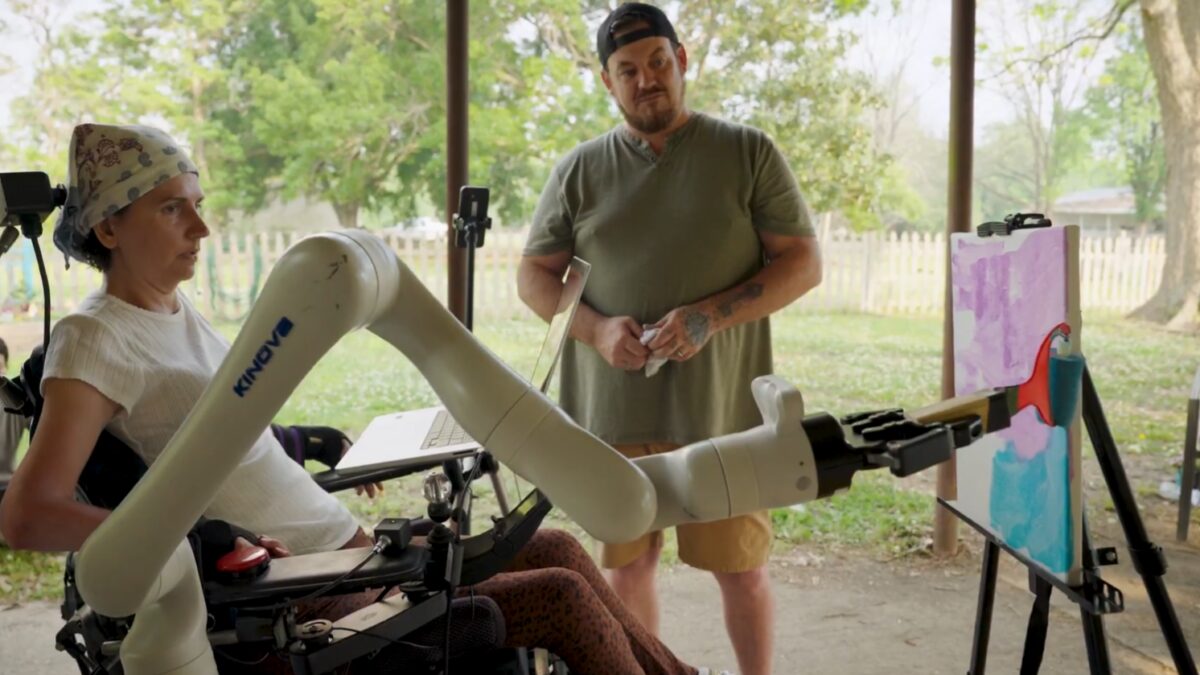
A woman identified as Audrey is drawing again after more than two decades of paralysis, and she is doing it with brain signals instead of hands. Neuralink says she is the first woman in its clinical program, making her case one of the clearest examples yet of how a brain-computer interface can be used for more than a tech demo.
According to the company, Audrey lost movement from the neck down after a severe accident and had assumed art was gone for good. Now the implant translates neural activity into commands that can move a computer cursor, control a robotic arm holding a brush, and let her create digitally without physical input. That is a big leap from the usual ”mind control” headline bait.
How Neuralink’s brain-computer interface is being used
Neuralink’s system sits in the broader field of brain-computer interfaces, or BCI, which aim to convert brain activity into actions on external devices. In practical terms, that means someone who cannot move a limb can still manipulate software, and in Audrey’s case, even guide a robotic hand with a brush attached.
- Controls a computer cursor with brain signals
- Moves a robotic arm with a brush
- Supports digital drawing without using the hands
Why this case matters for Neuralink
Neuralink, founded by Elon Musk in 2016, has positioned itself as a company building implants for people with paralysis and, more broadly, for neurological conditions. The company has also said it is working toward mass production of its chips in 2026, which is the kind of timeline that sounds bold right up until regulators, manufacturing, and biology all get a vote.
There is also a second product in the pipeline: Blindsight, a chip meant to bypass damaged eyes and optic nerves and send visual signals straight to the brain’s visual cortex. If that sounds ambitious, that’s because it is – and it’s exactly why stories like Audrey’s matter. They are the rare cases where a futuristic promise briefly looks less like hype and more like a prototype of daily life.
The bigger bet behind brain-computer interfaces
Neuralink is not alone in chasing brain-computer interfaces. Other neurotechnology firms have been pushing similar systems for years, but Musk’s company has a talent for turning a niche research field into a mainstream spectacle. That can be useful, because attention tends to attract funding, patients, and rivals – all of which accelerate the pace of development.
The open question is whether these implants stay impressive one patient at a time or become reliable enough to scale beyond headline-making demonstrations. For now, Audrey’s digital artwork is a tidy answer to a hard question: what does recovery look like when movement comes from thought alone?