

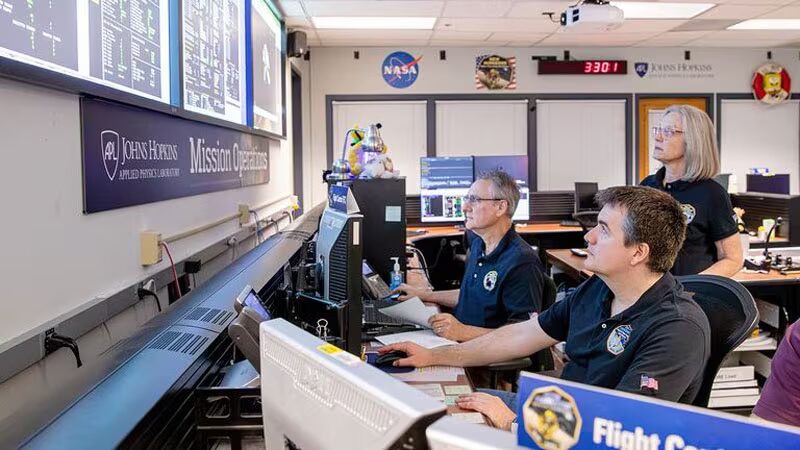
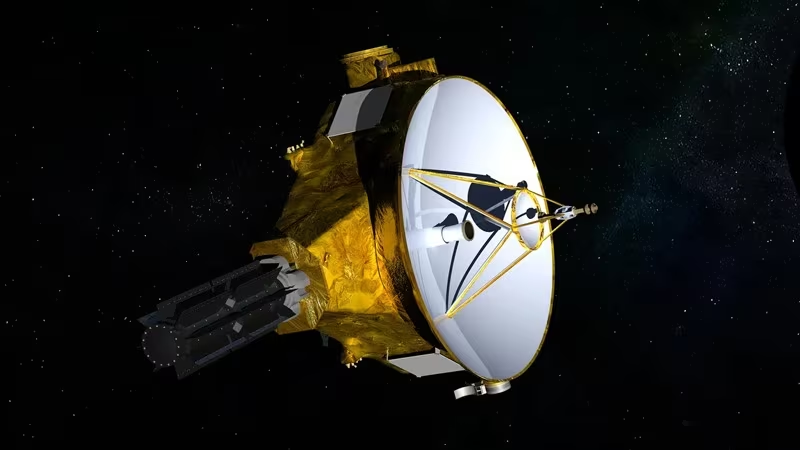
NASA has successfully brought its New Horizons spacecraft out of hibernation following its longest-ever sleep cycle-321 days-while the probe drifted roughly 9.5 billion kilometers from Earth. This routine wake-up, confirmed on June 23 via NASA’s Deep Space Network (DSN) antenna near Madrid, marks a key phase as the mission continues its journey through the far reaches of the solar system.
It took the wake-up signal 8 hours and 52 minutes to reach Earth, a reminder of the staggering distances involved in interplanetary missions. The DSN station in Madrid received the signal, a routine but patience-testing process given the sheer scale of the solar system.
Unlike a full shutdown, New Horizons’ hibernation mode powers down non-essential systems to conserve resources during long cruise phases but maintains autonomous control and ongoing scientific operations. During this extended sleep, the spacecraft transmitted weekly ”heartbeat” signals to confirm vital systems were functioning within normal parameters.
Even in hibernation, New Horizons kept its scientific instruments busy. The plasma detectors SWAP and PEPSSI continued monitoring the space environment, while the Venetia Burney Student Dust Counter measured interplanetary dust particles. After the wake-up, mission engineers will first download telemetry on spacecraft health before retrieving the scientific data gathered during the dormant period.
About three weeks post-wake-up, the ultraviolet imaging spectrograph Alice will be reactivated to study hydrogen distribution in the distant heliosphere-the boundary where the solar wind weakens and interstellar space begins. Meanwhile, engineers will conduct thorough system checks and test updated onboard software designed to optimize mission operations for the years ahead.
New Horizons mission timeline and milestones
New Horizons launched on January 19, 2006, aboard an Atlas V 551 rocket. Weighing about 478 kilograms, the spacecraft is powered by a radioisotope thermoelectric generator, which provides reliable energy far beyond the reach of sunlight-a critical enabler for its deep space voyage. In 2007, it gained a gravity assist from Jupiter, accelerating toward its primary target: Pluto.
In July 2015, New Horizons became the first mission to conduct a close encounter with Pluto, delivering unprecedented insights into the dwarf planet’s surface and atmosphere. The mission’s next milestone occurred on January 1, 2019, when it flew past Arrokoth, a Kuiper Belt object located even farther out. That flyby transformed the mission into an extended journey studying the outer solar system, beyond its initial ”Pluto mission” label.
Currently, New Horizons is over 60 astronomical units (AU) from the Sun. While impressive, this is only about half the distance Voyager 1 traveled before crossing into interstellar space at roughly 121 AU. This means New Horizons remains a valuable tool for probing the outer heliosphere-not quite the interstellar frontier but the solar system’s outer edge where the solar wind fades.
From an engineering standpoint, New Horizons presents an ongoing challenge. As it ventures farther, communication delays lengthen and power supplies from the radioisotope source gradually decline. NASA continuously upgrades ground software and autonomous systems to manage these constraints and ensure the probe optimally balances scientific instrument activity and communications.
Testing of updated ground software will continue through the end of 2026, with Alice’s new observations starting in the coming weeks. NASA aims to maintain New Horizons’ scientific mission into the 2030s-a remarkable feat for a spacecraft launched two decades ago and a testament to careful mission design and management.
In comparison, NASA’s Voyager probes pioneered deep space exploration decades earlier but are no longer operational as scientific platforms. New Horizons bridges the gap between those early pioneers and the future of outer solar system exploration, providing fresh data as we push ever farther from home.
With decades of operations behind it and still years of scientific work ahead, the critical question is how well New Horizons can stretch its dwindling energy and aging systems to deliver new discoveries in a region of space still full of mysteries.