

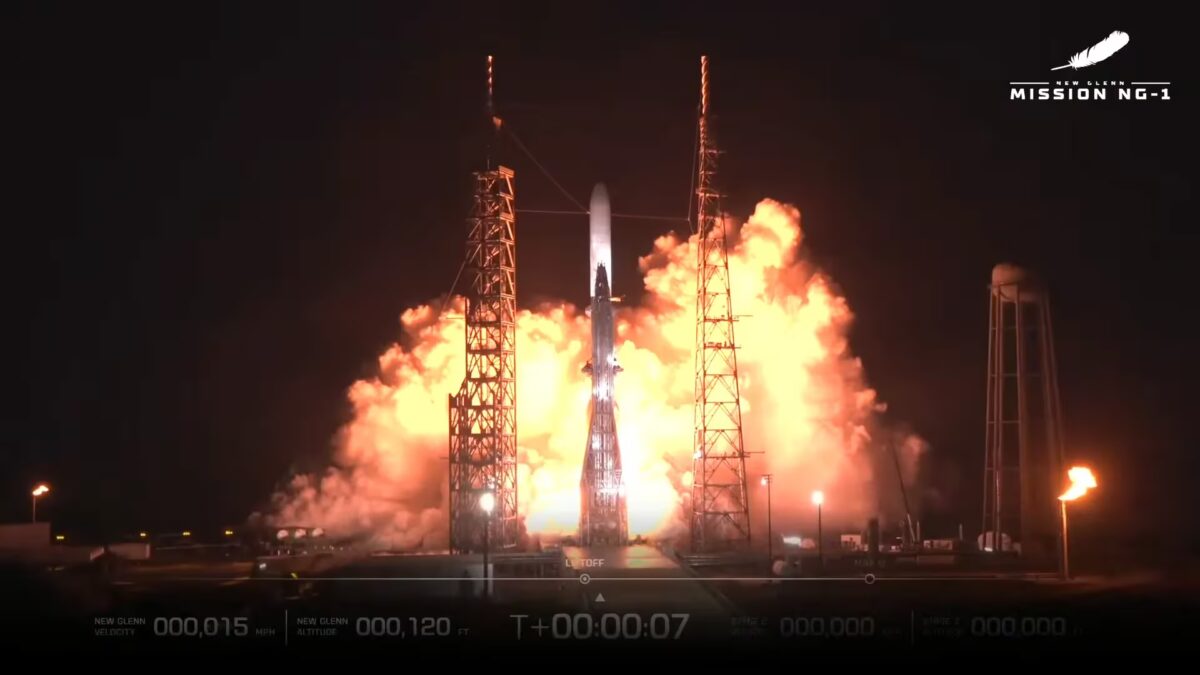
NASA has released a preliminary report on the May 28, 2026 explosion involving Blue Origin’s New Glenn rocket, attributing the powerful blast during a static fire test to issues with the rocket’s BE-4 engines. Jared Isaacman, head of NASA, confirmed the incident impacts a high-stakes program tied to both commercial launches and future NASA missions, marking a setback for Jeff Bezos’ company.
Isaacman revealed that NASA experts have been involved in investigating the incident from day one, assisting Blue Origin in pinpointing the root cause. The company is currently focusing on diagnosing potential problems in the propulsion system. Isaacman expressed optimism about a rapid repair of the launch pad and a swift return of New Glenn to testing.
The explosion occurred during a static fire test and was so intense that media reported seeing the flash from nearly 190 kilometers away. For a heavy-lift vehicle like New Glenn, this is one of the most significant ground-test failures in recent years. Blue Origin positions New Glenn as its main competitor to SpaceX’s Falcon Heavy and as a key workhorse for upcoming Pentagon and NASA heavy launches.
New Glenn rocket engine issues and their impact
New Glenn is a heavy-class rocket powered by seven BE-4 engines on its first stage. Engine troubles with the BE-4 aren’t new for Blue Origin. Previous delays with these engines have also pushed back the schedule for the Vulcan rocket developed by ULA, which relies on Blue Origin’s engine supply. If engine failure is confirmed as the cause of the explosion, the repercussions could extend well beyond a single failed test.
Potential delays in NASA’s lunar program
According to Politico, this incident could delay Blue Origin’s involvement in NASA’s lunar program by roughly a year. This holds particular significance as NASA has already awarded major contracts to several providers: SpaceX is handling the crewed Starship lander for Artemis III, while Blue Origin is developing its Blue Moon lander for subsequent lunar missions.
Upcoming challenges and market competition
Blue Origin now faces two critical milestones:
- Concluding the investigation
- Conducting the next static fire test on the repaired launch pad
If repairs and engine checks drag through much of 2026, the company risks falling further behind SpaceX in the heavy-launch sector. Industry analysts forecast strong growth in this market segment, fueled by military contracts, satellite constellations, and lunar exploration.
Blue Origin’s engine troubles highlight ongoing challenges in the competitive heavy-lift launch market, where reliability and timing are key. With SpaceX firmly ahead, how Blue Origin manages its recovery and engine development will determine whether New Glenn can still stake a serious claim in the years to come.