

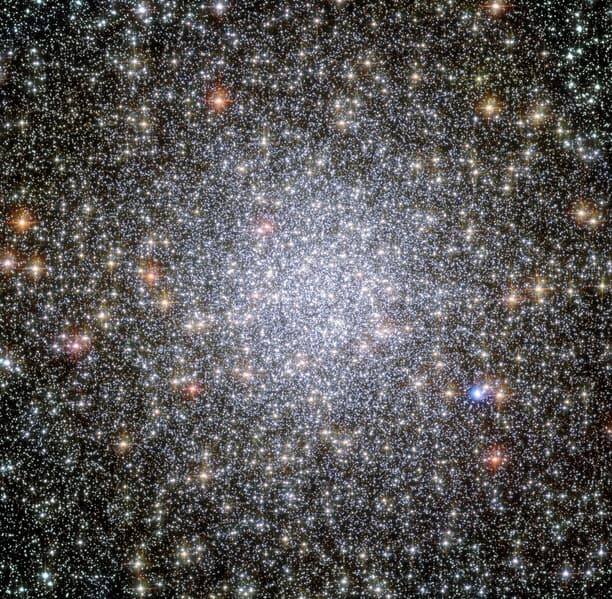
A radio telescope in South Africa has pushed one of astronomy’s favorite crowded neighborhoods into a new phase of scrutiny. Using MeerKAT, the TRAPUM collaboration has found 15 new millisecond pulsars in the globular cluster 47 Tucanae, lifting the known total there from 27 to 42 and ending a long stretch in which the system seemed to have stopped yielding surprises.
The MeerKAT pulsar discovery in 47 Tucanae is bigger than a tidy catalog update. In a cluster this dense, every new pulsar becomes a timing probe, a traffic camera, and a clue to how stars interact when they are packed absurdly close together.
MeerKAT’s sensitivity opened the door
The breakthrough came from MeerKAT’s L-band and UHF-band sensitivity, which let researchers catch signals down at microjansky levels. That matters because weak pulsars in a bright, noisy cluster core can easily disappear in the statistical fog.
To separate real sources from orbital smearing and background clutter, scientists used coherent beamforming, the accelsearch algorithm, and the SeeKAT localization method. The combination gave them enough spatial precision to confirm not only fresh discoveries but also older ”ghost” sources that had hovered in the data as maybes rather than certainties.
Binary systems dominate the new haul
Of the 15 new pulsars, 12 are in binary systems, pushing the binary fraction in the cluster to 69%. That is a handy reminder that globular clusters are not static star balls; they are collision-rich environments where close encounters can swap partners, tighten orbits, and leave behind odd little systems with excellent timing signatures.
- Total known pulsars in 47 Tucanae: 42
- Newly found millisecond pulsars: 15
- New binaries among them: 12
- Binary fraction in the cluster: 69%
One standout is 47 Tuc af, a ”black widow” pulsar with an orbital period of just 1.62 hours. Systems like that are the cosmic equivalent of a slowly eaten lunch: the pulsar’s radiation strips material from its companion until the star is shredded down to a remnant.
The same work also pinned down the link between 47 Tuc af and the optical source W34 opt, which had been sitting in Hubble data since 2002 without a clean explanation. Another object, 47 Tuc ai, is stranger still: it has the longest spin period in the newly highlighted group at 13.03 ms and an orbital eccentricity of 0.18, unusually high for a cluster where interactions typically circularize orbits over time.
Old Parkes data helped prove the faintest sources
Interstellar scintillation made the search harder, because some pulsars only flashed into view intermittently when propagation effects briefly boosted their signals. To nail them down, the team turned to 15 years of archival observations from the Parkes telescope and used the MeerKAT-derived ephemerides to recover signals that had previously been dismissed as noise.
That is the sort of unglamorous reprocessing that often pays off in radio astronomy. New hardware gets the headlines, but old data with better parameters can quietly cough up the missing pieces.
47 Tucanae becomes a richer timing laboratory
With a larger pulsar population, researchers can map the cluster’s gravitational potential more precisely and estimate the density of ionized gas inside it. Compare that with systems such as Terzan 5 in the Galactic bulge, where conditions are even more favorable for unusual binaries, and 47 Tucanae starts to look less like a finished case study and more like a benchmark for cluster dynamics.
Further observations are planned in 2026, and the next step is obvious: measure proper motions, refine accelerations, and use the pulsars to test models of mass distribution and strong-field gravity. If the cluster keeps revealing this many surprises, the old assumption that 47 Tucanae was already well understood may age badly.