

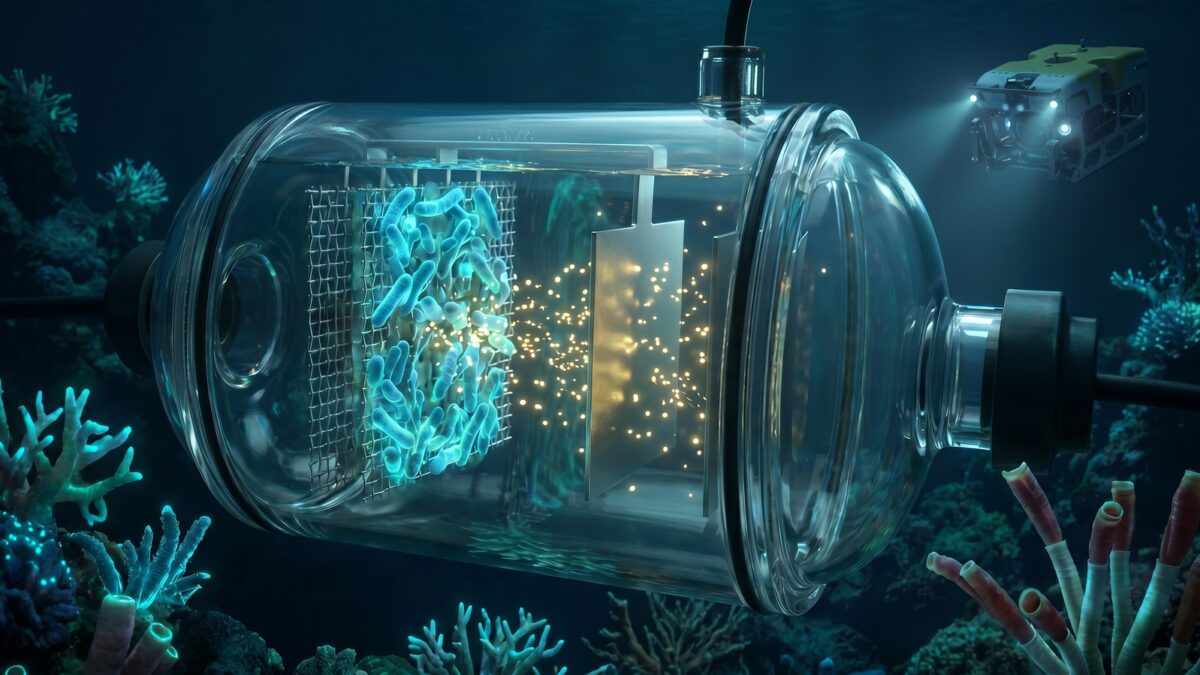
Researchers at Michigan Technological University are trying to do something oceans have been refusing to do for decades: pay for their own surveillance. Their underwater microbial fuel cells are designed to power marine sensors using organic material already dissolved in seawater, a concept now being pushed through DARPA’s BLUE program for long-lived, battery-free undersea systems.
The pitch is simple: let bacteria do the work. As they break down organic compounds, they release electrons, and the system captures that flow as electrical current. That avoids the classic pain point of underwater sensing – hauling batteries back to the surface for replacement, which is expensive, slow, and a little too maritime for modern robotics.
How the microbial fuel cells work
Microbial fuel cells are not new, but the ocean is a tougher customer than wastewater. Seawater contains far less organic material, and oxygen levels can interfere with bacterial activity. The Michigan Tech team says it addresses both problems with granular activated carbon inside tubular cells, which concentrates organic matter, gives bacteria a surface for biofilms, and improves electricity generation even in oxygen-rich water.
- Bacteria convert organic material into electrons
- Granular activated carbon helps capture more of that material
- Biofilms form on the carbon surface and boost output
- The system is meant to run without a separate fuel supply
Early sea tests have already lasted about 30 days
The prototype has been tested in the real world, which is where these schemes usually stop being cute. In Chesapeake Bay, the system operated underwater for about 30 days while continuing to produce electricity. In Galveston Bay, a modular version was trialed with four blocks, and three of them successfully generated power.
That is still a long way from replacing conventional batteries, but the direction is obvious. If the technology scales, it could support underwater environmental monitoring, acoustic sensor networks, and other low-power systems that need to sit in place for months instead of begging for a maintenance visit.
The next test aims for year-long autonomy
The next step is a larger trial in Chesapeake Bay using 10 microbial fuel cells, with researchers trying to find out whether the setup can handle truly long-duration autonomous operation for up to a year. That is the real prize here: not flashy peak output, but boring endurance, which is exactly what underwater sensing needs and exactly what batteries are worst at delivering.