

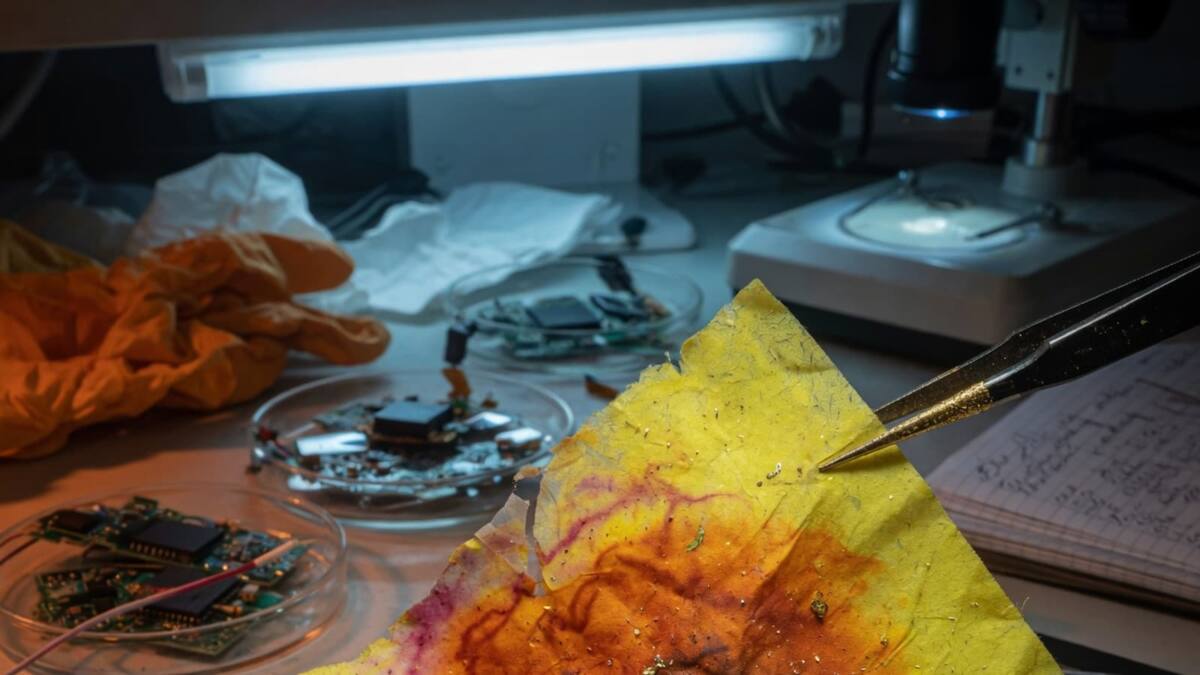
South Korean chemists say they have found a cheap, cleaner way to pull gold out of old gadgets and industrial waste, using ordinary rice paper as the base material. The pitch sounds like science fiction with better margins: a low-cost food product that could replace pricier petrochemical sorbents and recover most of the metal trapped in electronic scrap.
The work comes from a team led by Lee Jong-hyeon at Korea University in Seoul. If the rice paper gold extractor scales outside the lab, it could give recyclers a more accessible tool at a time when e-waste keeps growing and gold-rich components are increasingly expensive to recover with conventional processes.
How rice paper becomes a gold sponge
The process starts with starch-based rice paper, chosen for its porous structure. Researchers soak it in sodium iodate solution and then treat it with hydrazine, turning the paper into a yellow, highly effective sorbent.
Once the modified paper meets acid-dissolved electronic waste, it pulls in gold ions and gathers them into nanoparticles measuring 500 to 1,500 nanometers. The paper gradually shifts to a dark orange color, which is a handy visual cue that the metal grab is working.
98% gold recovery and a simple final step
According to the experiments, the method extracted about 98% of the gold from tested samples. That is the sort of number industrial recyclers pay attention to, because small gains in recovery can matter more than flashy chemistry.
There is also a bluntly simple end stage: burn the paper, and the metal is left behind as clean particles. The researchers say the chemical costs were well below the market value of the recovered gold, which is exactly the kind of spread that makes recycling tech interesting instead of merely academic.
Why this rice paper gold extractor could help e-waste recycling
Gold recovery is a crowded field, with companies and labs chasing cheaper ways to mine value from discarded phones, circuit boards, and other electronic debris. Most existing approaches still rely on materials and processes that are either expensive, energy-hungry, or awkward to scale; a paper-based sorbent is unusual precisely because it is so unglamorous.
The open question is whether this trick survives outside controlled experiments. If it does, the humble rice-paper route could become one of those rare lab ideas that makes recycling a little less wasteful and a lot less fussy.