

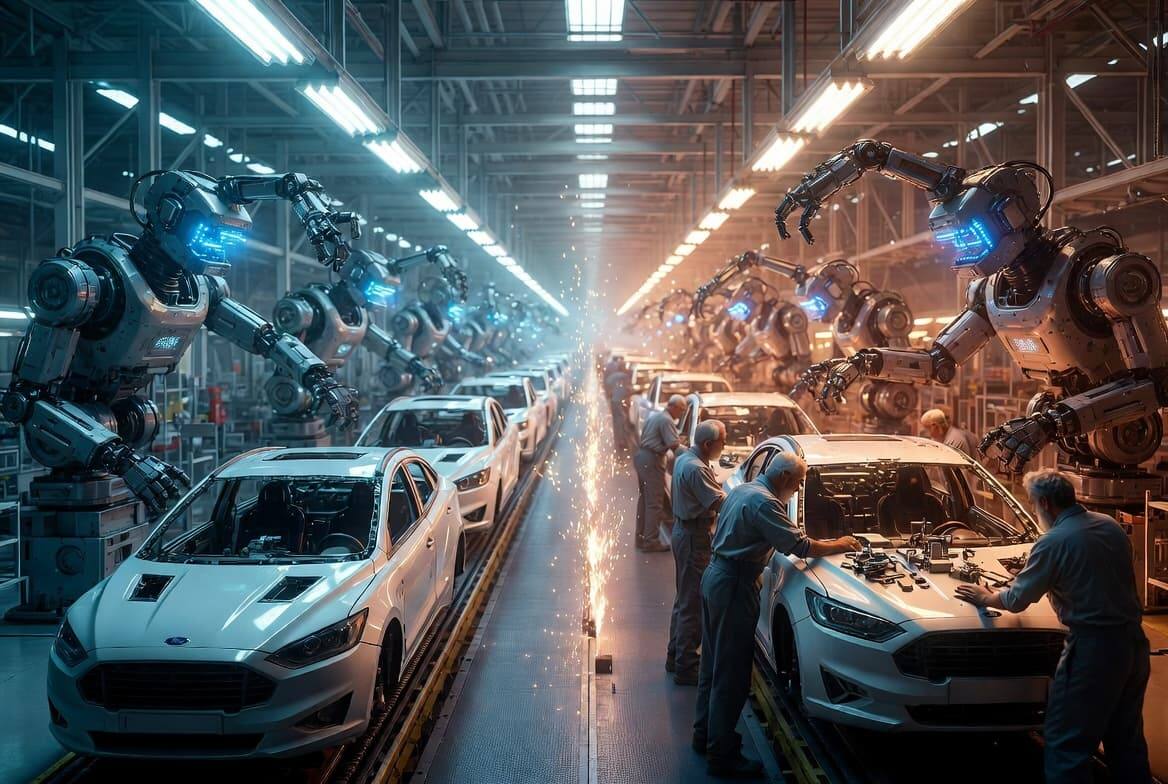
Ford has done something most companies would rather not advertise: it brought back hundreds of experienced engineers after automated systems and AI-driven workflows helped drag down vehicle quality. The company says the problem was not just bad software, but a bigger management bet that digital tools could replace a lot of hard-earned manufacturing know-how.
Ford now says those systems were less reliable than expected, and the automaker had to lean on veterans, including former employees, to fix mistakes made by robots and retrain younger staff who were left to deal with the fallout. The irony is hard to miss: the more Ford tried to streamline development, the more it discovered that old-fashioned expertise still has a job.
Ford’s AI strategy ran into reality
Charles Poon, Ford’s vice president of automotive hardware engineering, said the company was wrong to assume that simply adding AI and tightening design requirements would be enough to produce high-quality vehicles. The missing ingredient was institutional memory, the sort built by engineers who have seen multiple product cycles and know where defects tend to hide before they reach production.
Ford says some of its most experienced employees left before that knowledge had been fully transferred into its automated systems. Since then, the company has had to bring people back to help improve data collection, train AI models, and mentor younger engineers. In practice, that means Ford is paying twice: once for the automation push, and again for the humans needed to clean up the mess.
More than 350 engineers were hired, promoted, or rehired
Poon said Ford has hired, promoted, or brought back more than 350 experienced engineers. Their role is not just firefighting. They are also being used to teach the system what the company should have fed it in the first place: better data, better feedback loops, and a sharper sense of where quality failures start.
- More than 350 experienced engineers were hired, promoted, or returned.
- Former staff are helping retrain systems and mentor younger engineers.
- Ford says its quality has slipped in recent years, and its recall record is now among the worst in the industry.
A familiar warning for the auto industry
Ford is not alone in chasing automation, but its stumble is a reminder that carmaking is still a brutally physical business where tiny errors become expensive recalls. Other automakers have been pushing harder into software-defined vehicles and AI-assisted design, yet the winners are usually the ones that keep senior engineers close to the process rather than treating them like legacy baggage.
The open question is whether Ford can turn this into a durable reset or just a temporary correction. If the company actually keeps those veteran engineers in the loop, its quality problem may start to shrink. If not, the robots may keep writing checks the humans have to cash.