

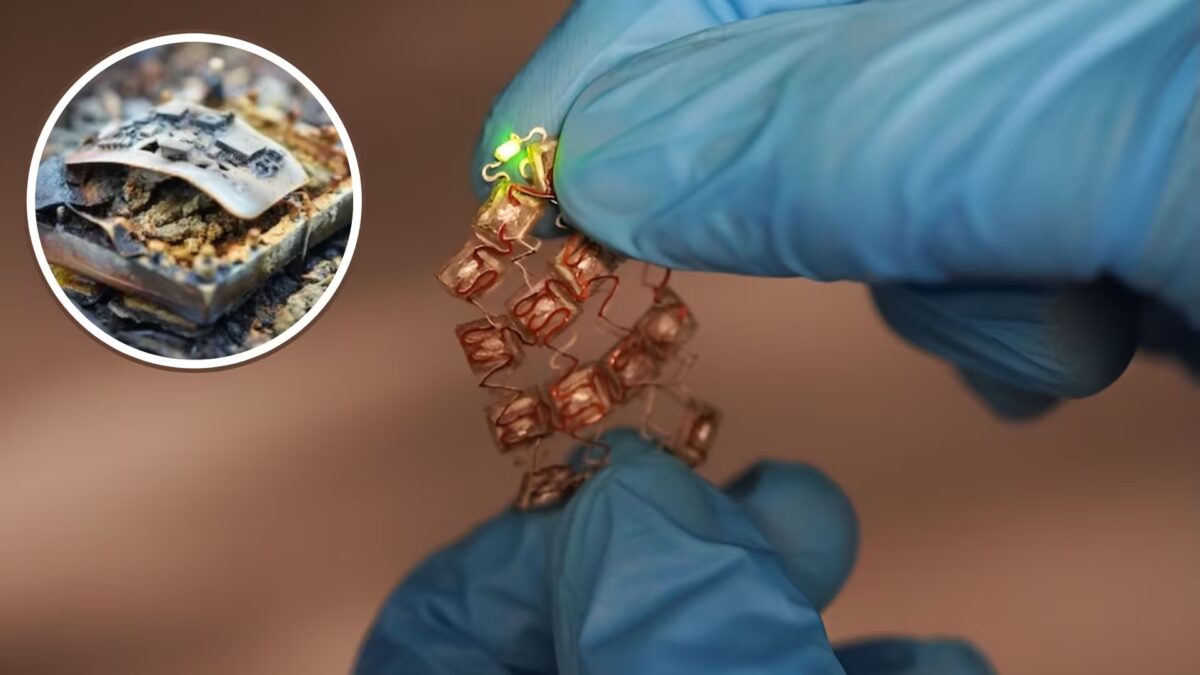
Researchers at Rice University and North Carolina State University have developed a flexible battery that activates automatically when exposed to humid air, requiring no pre-charging. The battery remains sealed and inactive until moisture forms an electrolyte inside, generating current. In lab tests, this was enough to keep a wireless Bluetooth oximeter running continuously for 30 hours.
This battery design deviates from conventional liquid-electrolyte cells by using a cellulose membrane soaked in lithium chloride instead of a liquid electrolyte. While sealed, the battery is stable and inactive; once exposed to airborne moisture, the membrane absorbs water, dissolving the salt and triggering the battery’s operation.
The internal components include a magnesium anode paired with a silver/silver chloride cathode. The developers emphasize safety: the battery contains no toxic or flammable liquids, common concerns for tiny batteries intended for medical devices and wearable electronics. It can also remain unused without degradation until the packaging is opened, providing a long shelf life.
The battery’s flexible design is inspired by pangolin scales. Overlapping segments in the casing allow it to bend, stretch, and twist without losing performance. This flexibility is crucial, as sensors embedded in patches, soft medical monitors, and disposable trackers rarely fit inside rigid housings.
An unusual and important feature is its self-destruct mechanism, designed to protect sensitive electronics. If the sealed unit is tampered with, mixing aluminum and iodine triggers a heat-generating chemical reaction. In a demonstration, this reaction disabled the wireless sensor within about three minutes. Such fail-safes have mostly been used in military or experimental prototypes, not in compact batteries for everyday sensors.
This battery technology addresses a growing niche. According to Statista, over 30 billion IoT devices are connected worldwide, many deployed in hard-to-reach locations. Wearables also require flexible power sources. In medical technology, priorities are safety, slim profiles, and predictable lifespans rather than raw power. A battery that self-activates from humidity and needs no pre-charge is a practical option for sensors, patches, and disposable health monitors.
Looking forward, key questions include how the battery performs under variable humidity and long-term wear, and whether its self-destruct feature can reliably secure sensitive medical data. Success could shift expectations for power supplies in wearable and disposable medical electronics beyond today’s mostly rigid, recharge-dependent solutions.