

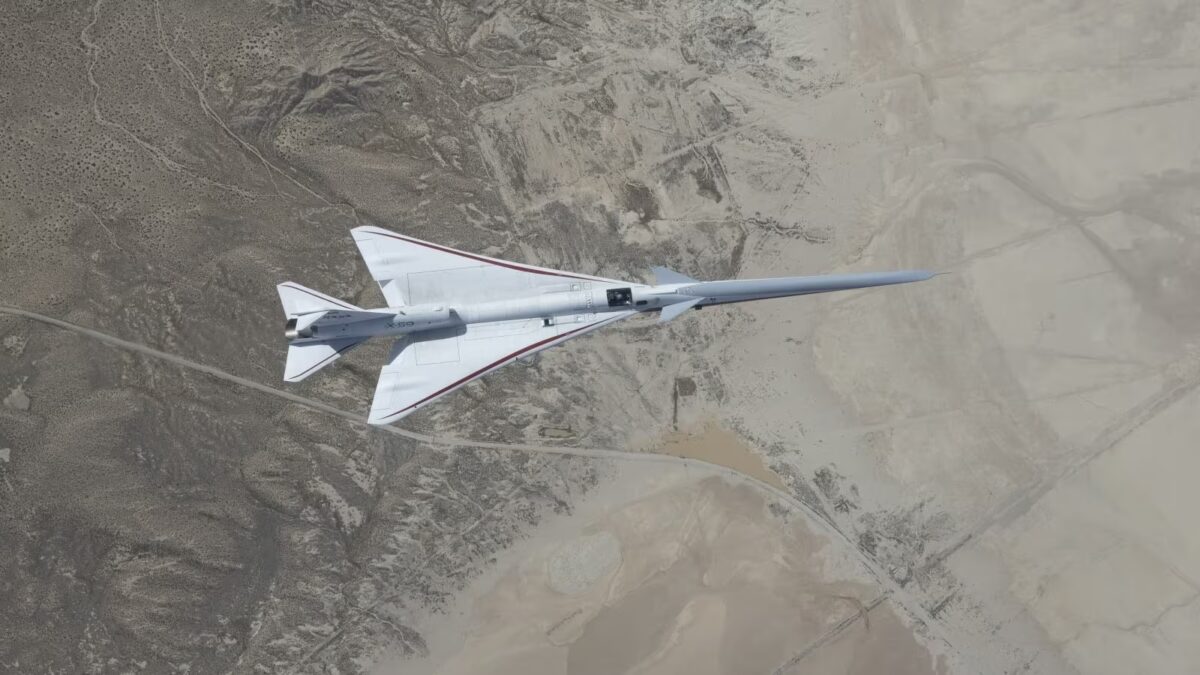
The Federal Aviation Administration (FAA) is poised to overturn a 53-year-old ban on supersonic civil flights over US land, potentially opening the door to a new generation of ”quiet” supersonic airliners for domestic routes. The agency’s proposal would replace the near-total prohibition that has been in place since 1973 with a measurable limit on the sonic boom’s ground impact, allowing flights faster than sound if the shockwave pressure stays below a tight threshold.
Under the FAA’s draft rule, supersonic flights would be allowed over land provided the excess pressure from the sonic boom does not exceed 0.11 pounds per square foot-approximately 5.3 pascals. This replaces a blanket ban with a performance-based standard, requiring manufacturers to prove through flight tests that their aircraft comply with the noise limits.
The standard is extremely demanding. By comparison, the Concorde generated a sonic boom pressure nearly 18 times higher (around 1.94 pounds per square foot) at Mach 2 and 15.8 kilometers altitude, which explains why it was restricted mostly to oceanic routes. For additional context, NASA’s Space Shuttle produced about 1.25 pounds per square foot during reentry, and the SR-71 Blackbird around 0.9 pounds per square foot.
The FAA outlines two technical approaches to meeting the new limit: one known as ”Mach cutoff,” exploiting atmospheric conditions to dissipate the sonic boom before it hits the ground; the other designing aircraft with ”low-boom” aerodynamics to soften the shockwave itself.
Boom Supersonic has already tested the Mach cutoff concept. Its experimental XB-1 demonstrator reached Mach 1.12 in February, with ground sensors reportedly detecting no traditional sonic boom. This was a key trial ahead of its planned Overture airliner, capable of cruising at up to Mach 1.7 with 60-80 seats. Boom claims transcontinental flights at a ”quiet” supersonic speed of about Mach 1.3 could cut travel time by roughly 90 minutes.
History of supersonic flight restrictions in the US
The 1973 ban on supersonic flights over the US mainland had decades of complaints behind it. In the 1960s, widespread concerns about sonic booms shaking city windows and damaging property led to calls for strict limits. Military supersonic flights caused thousands of noise-related grievances, pushing civil supersonic aviation to ocean crossings and curbing its development over land for nearly 50 years.
The Concorde never broke that mold. While an engineering icon of its era, it remained a niche service flying mostly transatlantic routes. After the 2000 Air France Concorde crash, rising operating costs, and decreasing demand, the aircraft were retired in 2003. Since then, supersonic passenger travel has periodically resurfaced as an ambition but was always hampered by noise, economics, and regulatory hurdles.
Today’s FAA move sends a clear market signal. Several startups promising civil supersonic travel have failed or stalled-Aerion Supersonic shut down in 2021 after funding dried up, and Spike Aerospace’s S-512 remains only a concept without production aircraft. Among major government-backed efforts, NASA’s X-59 QueSST is the standout: developed by Lockheed Martin, this demonstrator features a long nose and special aerodynamics designed to turn a disruptive sonic boom into a softer ”thump.” NASA aims to show supersonic flight can be quiet enough to avoid disturbing communities below, which is critical for regulatory approval.
Still, going from new rules to commercial service is a long haul. Aircraft certification in the US typically takes five to nine years, with new platforms often requiring over a decade to develop. Boom Supersonic, for instance, already has preliminary orders from United Airlines (15 jets) and American Airlines (20 jets contingent on meeting safety and performance milestones). Yet key technologies like the Symphony engine needed for Overture’s commercial operation remain in early stages.
Even with swift FAA approval, practical supersonic passenger flights over US land are unlikely before the 2030s. This regulatory shift marks the first time in half a century that an American authority has moved from a blanket ban to a quantifiable sonic boom limit. If the efforts by Boom, NASA, and others successfully demonstrate compliance, we could finally see supersonic travel reclaim its place on domestic routes where the time savings are economically significant.