

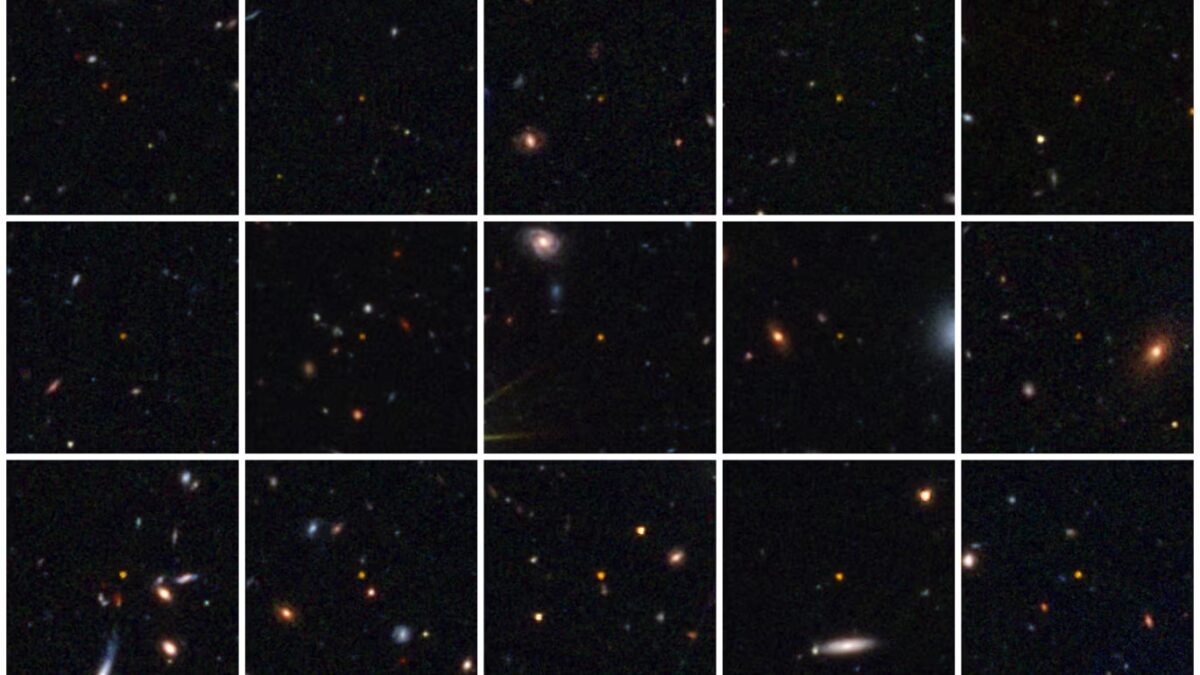
The European Space Agency’s Euclid telescope has dramatically sped up the hunt for the universe’s earliest cosmic beacons. In just one year, it discovered 31 new quasars dating from when the universe was roughly 670 million years old, including two that set records as the most distant quasars ever observed. These findings offer astronomers a rare glimpse into the universe’s infancy-when the first galaxies and supermassive black holes were just beginning to form.
Quasars rank among the brightest objects in the cosmos. They’re essentially active galactic nuclei, where matter spiraling into a supermassive black hole heats up intensely, causing the galaxy’s core to outshine all its stars combined by hundreds or thousands of times. Because their light travels across billions of years, quasars serve as cosmic lighthouses that reveal conditions from the universe’s earliest epochs.
The most distant quasar identified by Euclid is EUCL J172902.75+641018.1, boasting a redshift of 7.77. Close behind is EUCL J125308.55+705432.3 at a redshift of 7.69. Both shine from a period roughly 670 million years after the Big Bang, when the universe was only about 5% of its current age.
Additionally, Euclid uncovered a dozen quasars with redshifts above 7-a critical threshold marking an era less than 770 million years post-Big Bang. This new sample more than doubles the number of known quasars from that early window. For context, it took over a decade for astronomers to find the first ten quasars beyond redshift 7, yet Euclid accomplished more than that in just a single year of observations.
How the Euclid telescope finds quasars from the early universe
Euclid’s success isn’t accidental. Launched in 2023, the telescope’s primary mission is to unravel the mysteries of dark matter, dark energy, and cosmic structure by conducting a massive sky survey. But its wide-field imaging also makes it uniquely suited for spotting rare, distant objects like early quasars. Euclid’s Euclid Wide Survey aims to cover over a third of the sky by the time it finishes, an enormous scale unmatched by most space telescopes.
While the James Webb Space Telescope can peer deeper and study detailed features of distant objects, its field of view is relatively narrow. Euclid trades some of that depth for broad coverage, enabling it to scan thousands of square degrees and quickly flag quasar candidates. In practice, astronomers rely on this teamwork: Euclid identifies targets en masse, then Webb and other telescopes follow up to analyze the most intriguing finds.
The discoveries come from the era called reionization, a foggy chapter in cosmic history when the universe emerged from its ”dark ages.” During this time, neutral hydrogen gas gradually became ionized through radiation from the first stars, galaxies, and possibly quasars. Scientists still debate how much active galactic nuclei contributed to this process. With a larger sample of early quasars now in hand, the debate can be informed by stronger data.
One of the quasars has already been studied in detail, revealing it resides in a galaxy rich in gas and dust with active star formation. This suggests that supermassive black holes in the early universe grew inside ”lively” galaxies where stars and black holes were developing simultaneously. Previous observations by ALMA and James Webb hinted at this scenario, but Euclid’s expanding catalog means it’s less likely these connections are mere coincidence.
ESA estimates that over the coming years, Euclid could boost the known population of early quasars from dozens to thousands. If the survey achieves its sky coverage goals, astronomers will soon hold the largest map ever of bright active galactic nuclei dating to the cosmic dawn. Then, the big question won’t be if these ancient giants exist, but how they managed to grow black holes weighing millions to billions of solar masses within the universe’s first billion years.