

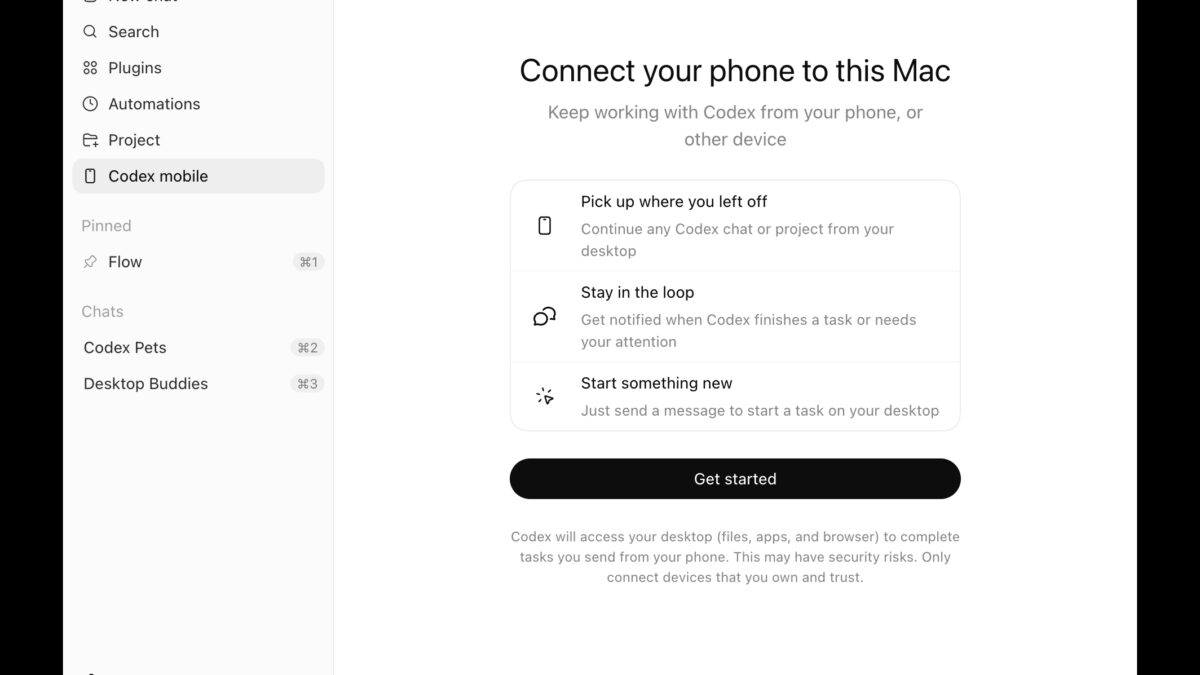
OpenAI has pushed Codex deeper into ChatGPT, and this time the pitch is simple: let people keep agentic coding work moving from an iPhone, iPad, or Android phone without being tied to the desk. The new mobile access does more than fire off a task remotely; it lets users review outputs, approve commands, switch models, and start fresh work while Codex keeps running on a laptop, Mac mini, or remote environment.
That matters because coding assistants are drifting from ”help me write this function” into something closer to a long-running workflow manager. OpenAI is clearly trying to make Codex useful for the annoying middle ground between a quick prompt and a full developer session: the part where a model needs approval, a human needs context, and nobody wants to be chained to one machine.
Getting started on the Mac side involves scanning a QR code from the iPhone, iPad, or Android version of ChatGPT. OpenAI says the new mobile access is a fully featured experience for working with Codex, which is a stronger claim than ”remote control” and probably why it’s framing the feature so aggressively.
- Approve or reject Codex actions from your phone
- Review outputs and terminal activity remotely
- Switch models or launch a new task without returning to your computer
- Keep the host machine’s environment, permissions, and credentials in place
Availability and the Windows gap
Remote access through the ChatGPT mobile app is available now, but it requires the latest version of Codex for Mac and the latest ChatGPT app on iOS and Android. OpenAI says support for remotely controlling Codex on Windows is coming later, which leaves Microsoft’s platform in the usual waiting room while Mac gets the first pass.
That sequencing is familiar. OpenAI tends to plant new product ideas in one place, usually where the developer audience is already paying attention, then widen support after the workflow proves itself. The bigger question is whether developers will actually want another approval stream on their phones, or whether they’ll treat it as the kind of convenience that sounds brilliant until your battery hits 3%.
OpenAI’s Codex updates and product expansion
The mobile rollout lands after a run of upgrades around Codex, including support for using apps on a computer without taking over the cursor, a subscription aimed at Codex users, and newer model and image-generation updates across OpenAI’s products. Codex itself only reached the Mac in February after beginning life as a command-line tool, which makes the current mobile move feel less like a launch than a steady expansion of the same idea.
The real test is whether OpenAI can make agentic coding feel routine instead of theatrical. If approvals, diffs, and test results can keep flowing cleanly to a phone, Codex becomes a lot more practical for real projects; if not, it’s just another app that promises to free you from your desk while still demanding you babysit the machine from the sofa.