

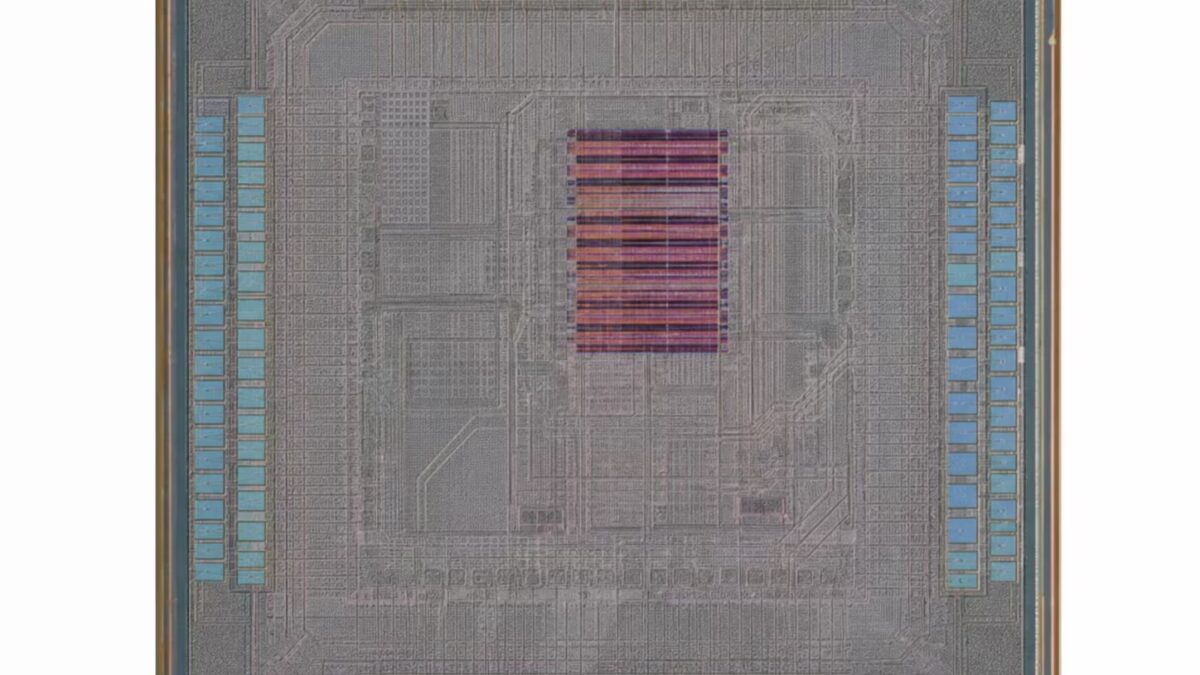
Chinese scientists from Peking University and the Shanghai Institute of Microsystem and Information Technology have developed a neuromorphic chip built on memristors that performs computations directly within memory. Published in the journal Science, their memristor chip reportedly runs specialized tasks between 50 and 478 times faster than modern GPUs.
The breakthrough isn’t tied to a leading-edge manufacturing node-this chip is fabricated using a mature 40 nm process. Instead, the innovation lies in its architecture. The chip relies on phase-change memristors that both store data and handle calculations simultaneously, drastically cutting down on the data shuttling between memory and processors-a common bottleneck that increases latency and power use in conventional GPU systems.
The team reports that each computational step in their neurodynamic system takes just 2.12 milliseconds. Their GPU speed comparison applies only to niche scenarios like modeling the cerebral cortex and other dynamic tasks where temporal state management and high parallelism matter most. These memristor chips are not positioned to replace GPUs for general AI workloads, large language model training, or graphics rendering.
- Process technology: 40 nm
- Computational core area: 0.28 mm²
- Operating frequency: 50 MHz
- Architecture: in-memory computing using phase-change memristors
- Integrated ADCs and programming pulse generation circuits
Memristor-based neuromorphic computing isn’t new. IBM previewed its TrueNorth chip back in 2014, and Intel has been advancing its Loihi series since 2018. Earlier in 2024, Intel unveiled Hala Point, a system with 1.15 billion artificial neurons aimed at energy-efficient AI research. What sets the Chinese memristor chip apart is its focus on memristor technology and achieving millisecond-range step times on actual hardware, rather than simulations.
This approach also aligns with China’s strategy to push specialized computation without chasing the leading-edge process technologies dominated by TSMC, Samsung, and Intel. Amid ongoing U.S. export restrictions, Chinese labs and companies increasingly prioritize architectural innovation, packaging, and niche accelerators. If these Science results scale to larger systems, memristor chips could carve out a role in brain simulation, industrial dynamics, and sensor-based AI devices-areas where low latency and power efficiency trump the versatility of GPUs.
The big question now is whether this memristor architecture can move beyond early prototypes and deliver consistent performance at scale. Success could redefine how certain AI and dynamical systems are accelerated, especially where traditional GPU-centric designs hit power or latency walls.