

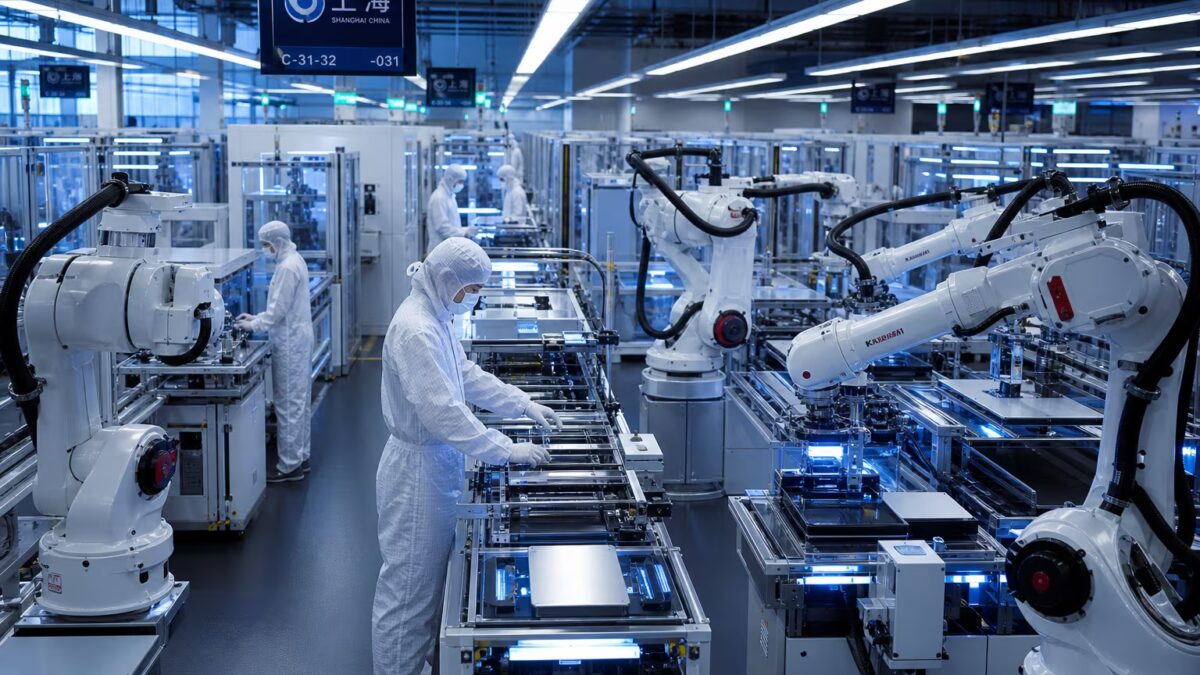
Chinese semiconductor giant JCET is investing $1.15 billion (8.2 billion yuan) in a state-of-the-art chip packaging and testing factory in Shanghai. The new facility, located in the Lingang Special Economic Zone, will have its first phase-including production buildings and equipment-ready by the second half of 2028.
JCET, one of the world’s largest OSAT (outsourced semiconductor assembly and test) providers, is focusing on advanced packaging technologies. This segment has evolved rapidly from merely fabricating smaller chips to mastering how multiple chiplets are integrated into a single package. This shift aligns with global trends where performance gains in AI accelerators, servers, and high-performance systems increasingly depend on packaging innovations that reduce latency, boost bandwidth, and lower power consumption.
Unlike traditional chipmaking, modern packaging isn’t just the final step after wafer fabrication. For AI chips especially, sophisticated multi-chip designs integrate compute cores, high-bandwidth memory (HBM), and ultrafast interfaces into one compact module. These complex assemblies require precision manufacturing to manage heat dissipation and maintain signal integrity-challenges that transistor size reduction alone can no longer solve.
Importance of advanced chip packaging technology
Globally, advanced packaging capacity is expanding rapidly. Taiwan’s TSMC is accelerating its CoWoS (chip-on-wafer-on-substrate) technology to meet soaring AI accelerator demand. Samsung and Intel are competing with solutions like Foveros and EMIB, aiming to secure their contract manufacturing businesses. JCET’s investment underscores China’s ambition to catch up and assert itself in this critical and fast-growing semiconductor segment.
For China, enhancing advanced packaging capabilities offers a way to circumvent the strict US export restrictions, which primarily target cutting-edge chip lithography and advanced computational chips. Although China still faces challenges accessing the latest fabrication nodes, improving packaging technologies provides a practical method to extract better performance and efficiency from existing silicon designs-enabling more competitive AI and high-performance systems domestically.
JCET’s position supports this strategy. Ranked among the top global OSAT companies alongside Taiwan’s ASE Technology and the US’s Amkor, JCET benefits from the strong presence of Asian firms in the packaging and testing sector-a once ”behind the scenes” market now vital to chip innovation and performance.
Industry analysts estimate the global advanced packaging market is worth tens of billions of dollars and growing faster than traditional assembly. As transistor scaling faces both physical and economic limits, chip designers increasingly rely on multi-chip modules and sophisticated packaging techniques to maintain performance improvements without incurring the escalating costs of smaller lithography nodes.
If JCET meets its 2028 timeline, the Shanghai plant will begin operations amid sustained high demand for AI infrastructure components. Competition will intensify, with TSMC, Samsung, Intel, and Amkor also expanding their advanced packaging capabilities. China’s success will be measured by JCET’s revenues and its ability to reduce dependence on foreign subcontractors in this geopolitically sensitive semiconductor segment.


JCET’s investment in Shanghai signifies a move toward semiconductor technological self-reliance, reflecting a broader global trend of securing supply chains for AI and data center chips. The new factory will serve as a testing ground for next-generation packaging technologies, including tighter chip integration and advanced surface treatments to minimize contact roughness-details that substantially improve yield and signal reliability.
Looking forward, innovation in multi-chip packaging will be crucial for the future of AI hardware and high-performance computing. As fabs approach transistor scaling limits, the competitive edge will come from how effectively companies design and assemble chiplets. JCET’s Shanghai plant has the potential to become a significant player in this evolving field-provided it can keep pace with global leaders and translate its investment into a competitive advantage.