

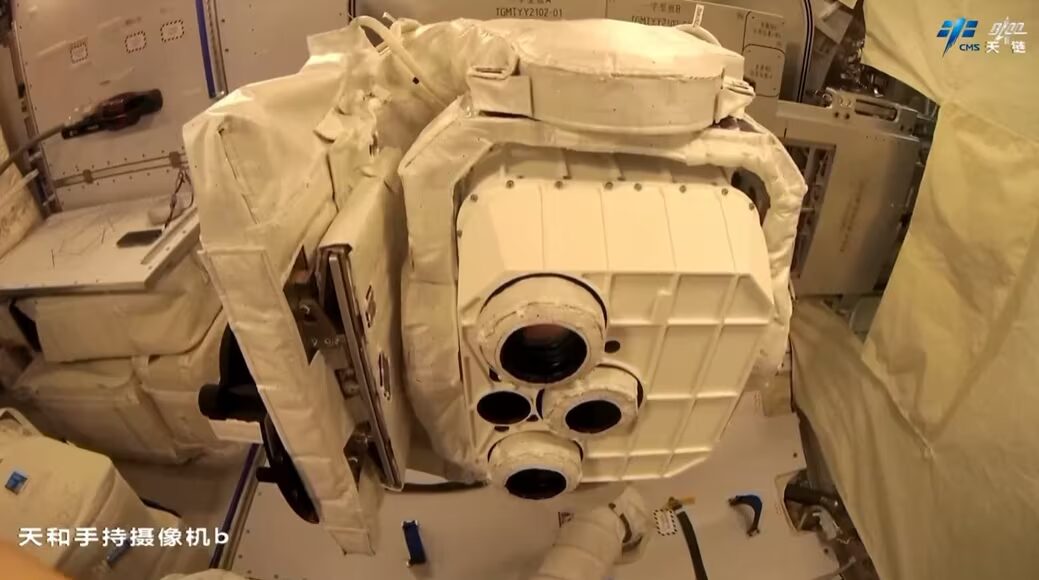
Chinese astronauts aboard the Shenzhou-23 spacecraft have installed and tested the Tianyun camera outside China’s national space station. Despite its compact size-comparable to a household washing machine-this instrument carries a serious mission: from an altitude of about 400 km, it will detect pinpoint emissions of carbon dioxide and methane and measure their intensity. Tianyun represents China’s first scientific payload on its space station and is being hailed as the lightest CO2 and methane detector of its kind.
According to China’s manned spaceflight agency, Tianyun has completed assembly and testing in orbit. It provides spectral imaging with a spatial resolution of roughly 100 meters, enabling not just detection of gas clouds but also accurately linking emissions to specific ground sources. This level of detail is important for monitoring pollution hotspots.
The Tianyun camera operates on a principle familiar to satellite climate science: it analyzes changes in sunlight as it passes through Earth’s atmosphere and reflects off the surface. By measuring specific absorption patterns, Tianyun can calculate concentrations of CO2 and methane, pinpointing the locations of industrial emitters. Its primary targets include power plants, waste disposal sites, and other large-scale facilities significantly contributing to greenhouse gas emissions.
While the concept isn’t new-European Sentinel-5P and NASA’s EMIT mission aboard the ISS have tackled similar monitoring tasks before-the approach to Tianyun is notable for its compactness and deployment. Instead of launching a dedicated satellite, China integrated this device directly onto its orbital space station, marking a novel path in space-based emissions tracking.
Demand for such targeted monitoring systems is surging worldwide. The International Energy Agency estimates the global energy sector alone leaks tens of millions of tons of methane annually, much of which could be curtailed with earlier detection. As orbital instruments become increasingly precise, major pollution sources will find it harder to slip through aggregate reporting unnoticed.
China’s Tianyun initiative spotlights a growing trend toward miniaturizing environmental sensors in orbit and embedding them on versatile platforms like space stations. The next step will be to see how this tool performs over time and whether its data can influence real-world emissions mitigation efforts. Other nations and commercial players will likely watch closely as China pioneers this lightweight, high-resolution method of climate surveillance from space.