

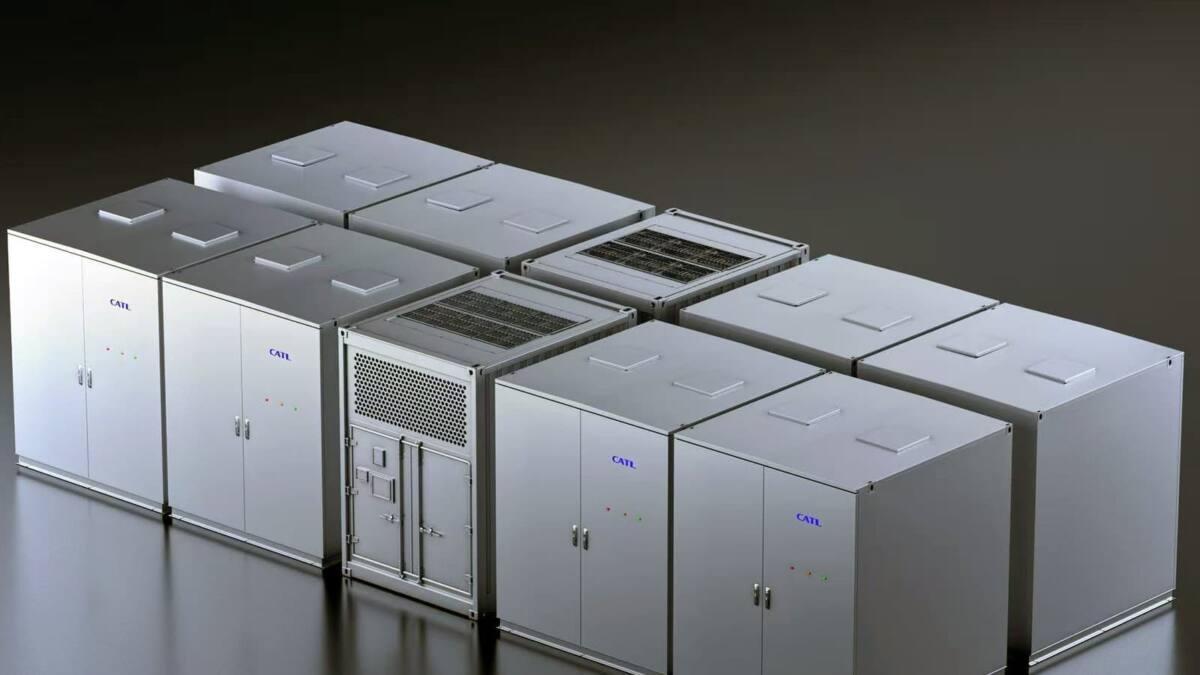
CATL has unveiled a sodium-ion energy storage system it says is designed to last up to 30 years, survive 15,000 charge and discharge cycles, and do it without demanding a wholesale rebuild of existing power sites. That combination is the real pitch here: longer life, easier deployment, and a chemistry that could make stationary storage less dependent on lithium.
The company showed the Tener system at an industry event in Munich, and its headline numbers are aggressive even by battery-marketing standards. CATL says the pack keeps about 70% of its original capacity after 15,000 cycles, while most current sodium-ion storage systems are closer to 10,000 cycles. That puts the product squarely in the race to replace expensive, maintenance-heavy grid hardware with something that can sit in place for decades.
Tener battery specs and durability claims
- Battery chemistry: sodium-ion
- Service life: up to 30 years
- Cycle life: 15,000 charge/discharge cycles
- Capacity retention: about 70% after 15,000 cycles
- Low-temperature performance: more than 92% capacity at -20 °C
CATL also says the system is built for harsh weather, thanks to proprietary electrode technology developed for difficult climates. That matters because grid storage is not just a lab exercise; it has to keep working through freezing winters, hot summers, and the occasional unpleasant surprise from the power sector.
Modular design and safety claims
The Tener platform uses a modular setup, with each module exceeding 30 MWh. CATL says a 1 GWh installation would need only 34 blocks, which is a neat way of saying large projects should be simpler to build and manage. In a market where developers hate complexity almost as much as downtime, that kind of packaging can matter as much as chemistry.
Safety is another selling point. CATL says surface temperature during thermal runaway does not exceed 200 °C, roughly 60% lower than traditional lithium batteries, and mechanical expansion is reduced by 40% during operation. The company also claims the system’s own energy consumption is around 1% and noise is about 65 dB, which helps explain why it says the units can be placed near residential areas.
Rollout plans and the sodium-ion versus lithium comparison
Perhaps the most commercially interesting detail is compatibility with existing LFP infrastructure. That lowers the barrier for utilities that want a sodium-ion option without ripping out everything they already bought. It also signals where the battery fight is heading: not just between chemistries, but between whoever can make the transition least painful.
CATL says it plans to deploy more than 200 GWh of sodium-ion storage systems. Shipments for the Chinese market are due to begin in September 2026, with a global launch set for 2027. The company also says sodium-ion costs are already nearing lithium levels, which is the kind of statement that makes competitors in both battery camps sit up a little straighter.
If those cost claims hold and the durability figures survive real-world use, sodium-ion could move from backup curiosity to serious grid option. The bigger question is whether utilities will trust a newer chemistry for long-duration storage fast enough to matter before lithium keeps getting cheaper, better, and harder to displace.