

The surf angle is where Casio gives the watch its identity. Through the smartphone app, it can load tide patterns for about 3,300 global surf spots directly onto the device. That makes it more practical than a generic fitness watch for anyone whose day is shaped by waves, not step goals.
Battery life and connected features
Casio says the hybrid USB and solar-assisted charging setup can last up to 35 hours with continuous heart rate tracking during activities. Turn that off and use it as a normal digital watch, and the battery stretches to about a month. Power-saving mode pushes standby time to roughly 11 months, which is a lot more forgiving than the usual charge-every-night routine that has become normal elsewhere in wearables.
As a connected watch, it also mirrors smartphone notifications for calls, emails, and social media, and includes a phone finder plus automatic time adjustment. Casio has been busy expanding its US G-Shock lineup lately, including the Aka-Chochin models and a translucent design tied to 1990s streetwear, so the GBX-H5600 is arriving into a brand that clearly wants more than one kind of rugged-watch buyer.
A tougher watch for people who still check tide charts
The GBX-H5600 is not trying to beat Apple at being Apple, and that is the point. Casio is selling a niche device with broad enough specs to feel modern, but focused enough to avoid the usual smartwatch bloat. The real question is whether more buyers want a surf watch with health tracking, or a health tracker that happens to survive a wipeout.
The surf angle is where Casio gives the watch its identity. Through the smartphone app, it can load tide patterns for about 3,300 global surf spots directly onto the device. That makes it more practical than a generic fitness watch for anyone whose day is shaped by waves, not step goals.
Battery life and connected features
Casio says the hybrid USB and solar-assisted charging setup can last up to 35 hours with continuous heart rate tracking during activities. Turn that off and use it as a normal digital watch, and the battery stretches to about a month. Power-saving mode pushes standby time to roughly 11 months, which is a lot more forgiving than the usual charge-every-night routine that has become normal elsewhere in wearables.
As a connected watch, it also mirrors smartphone notifications for calls, emails, and social media, and includes a phone finder plus automatic time adjustment. Casio has been busy expanding its US G-Shock lineup lately, including the Aka-Chochin models and a translucent design tied to 1990s streetwear, so the GBX-H5600 is arriving into a brand that clearly wants more than one kind of rugged-watch buyer.
A tougher watch for people who still check tide charts
The GBX-H5600 is not trying to beat Apple at being Apple, and that is the point. Casio is selling a niche device with broad enough specs to feel modern, but focused enough to avoid the usual smartwatch bloat. The real question is whether more buyers want a surf watch with health tracking, or a health tracker that happens to survive a wipeout.
- Heart rate monitoring
- Blood oxygen estimates
- Steps, distance, and pace tracking
- Tide graphs, moon phase data, sunrise and sunset times
- Bluetooth syncing with location-specific tide patterns
The surf angle is where Casio gives the watch its identity. Through the smartphone app, it can load tide patterns for about 3,300 global surf spots directly onto the device. That makes it more practical than a generic fitness watch for anyone whose day is shaped by waves, not step goals.
Battery life and connected features
Casio says the hybrid USB and solar-assisted charging setup can last up to 35 hours with continuous heart rate tracking during activities. Turn that off and use it as a normal digital watch, and the battery stretches to about a month. Power-saving mode pushes standby time to roughly 11 months, which is a lot more forgiving than the usual charge-every-night routine that has become normal elsewhere in wearables.
As a connected watch, it also mirrors smartphone notifications for calls, emails, and social media, and includes a phone finder plus automatic time adjustment. Casio has been busy expanding its US G-Shock lineup lately, including the Aka-Chochin models and a translucent design tied to 1990s streetwear, so the GBX-H5600 is arriving into a brand that clearly wants more than one kind of rugged-watch buyer.
A tougher watch for people who still check tide charts
The GBX-H5600 is not trying to beat Apple at being Apple, and that is the point. Casio is selling a niche device with broad enough specs to feel modern, but focused enough to avoid the usual smartwatch bloat. The real question is whether more buyers want a surf watch with health tracking, or a health tracker that happens to survive a wipeout.
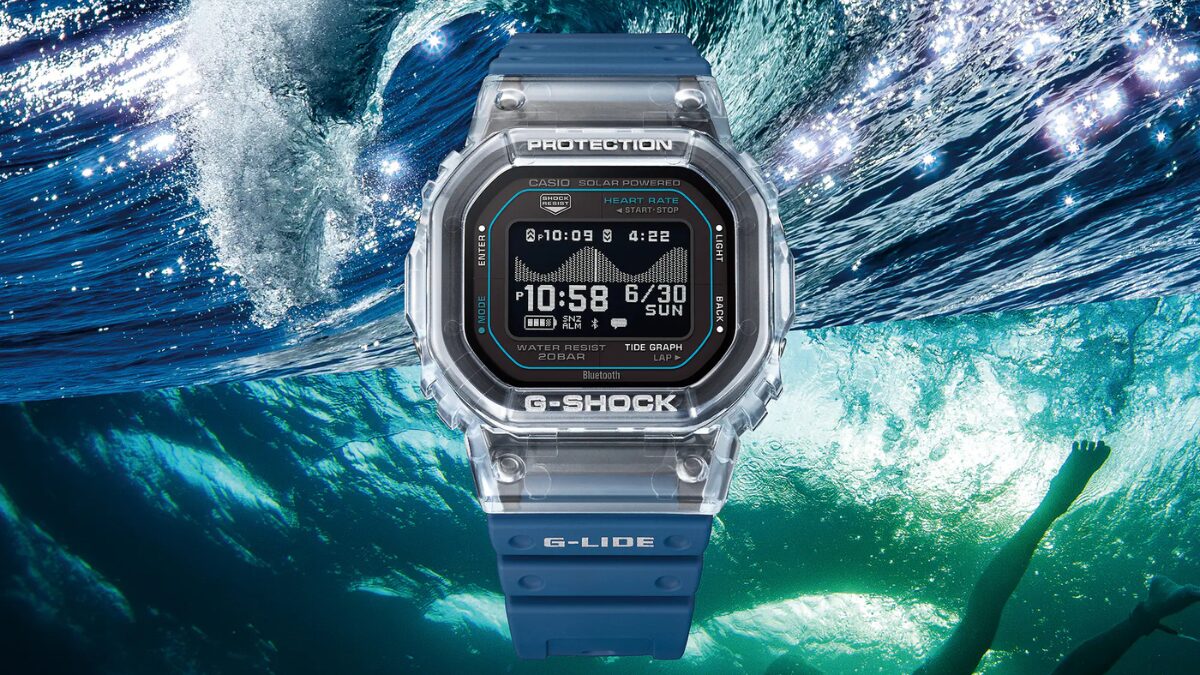
Casio has put the G-Shock G-Lide GBX-H5600 series on sale in the US, turning its square digital watch into a more serious fitness and surf companion without abandoning the brand’s tank-like styling. The Casio GBX-H5600 models cost $330, pack an optical heart rate sensor, and keep the beach-first extras that matter to surfers: tide data, moon phases, and sunrise and sunset times.
The new watches are a cleaner example of where Casio keeps heading: old-school toughness on the outside, watch-app data on the inside. That formula has worked for Garmin and Apple in very different ways, and Casio’s bet is that a lot of people still want a rugged watch that does not look like a tiny smartphone strapped to the wrist.
Casio GBX-H5600 models and a lighter case
The lineup arrives as the black GBX-H5600-1 and the blue GBX-H5600-2. Both use a translucent bezel and a solid bio-based resin band, while Casio says the watches weigh 47 grams, about 12 grams less than the older DW-H5600 models. The lighter build comes from a new case back made with carbon fiber-reinforced resin, which is a sensible upgrade for a watch aimed at people who actually move around in water and sand.
Casio also uses a high-resolution Memory-in-Pixel LCD, the kind of display that makes more sense outdoors than a flashy OLED ever will. It stays readable in direct sunlight, which is a very useful trait for a surf watch and a very unglamorous one for marketing slides.
Fitness tracking, surf data, and smartphone sync
Inside, the Casio GBX-H5600 works like a standard fitness tracker. It includes optical heart rate monitoring, blood oxygen estimates, a three-axis accelerometer for steps, distance, and pace, plus multi-sport tracking, sleep analysis, and cardio load measurements.
- Heart rate monitoring
- Blood oxygen estimates
- Steps, distance, and pace tracking
- Tide graphs, moon phase data, sunrise and sunset times
- Bluetooth syncing with location-specific tide patterns
The surf angle is where Casio gives the watch its identity. Through the smartphone app, it can load tide patterns for about 3,300 global surf spots directly onto the device. That makes it more practical than a generic fitness watch for anyone whose day is shaped by waves, not step goals.
Battery life and connected features
Casio says the hybrid USB and solar-assisted charging setup can last up to 35 hours with continuous heart rate tracking during activities. Turn that off and use it as a normal digital watch, and the battery stretches to about a month. Power-saving mode pushes standby time to roughly 11 months, which is a lot more forgiving than the usual charge-every-night routine that has become normal elsewhere in wearables.
As a connected watch, it also mirrors smartphone notifications for calls, emails, and social media, and includes a phone finder plus automatic time adjustment. Casio has been busy expanding its US G-Shock lineup lately, including the Aka-Chochin models and a translucent design tied to 1990s streetwear, so the GBX-H5600 is arriving into a brand that clearly wants more than one kind of rugged-watch buyer.
A tougher watch for people who still check tide charts
The GBX-H5600 is not trying to beat Apple at being Apple, and that is the point. Casio is selling a niche device with broad enough specs to feel modern, but focused enough to avoid the usual smartwatch bloat. The real question is whether more buyers want a surf watch with health tracking, or a health tracker that happens to survive a wipeout.