

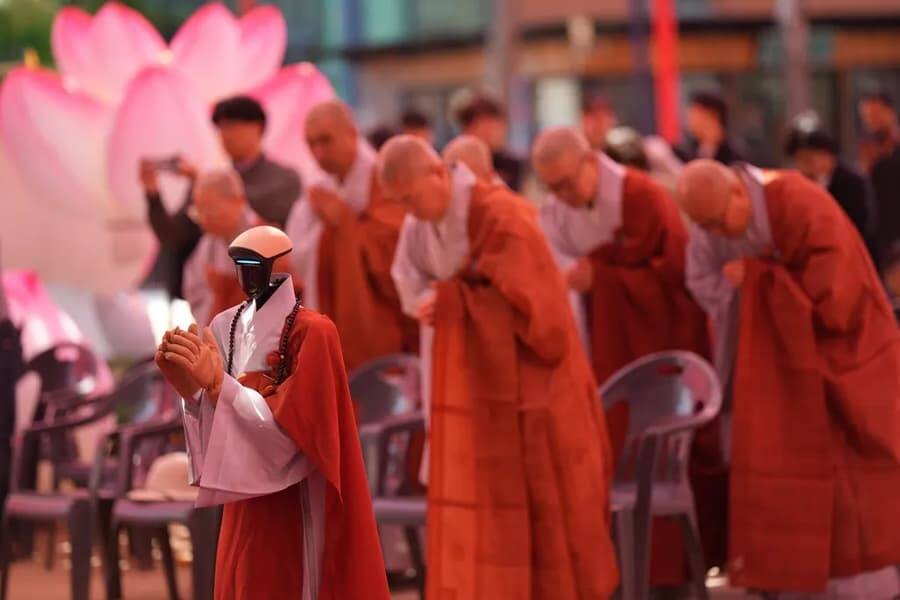
In Seoul, a humanoid robot has done something most startups would probably never dare put in a product demo: it took Buddhist vows. Gabi, a 120-centimetre-tall robot built by China’s Unitree Robotics, was officially inducted into South Korea’s largest Buddhist order in a ceremony that mixed incense, lanterns, and a very modern question – can a machine belong in a religion built around human intention?
The answer, at least in this temple, was yes. The robot was given the name Gabi, translated as ”mercy”, after reciting five vows adapted for artificial intelligence: respect life, treat other robots and objects peacefully, obey humans, avoid deception in words and actions, and conserve electricity.
A Buddhist robot ritual built for machines
The ceremony included the ”yeonbi” purification ritual, usually reserved for monks, along with a festival lotus sticker and prayer beads around the robot’s neck. The details were theatrical, but the symbolism was plain: the Jogye order wants Buddhism to stay visible in a country where the number of believers is shrinking and technology is swallowing more daily attention by the hour.
That is not a small pivot. Across Asia, religious institutions have been experimenting with chatbots, robot assistants, and automated sermons, but formal ritual participation is still rare and predictably controversial. The unease is familiar: believers may accept a helpful machine at the gate, but a machine inside the sacred circle raises sharper questions about authenticity, agency, and whether imitation is participation.
Jogye’s bet on the age of AI
Jogye president Venerable Jinwoo told the congregation to ”fearlessly lead the era of AI” and steer technological progress toward peace of mind and enlightenment. That sounds optimistic, but it is also strategic. If Buddhism wants younger audiences to notice it, a humanoid monk may do more for visibility than another polite brochure ever could.
Researchers at the University of Vienna have found that people often feel neutral or positive toward robots in religious settings, even as critics argue machines cannot truly worship or believe. In Eastern traditions, though, practice often carries more weight than inner conviction, so if the rite is performed correctly, the performer matters less than the performance.
What Gabi does next
Gabi is expected to appear at a major lantern festival later this month for Buddha’s birthday, which would push the experiment from headline stunt into repeat appearance. That is where the real test begins: not whether a robot can be blessed once, but whether worshippers keep treating it as part of the ritual rather than a clever prop with joints.